The complexity of transferring a trade license varies significantly based on jurisdiction. Mainland companies operate under the Commercial Companies Law and local emirate regulations, while free zone entities follow the specific rules of their respective zones. Financial free zones like DIFC and ADGM introduce additional layers governed by common law principles.
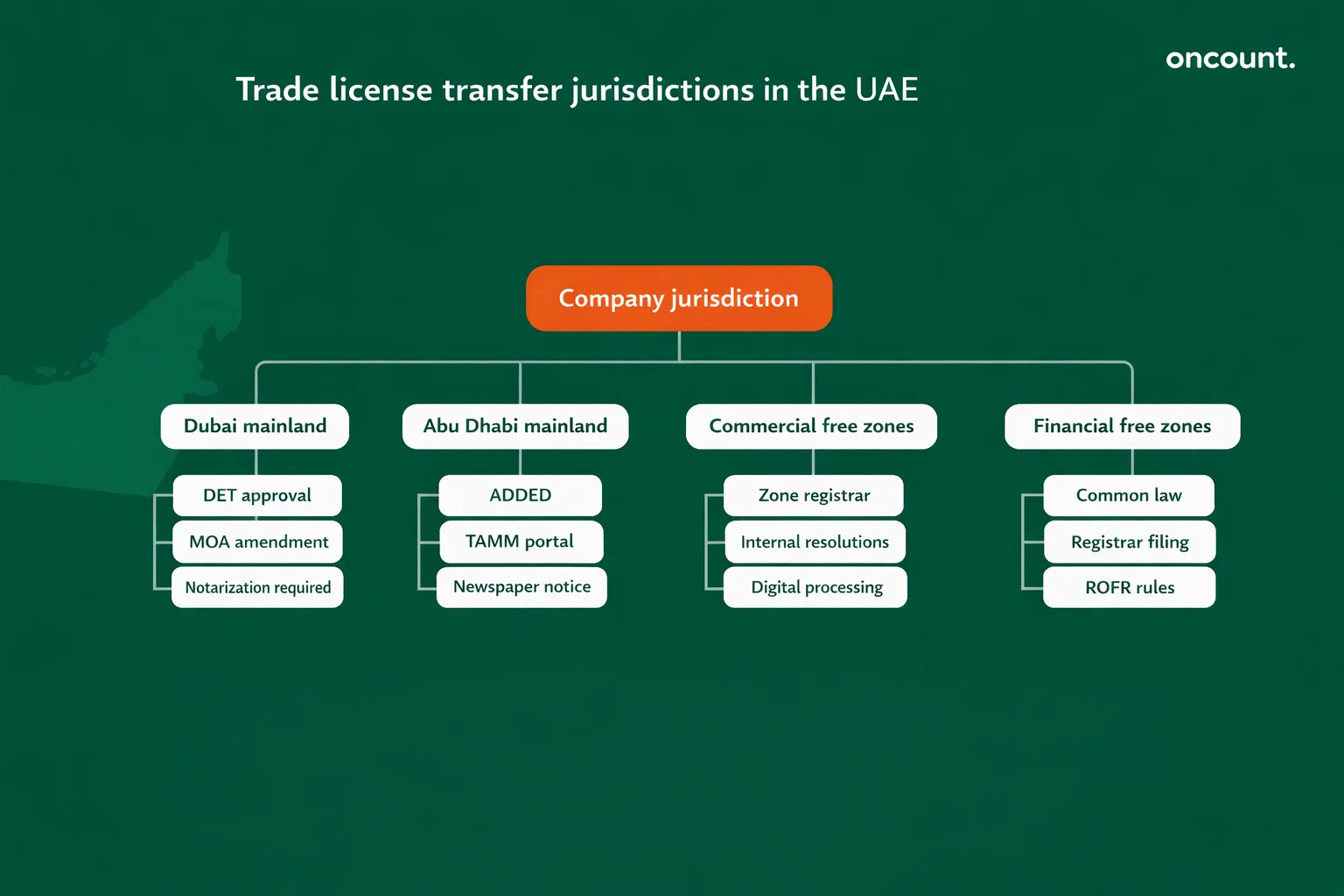
Key Jurisdictional Distinctions:
- Dubai Mainland: Regulated by DET with 100% foreign ownership permitted, offering full market access
- Abu Dhabi Mainland: Managed through ADDED and the TAMM portal with integrated digital services
- Commercial Free Zones (JAFZA, DMCC): Self-contained regulatory environments with streamlined processes
- Financial Free Zones (DIFC, ADGM): Common law frameworks with sophisticated shareholder protections
Understanding the Prerequisites for Ownership Transfer in Dubai
Before submitting any formal transfer application, the current license owner needs to inform the licensing authority and ensure several foundational requirements are satisfied. The new owner must be eligible to own a trade license in the relevant jurisdiction, and the business must maintain good standing with all government authorities.
The 2021 amendments to the Commercial Companies Law now permit up to 100% foreign ownership in most mainland sectors, removing the previous requirement for a UAE national partner. However, certain strategic activities still require a local service agent or maintain restrictions on foreign investors. For regulated sectors such as healthcare, education, or professional services, the new owner should have the necessary qualifications to operate in that industry.
Among the primary prerequisites is confirming that the company has no outstanding liabilities or violations. This includes settling all obligations with the municipality, utility providers such as DEWA or ADDC, and clearing any pending fines with the licensing authority. Outstanding debts can prevent approval of the transfer request and delay the entire process significantly.
Essential Pre-Transfer Requirements:
- Current trade license must be valid and renewable
- All government fees and penalties must be settled before the transfer process begins
- VAT registration must be current with no outstanding tax liabilities
- Labor file must show all employees with valid work permits
- Lease agreements must be verified and transferable to the new owner
- UBO register must be accurate and up to date
The Mainland License Transfer Process: Step-by-Step Guide
Transferring ownership of a mainland trade license follows a structured sequence that ensures proper legal documentation and government approval at each stage. The process that requires careful coordination begins with securing initial approval from the Department of Economy and Tourism or the relevant emirate authority.

The current license holder must notify the authority of the intended transfer of ownership by submitting a letter along with supporting documents. These documents include passport copies and Emirates IDs for the new owner, as well as a brief explanation of the business transition. This initial approval phase serves as a regulatory checkpoint where the licensing authority reviews the proposed ownership change for compliance with sectoral regulations.
During this preliminary stage, the DET or ADDED will assess whether external approvals are needed. For businesses operating in regulated industries, a No Objection Certificate from the sector-specific regulator becomes mandatory. The Dubai Health Authority, Knowledge and Human Development Authority, or Roads and Transport Authority may need to verify that the new owner possesses the requisite qualifications to continue business operations in sensitive sectors.
| Initial Approval Stage | Timeline | Key Requirements |
| Notification submission | 1-2 days | Formal letter with new owner’s details |
| Authority review | 3-5 days | Verification of eligibility and sector compliance |
| External NOC (if required) | 7-14 days | Approval from specialized regulators |
| Initial approval issued | Upon completion | Green light to proceed with legal documentation |
Drafting and Executing the Share Transfer Agreement
Once initial approval is secured, the parties must formalize the transaction through a Share Transfer Agreement. This legal document signed by all parties details the terms of the ownership transfer and serves as the foundation for all subsequent administrative steps.
For Limited Liability Companies, the Share Transfer Agreement must specify the number of shares being transferred, the purchase price, and the effective date of the transfer. The agreement should include representations and warranties from the seller confirming that the shares are free from encumbrances and that all disclosed information about the company’s financial condition is accurate. This protects the buyer from inheriting undisclosed liabilities or pending litigation.
The company’s Memorandum of Association must also be amended to reflect the new ownership structure. This amendment, prepared as an addendum to the MOA, shows the revised shareholding percentages and identifies any changes to the company’s management structure. If the transfer brings in new partners or changes the authorized signatories, these modifications must be explicitly documented in the amended MOA.
Critical Elements of the Share Transfer Agreement:
- Complete identification details of buyer and seller
- Precise number of shares and percentage of ownership being transferred
- Agreed purchase price and payment terms
- Effective date of the ownership transfer
- Warranties regarding absence of hidden liabilities
- Conditions of the ownership transfer that must be fulfilled
- Dispute resolution mechanisms
Notarization Requirements for Mainland Transfers
All ownership transfer documents for mainland companies require notarization to be legally recognized by relevant authorities. This critical step must be completed through a Public Notary attached to the judicial system or a licensed Private Notary authorized by the government.
The notary verifies the identity of the signatories using the UAE Pass or physical identification, confirms their legal capacity, and witnesses the signing of the documents. Crucially, all documents submitted for notarization must be in Arabic. If the original agreement is drafted in English, it must undergo certified legal translation before the notarization process can proceed.
Once the notary stamps and signs the documents, they become legally binding instruments recognized by all government departments. For international investors in Dubai who cannot be physically present, the UAE has increasingly adopted digital notarization, allowing parties to attend virtual meetings with a notary to complete the transfer without being in the country.
| Notarization Component | Typical Fee (AED) | Notes |
| MOA Amendment Notarization | 500 – 2,000 | May be calculated as 0.25% of share value |
| Share Transfer Agreement | 500 – 1,500 | Flat fee for standard transactions |
| Document Translation | 300 – 800 | Per document, Arabic certification required |
| Attestation Services | 200 – 500 | For foreign shareholder documents |
Free Zone License Transfer Procedures
The license transfer allows for different procedural approaches in free zones compared to mainland jurisdictions. Free zones such as JAFZA and DMCC operate as separate legal enclaves, each with its own Registrar of Companies and unique regulations that govern the transfer of shares.
These authorities often leverage integrated digital portals to facilitate transfers, which typically bypass the need for external notarization required for mainland entities. The relevant free zone authority acts as both registrar and notary, streamlining the administrative burden and reducing processing timelines significantly.
In JAFZA, the transfer process is treated as a high-level registration amendment requiring specific board resolutions and the surrender of original share certificates. The authority requires submission of two distinct resolutions: one from the buyer and one from the seller, both drafted on official company letterhead clearly stating the intention to transfer a specific number of shares.
JAFZA Transfer Documentation:
- Resolution 10R from the buyer confirming acquisition intent
- Resolution 10R from the seller authorizing the share sale
- Corporate Action Form specific to FZE or FZCO structure
- Original share certificates for cancellation
- New owner’s identification and KYC documents
- For corporate buyers: Certificate of Registration and Good Standing
DMCC and Other Commercial Free Zones
The Dubai Multi Commodities Centre follows a similar framework but with variations in fee structure and documentation requirements. DMCC requires a formal application through its online portal, accompanied by board resolutions and updated shareholder information.
If the new shareholder is a foreign corporate entity, the documentation requirements increase significantly. The company must provide a Certificate of Registration, a Certificate of Good Standing, and the parent company’s MOA, all of which must be notarized and attested by the UAE Embassy in the country of origin and counter-attested by the UAE Ministry of Foreign Affairs.
The setup and trade license transfers in commercial free zones typically complete within one week once all required documents are submitted. The free zone authority will issue a new trade license with the updated ownership information and revised share certificates reflecting the new ownership structure.
| Free Zone | Processing Time | Transfer Fee Range (AED) | Special Requirements |
| JAFZA (FZCO) | 6-7 working days | 2,000 per share (max 50,000) | Dual resolutions required |
| JAFZA (FZE) | 6-7 working days | 20,000 flat fee | Single shareholder structure |
| DMCC | 5-7 working days | 3,000 – 8,000 | Newspaper announcement may be required |
| RAKEZ | 5-10 working days | 2,500 – 6,000 | Online portal submission |
Financial Free Zone Transfers: DIFC and ADGM Protocols
The Dubai International Financial Centre and Abu Dhabi Global Market offer distinctive legal landscapes for license transfers, influenced by common law principles. These jurisdictions are favored by private equity firms and financial institutions due to the clarity they provide regarding shareholder rights and the sophistication of their registration systems.
In the DIFC, the Registrar of Companies maintains rigorous oversight. Any transfer of shares in a DIFC-incorporated company must be filed with the Registrar using the prescribed form within 30 days of the transfer. This notification is mandatory, and failure to comply can lead to significant administrative fines and may jeopardize the legal recognition of the transfer.
The DIFC framework incorporates default shareholder protections through its Standard Articles of Association. For private companies that have not specifically amended their Articles, existing partners have a Right of First Refusal when a shareholder wishes to transfer shares to a non-shareholder. The existing partners have 15 days from the date of the special resolution authorizing the transfer to acquire those shares in proportion to their current holdings.
DIFC Transfer Requirements:
- Share transfer form filed within 30 days of execution
- Special resolution by directors authorizing the transfer
- ROFR process completed if applicable to existing partners
- Updated Register of Members submitted to the Registrar
- Payment of registration fees and stamp duties
- KYC documentation for all new shareholders verified
ADGM High-Speed Digital Processing
The Abu Dhabi Global Market is characterized by its Online Registry Solution, which facilitates share transfers with remarkable speed. Once the KYC documentation for the new shareholders is verified, the ADGM Registrar can often process a share transfer and issue updated certificates within three to five working days.
Unlike many other jurisdictions, the ADGM’s model Articles of Association do not contain automatic restrictions on share transfers. This makes it a highly flexible jurisdiction for companies that anticipate frequent ownership changes or are structured for venture capital investment. However, companies are free to adopt amended Articles that introduce ROFR or other restrictions, which the Registrar will respect during the transfer process.
Professional service providers who specialize in business setup and trade license transfers can navigate the specific requirements of each financial free zone, ensuring that all statutory deadlines are met and that the transfer complies with both local regulations and international corporate governance standards.
Post-Transfer Compliance: Tax and Regulatory Updates
The issuance of a revised trade license with the updated ownership information marks the midpoint of a successful transition, not the conclusion. The new owner must navigate a complex landscape of federal tax and transparency regulations to ensure the entity remains in good standing with all relevant authorities.

For any company registered for Value Added Tax, a change in ownership is considered a change in circumstances that must be reported to the Federal Tax Authority. The law is uncompromising regarding the timeline: the FTA must be notified of the change within 20 business days of the occurrence through the EmaraTax portal.
While some details like business activities can be updated directly, changes to the name, ownership structure, or banking details require formal FTA approval. Failure to notify the authority within the 20-day window can result in administrative penalties for late notification, which can significantly increase if the delay persists beyond the initial grace period.
Federal Tax Authority Update Requirements:
- Notification of ownership change within 20 business days
- Submission of updated trade license through EmaraTax portal
- Amendment of VAT registration details if applicable
- Update of authorized signatory information
- Verification of corporate tax registration status
- Assessment of Transfer of Going Concern applicability
Ultimate Beneficial Ownership Transparency
The UAE has implemented a rigorous UBO reporting regime as part of its commitment to global Anti-Money Laundering standards. Every company, whether mainland or free zone, must maintain a UBO Register and a Register of Partners/Shareholders that accurately reflects the natural persons who ultimately control the entity.
Upon any change in shareholding, the UBO register must be updated to reflect the new natural persons who ultimately own or control 25% or more of the company’s capital. This updated information must be submitted to the licensing authority within 15 days of the change. Maintaining an inaccurate or outdated UBO register is one of the most common grounds for administrative fines during government audits.
The introduction of Federal Corporate Tax at 9% on taxable income exceeding AED 375,000 has added a new layer of complexity to license transfers. During the due diligence process, a buyer must ensure that the company has registered for Corporate Tax and that all previous tax returns are accurate and filed on time.
| Post-Transfer Compliance | Deadline | Responsible Authority | Penalty for Non-Compliance |
| FTA Notification | 20 business days | Federal Tax Authority | AED 1,000 – 10,000 |
| UBO Register Update | 15 calendar days | DET/ADDED/Free Zone | AED 10,000 – 50,000 |
| Corporate Tax Assessment | 30 days | Federal Tax Authority | Variable based on delay |
| Immigration Card Update | 30 days | GDRFA/ICP | Inability to process visas |
Updating Labor and Immigration Files
A UAE trade license is the prerequisite for an Establishment Card, also known as a Computer Card or Immigration Card, which is the document that allows a company to sponsor employees and process visas. When ownership changes, the establishment card must be updated to reflect the new authorized signatories.
This process is managed by the General Directorate of Residency and Foreigners Affairs for Dubai mainland entities and the Federal Authority for Identity, Citizenship, Customs and Port Security for other emirates and many free zones. Updating the establishment file is critical because if the new owner is not registered as an authorized signatory with the immigration authorities, the company will be unable to renew current employee visas or issue new ones.
The application requires submission of the updated trade license issued by the Department of Economy and Tourism, the amended MOA, and passport and Emirates ID copies of the new owners. For companies with existing employees, the new owner assumes all labor obligations including end-of-service gratuity calculations from each employee’s original start date.
Immigration and Labor Update Process:
- Submit updated trade license to immigration authority
- Provide amended MOA showing new ownership structure
- Update authorized signatory information with GDRFA or ICP
- Modify labor file with Ministry of Human Resources and Emiratisation
- Issue new labor contracts reflecting current ownership if required
- Ensure continuity of employee visa sponsorship during transition
Managing Banking Mandates and Signatory Changes
One of the most frequent points of operational friction in an ownership transfer is the transition of corporate banking mandates. Banks in the UAE are subject to intense regulatory pressure from the Central Bank to conduct thorough due diligence on all account holders and signatories.
When a trade license is updated with a new owner, the bank will typically freeze or restrict certain account functions until the Know Your Customer records are refreshed. To update the mandate, the bank will require an Indemnity Letter signed by the new authorized signatories and a comprehensive set of documents including the updated trade license, amended MOA, board resolution, identity documents, and proof of address.
The bank’s compliance and regulatory paperwork involves verifying the entire ownership chain, especially for entities owned by other corporations. For companies with foreign shareholders, this process can take four to eight weeks as the bank must verify the legality of foreign documents. The bank may also request past personal bank statements for six to 12 months for the new shareholders to assess their financial background.
Banking Update Documentation:
- Updated trade license showing new owner name
- Notarized amended MOA or Articles of Association
- Board resolution formally instructing signatory changes
- Emirates ID for residents and passports for non-residents
- Proof of address through utility bills or tenancy contracts
- Bank reference letters for non-resident or corporate owners
- Historical financial statements demonstrating financial stability
Strategic Due Diligence for Business Ownership Transfer
A trade license transfer in the UAE is more than a change of name; it represents the acquisition of a legal entity’s entire regulatory history and operational obligations. A buyer must evaluate the company’s standing comprehensively to avoid inheriting undisclosed debts or compliance violations.
The due diligence process should explicitly cover end-of-service benefits for all current employees, as the new owner assumes the liability for gratuity from each employee’s original start date. This obligation must be calculated accurately and factored into the purchase price to avoid unexpected cash flow requirements after the transfer completes.
VAT and tax arrears represent another critical area of investigation. The buyer should verify that a VAT Clearance Certificate can be obtained and ensure no penalties for late filings are outstanding. Outstanding payments to Dubai Electricity and Water Authority, Abu Dhabi Distribution Company, or the municipality can prevent the renewal of the existing trade license or the registration of a new tenancy contract.
Critical Due Diligence Areas:
- End-of-service gratuity liability for all employees
- VAT compliance status and clearance certificate
- Corporate tax registration and filing history
- Outstanding municipality and utility dues
- Pending litigation in labor or civil courts
- Lease agreement terms and transferability
- Supplier and distributor contract review
- Banking facilities and credit line terms
Contract Audits and Change of Control Provisions
Many key trading relationships are governed by contracts that include change of control provisions. These clauses allow the counterparty to terminate the contract if the ownership of the company changes by more than a certain percentage, often 50%. This can have severe implications for business continuity if critical contracts are at risk.
Lease agreements require particular attention because if the business location is critical to operations, the new owner must ensure that the landlord approves the transfer and that the Ejari in Dubai or Tawtheeq in Abu Dhabi can be updated to reflect the new owner’s name. For businesses with utility connections at specific premises, ensuring continuity of service through the ownership transition is essential.
Supplier and distributor contracts may have exclusive rights tied to the current owner’s personal reputation or financial guarantee. These must be renegotiated or novated to the new owner to maintain supply chain continuity. Banking facilities including business loans and credit lines are almost always subject to immediate review and potential cancellation upon changes in ownership, requiring proactive communication with lenders before the transfer is finalized.
| Contract Type | Transfer Risk | Mitigation Strategy |
| Commercial Lease | High | Obtain landlord consent before finalizing purchase |
| Exclusive Distribution | High | Negotiate novation or new agreement with principals |
| Banking Facilities | Very High | Pre-notify lender and prepare refinancing options |
| Employee Contracts | Medium | Ensure continuity under labor law provisions |
| Supplier Agreements | Medium | Review termination clauses and renegotiate terms |
| Insurance Policies | Low | Update policyholder information with insurers |
Timeframes and Cost Structure for License Transfers
The efficiency of a license transfer in Dubai or elsewhere in the UAE is predicated on the preparation of the complete documentation stack before the application is filed. For mainland jurisdictions in Dubai or Abu Dhabi, a standard share transfer can be completed in one to two weeks if all parties are physically present in the UAE and documents are properly prepared.
If external approvals from sector-specific regulators or newspaper announcements are required, as is common in Abu Dhabi for certain types of ownership changes, the timeline can extend to four to six weeks. The Abu Dhabi Department of Economic Development may require publication of an announcement in two local newspapers to notify the public and potential creditors of the change in ownership.
Free zone transfers through JAFZA or DMCC are typically resolved within one week, usually six to seven working days, as the authorities act as both registrar and notary in-house. Financial free zones including DIFC and ADGM process transfers within three to 10 working days, depending on the speed of the Registrar’s background checks and KYC verification for new shareholders.
Typical Processing Timelines:
- Dubai Mainland (DET): 7-14 working days for standard transfers
- Abu Dhabi Mainland (ADDED): 14-21 working days including newspaper publication
- JAFZA: 6-7 working days with complete documentation
- DMCC: 5-7 working days for most transactions
- DIFC: 5-10 working days after ROFR period completion
- ADGM: 3-5 working days with verified KYC documents
Comprehensive Fee Structure for Ownership Transfers
The financial implications of a business setup and trade license transfer extend well beyond the basic license amendment fee. Transfer fees vary significantly based on the jurisdiction, the company’s legal structure, and whether the transfer involves additional corporate restructuring.
For mainland companies, the DET or ADDED amendment fee typically ranges from AED 1,500 to AED 5,000 depending on the number of activities on the license. Notary fees for MOA amendments are usually between AED 500 and AED 2,000, or may be calculated as 0.25% of the share value for high-value transactions.
Engaging a legal advisor or service agent who specializes in business setup can add AED 2,000 to AED 10,000 to the total cost, but professional guidance helps ensure a smooth process and compliance with all UAE regulations. Document translation and attestation services, essential when foreign investors are involved, typically cost between AED 1,000 and AED 3,000 depending on the volume and complexity of documents.
| Cost Component | Dubai Mainland (AED) | Abu Dhabi Mainland (AED) | Free Zones (AED) |
| License Amendment Fee | 1,500 – 5,000 | 1,500 – 5,000 | 2,000 – 20,000 |
| Notarization Charges | 500 – 2,000 | 500 – 2,000 | Not required |
| Newspaper Advertisement | Not required | 1,000 – 1,500 | 1,000 (DMCC only) |
| Professional Service Fees | 2,000 – 10,000 | 2,000 – 10,000 | 2,000 – 8,000 |
| Translation/Attestation | 1,000 – 3,000 | 1,000 – 3,000 | 1,000 – 3,000 |
| Total Estimated Range | 6,000 – 21,000 | 7,000 – 22,500 | 5,000 – 35,000 |
Converting Sole Establishments During Ownership Transfer
Many businesses in the UAE begin as Sole Proprietorships or Establishments owned by a single individual. When these businesses are sold, transferring the ownership often requires canceling the existing trade license and issuing a new one, as the legal personality of a sole establishment is inextricably linked to the owner’s personal identity.
This presents a strategic opportunity to restructure the entity into a Limited Liability Company during the ownership transfer. The Department of Economy allows for certain professional establishments to be converted to LLCs as part of the transfer process, providing the new owner with limited liability protection and the flexibility to add partners in the future.
Converting from a sole establishment to an LLC involves drafting a new Memorandum of Association, settling all personal liabilities of the previous owner, and typically paying higher government fees. However, this conversion provides a more robust corporate structure that protects the new owner’s personal assets and facilitates future business growth through the addition of multiple shareholders.
Benefits of Converting to LLC During Transfer:
- Limited liability protection for the new owner
- Ability to bring in additional partners or investors
- Enhanced credibility with banks and major clients
- Simplified succession planning for future transitions
- Separation of personal and business assets
- Professional corporate governance structure
Conclusion: Ensuring a Seamless Ownership Transition
The transfer of a trade license in the UAE is a sophisticated legal procedure that defines the continuity of business operations. Success requires comprehensive preparation, meticulous documentation, and strict adherence to regulatory timelines across multiple government entities.
The primary recommendation for any ownership transfer in the UAE is completing a full regulatory audit prior to signing the Share Purchase Agreement. This audit must verify the company’s standing with the Federal Tax Authority, confirm all employees have valid status under the Ministry of Human Resources and Emiratisation, and validate all current permits and approvals. This due diligence protects both buyer and seller from unexpected liabilities and ensures the transfer proceeds without regulatory obstacles.
Parties should leverage available digital tools such as the TAMM portal for Abu Dhabi or Dubai Trade for JAFZA to reduce processing time and track application status in real time. Ensuring that initial approval is secured before final payments are made protects the buyer’s financial position and provides certainty that the relevant authorities approve the transfer request.
The post-transfer phase demands equal rigor to the documentation phase. The 20-day window for Federal Tax Authority updates and the 15-day window for UBO registration are strict deadlines that carry substantial penalties if missed. By addressing these compliance pillars concurrently rather than sequentially, the new owner can minimize operational uncertainty and establish a firm legal foundation for the business’s continued success in the UAE market.
For businesses requiring expert guidance through this complex process, professional service providers who specialize in business setup and trade license transfers can navigate jurisdiction-specific requirements, coordinate with multiple authorities simultaneously, and help ensure that all conditions of the ownership transfer are properly fulfilled. Their expertise can significantly reduce processing time, minimize compliance risks, and allow business owners to focus on operational continuity during the transition period.