What is an Ultimate Beneficial Owner?
An Ultimate Beneficial Owner, referred to in UAE law as a “Real Beneficiary,” is the natural person who ultimately owns or exercises ultimate control over a legal entity. The definition encompasses both direct ownership and indirect control through chains of corporate structures or other mechanisms.
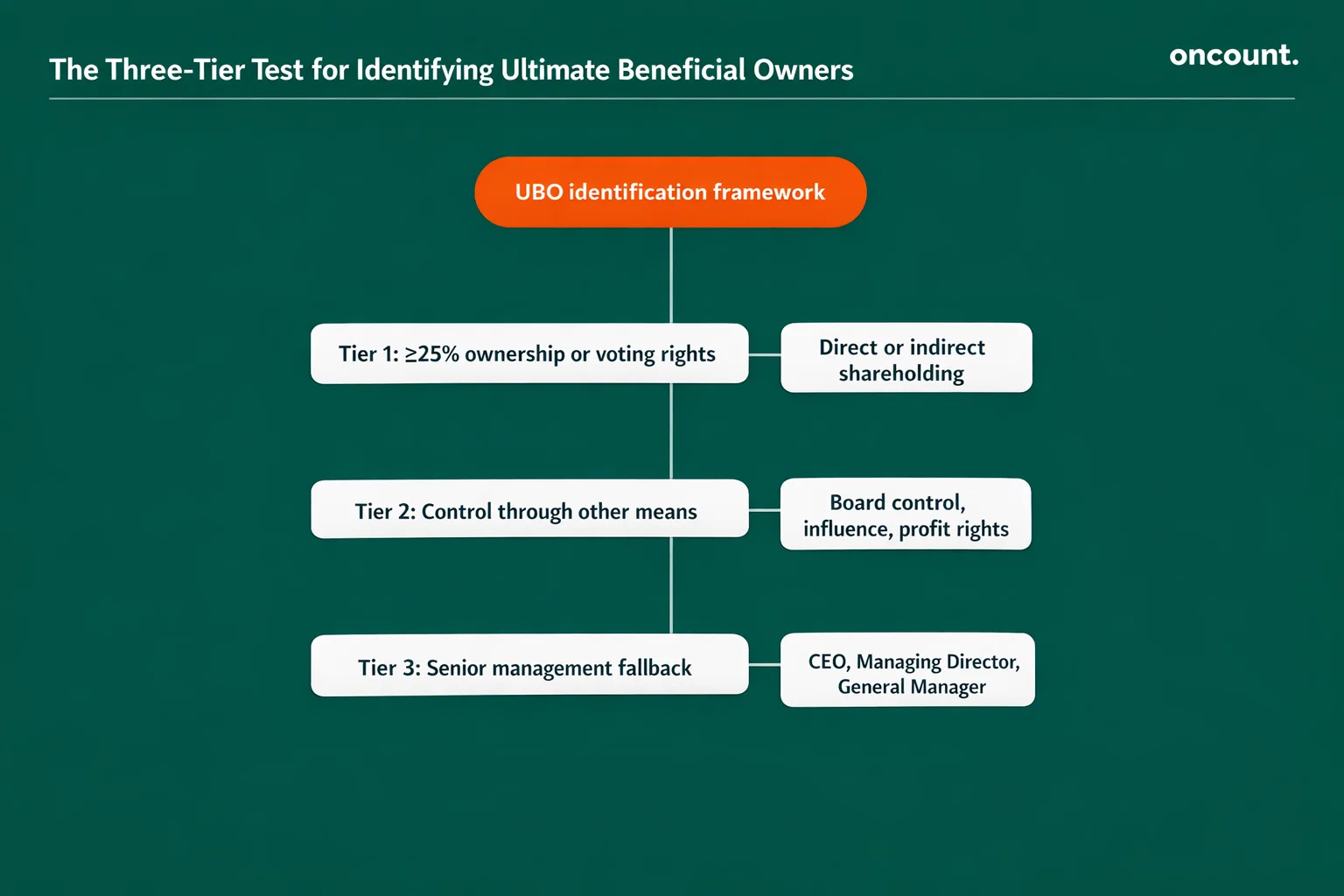
The UAE employs a sophisticated Three-Tier Test to ensure that every legal person can identify at least one natural person as the point of accountability. This cascading approach leaves no entity “ownerless” in the eyes of regulators.
The Three-Tier Test Explained
Tier 1: Ownership and Voting Rights Threshold
Any natural person who ultimately owns or controls 25% or more of your company’s capital or voting rights qualifies as a UBO. This threshold applies whether the ownership is direct or achieved through a chain of corporate entities. When tracing complex ownership structures, you must follow each layer upward until you identify the natural persons at the end of the chain.
If multiple natural persons jointly own or control a combined stake that meets or exceeds 25%, all of them must be recorded as UBOs. The law does not permit you to designate only one representative from a group of joint owners.
Tier 2: Control Through Other Means
When no individual meets the 25% ownership threshold, or when you have reason to suspect the largest shareholder is not the true controller, the second tier applies. This tier identifies natural persons who exercise ultimate control through alternative mechanisms.
Control can be exercised through the right to appoint or dismiss the majority of board members or managers. It may also manifest through the ability to exercise significant influence over major operational decisions or strategic management. Additionally, the right to receive a substantial portion of profits or assets, even without formal voting rights, can establish control under this tier.
Tier 3: Senior Management Fallback
In rare instances where no natural person can be identified under the first two tiers—such as companies with extremely fragmented ownership—the law requires designating the Senior Management Officer as the UBO. This individual is typically the person responsible for day-to-day management and executive decision-making, such as the Chief Executive Officer, Managing Director, or General Manager.
This fallback provision ensures that regulatory authorities always have a natural person to hold accountable, even in the most complex corporate structures.
Legal Framework: Understanding the Key Regulations
The current UBO framework represents an evolution of regulations refined over several years to close compliance gaps and streamline reporting processes.
Cabinet Decision No. 58 of 2020 introduced the foundational obligation for legal persons to identify their Real Beneficiaries and maintain specific internal registers. This decision established the basic architecture of the transparency regime.
Cabinet Resolution No. 109 of 2023 effectively replaced the 2020 regulations for most entities, introducing enhanced procedures for managing beneficial ownership information. This resolution refined the definitions of control and established clearer mandates for the various licensing authorities across the emirates. The 2023 framework represents a shift from simple data collection to an active, risk-based supervisory model.
To ensure enforcement, the government simultaneously issued Cabinet Resolution No. 132 of 2023, which outlines a comprehensive and escalating schedule of administrative penalties. These penalties range from written warnings for first-time violations to business license suspensions lasting up to twelve months for repeat offenders.
Who Must Comply with UBO Regulations in the UAE?
The UBO declaration requirement applies broadly across the UAE’s business landscape, with specific exceptions for certain entity types.
Entities Required to Comply
Nearly all legal persons registered in the UAE must comply with UBO regulations. This includes mainland companies licensed by the Department of Economy and Tourism in each emirate. Commercial free zone entities, with the exception of those in financial free zones, must also file UBO declarations with their respective free zone authorities.
Offshore companies registered in various UAE jurisdictions fall under the UBO framework as well. The regulations apply regardless of the legal form of your entity, covering limited liability companies, sole proprietorships with corporate shareholders, partnerships, and other business structures.
Exempt Entities
Certain categories of legal persons are exempt from the federal UBO requirements. Government-owned entities, where ownership vests entirely in the federal or local government, do not need to file UBO declarations. Companies listed on UAE stock exchanges benefit from an exemption due to their existing transparency and disclosure obligations.
Entities registered in financial free zones—specifically the Dubai International Financial Centre and Abu Dhabi Global Market—are exempt from the federal framework but must comply with their respective beneficial ownership regulations, which are equally stringent. Additionally, investment funds or collective investment schemes subject to oversight by the Securities and Commodities Authority may be exempt, depending on their specific regulatory status.
Step-by-Step Guide to Filing Your UBO Declaration
Successfully navigating the UBO compliance process requires systematic attention to identification, documentation, and timely submission. The following framework will help ensure your business meets all regulatory requirements.
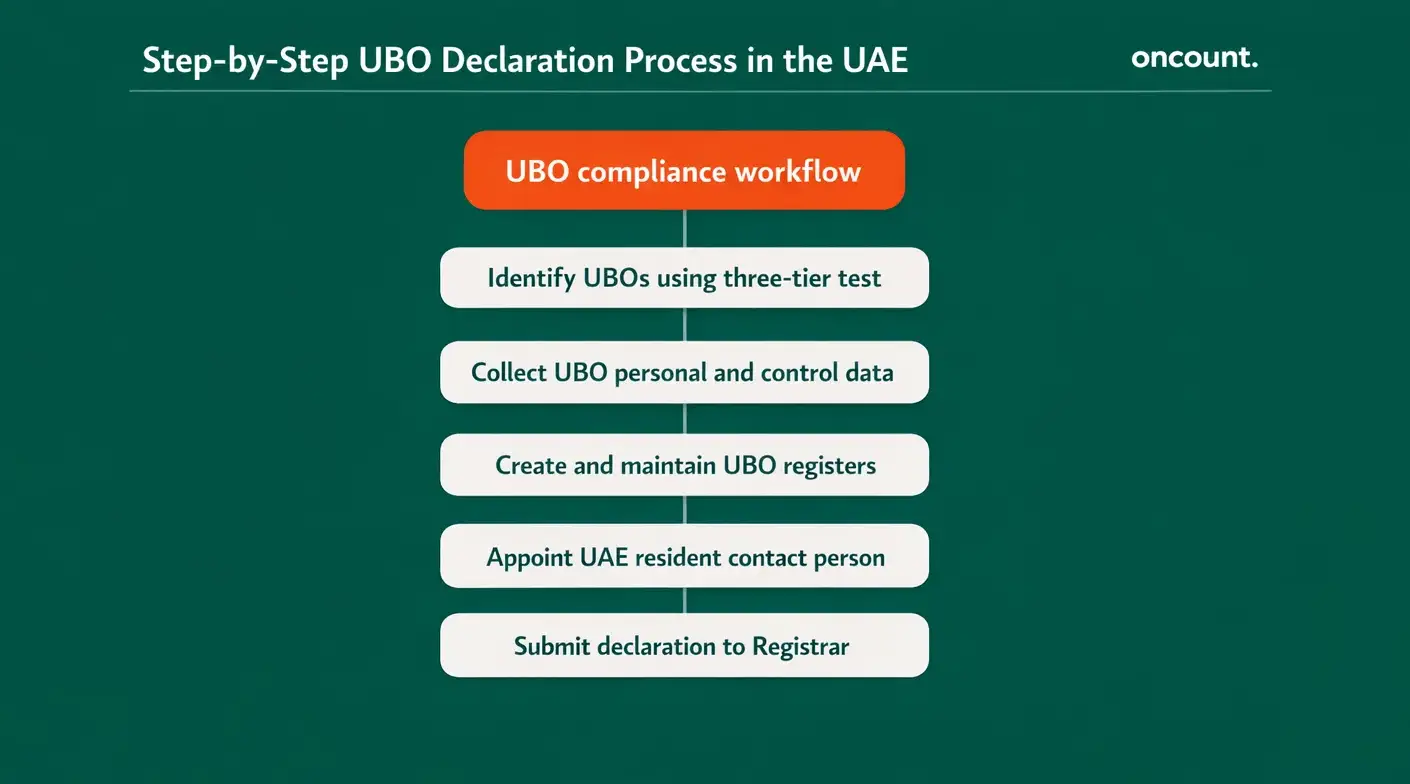
Step 1: Identify Your Ultimate Beneficial Owners
Begin by applying the Three-Tier Test to your ownership structure. Gather your company’s memorandum of association, shareholder register, and any shareholder agreements that detail voting rights or profit-sharing arrangements.
For each shareholder that is a legal entity rather than a natural person, you must trace the ownership chain upward. Document each layer of corporate ownership until you identify the natural persons who ultimately own or control 25% or more. In cases where no individual meets this threshold, document who has the right to appoint board members or exercise significant management influence.
If your company has nominee arrangements, you must identify both the nominee and the person on whose behalf they act. Transparency about these relationships is critical to compliance.
Step 2: Collect Required Information and Documentation
For each identified UBO, you must collect comprehensive data that meets the Registrar’s specifications. You need their full legal name exactly as it appears on official identification documents. Record their current nationality and note any former nationalities that may be relevant for anti-money laundering screening purposes.
Obtain their date and place of birth, verifiable against government-issued documents. Critically, you must record their actual residential address—the use of post office boxes is explicitly prohibited for this field. Collect their passport or Emirates ID number, including the country of issuance and both issuance and expiry dates.
Document the specific basis for their UBO status with precision. Rather than simply noting “shareholder,” specify the exact percentage of ownership or describe the control mechanism, such as “holds 30% of voting shares” or “exercises right to appoint majority of board members.”
Step 3: Create and Maintain Required Registers
Your company must maintain three specific registers at your registered office within the UAE. These registers serve as the primary source of truth for regulatory authorities.
Register of Real Beneficiaries
This register must contain all the data you collected in Step 2 for each UBO. Include the effective date when each person became a UBO and, if applicable, the date they ceased to hold that status. This register must be updated within fifteen days of any change in UBO status or information.
Register of Partners or Shareholders
Document all shareholders or partners, whether they are natural persons or legal entities. For corporate shareholders, include the entity’s name, legal form, memorandum of association, and registered office address. For foreign legal entities, record the name and UAE address of their legal representative.
Register of Nominee Directors and Managers
If any of your managers or board members serve in a nominee capacity, they must inform your company of this status within fifteen days of appointment. Record their details along with the identity of the person on whose behalf they act and the basis of the arrangement.
Step 4: Appoint a UAE Resident Contact Person
Cabinet Resolution No. 109 of 2023 requires every legal person to appoint a Designated Contact Person who is a resident in the UAE. This individual serves as the official liaison between your company and the Registrar for all UBO-related matters.
Provide the Registrar with this person’s full name, residential address, and identification details. Ensure they understand their responsibility to respond promptly to Registrar inquiries, as failure to do so can trigger immediate administrative fines.
Step 5: Submit Your UBO Declaration to the Relevant Registrar
The filing process varies depending on your jurisdiction and licensing authority. Each Registrar manages its own submission platform, though the data requirements remain largely uniform.
For Mainland Companies
Companies licensed by the Department of Economy and Tourism in Dubai typically file through the DED e-services portal. Navigate to the UBO declaration section and submit the required information electronically. Other emirates have similar dedicated portals through their respective DETs.
For Free Zone Entities
Commercial free zones utilize proprietary systems for UBO management. The table below outlines the submission methods for major free zones:
| Free Zone | Submission Method | Platform Details |
| Jebel Ali Free Zone (Jafza) | Dubai Trade Portal | Access via Dubai Trade compliance section |
| Dubai Silicon Oasis | Email Submission | Send to lic_section@dso.ae |
| Ajman Free Zone | AFZ e-Portal | Company Services section |
| Hamriyah Free Zone | HFZA e-Portal | Dedicated UBO module |
| SAIF Zone | SAIF Zone Portal | Online submission system |
| Fujairah Creative City | Email Submission | Send to ubo@ccfz.ae |
Note: Submission methods are subject to change as Free Zones upgrade their digital infrastructure. Always verify with your specific authority.
Compliance often requires both an initial filing and annual confirmation during your license renewal process. Verify the specific requirements with your free zone authority to ensure complete compliance.
Step 6: Maintain Compliance Through Regular Updates
UBO compliance is not a one-time event but an ongoing obligation. You must monitor your ownership structure continuously and report any changes to the Registrar within fifteen days of the change occurring or your company becoming aware of it.
Changes requiring updates include any modification to shareholding percentages, the appointment or removal of board members who exercise control, changes to a UBO’s personal information such as residential address or identification documents, and the addition or departure of any UBO.
Conduct internal audits of your shareholder and control structures at least annually, ideally timed with your license renewal process. This proactive approach helps identify discrepancies before they become compliance violations.
Critical Compliance Deadlines You Cannot Miss
The UAE’s UBO regime imposes strict timelines that directly correlate to the penalty structure. Missing these deadlines triggers escalating administrative sanctions.
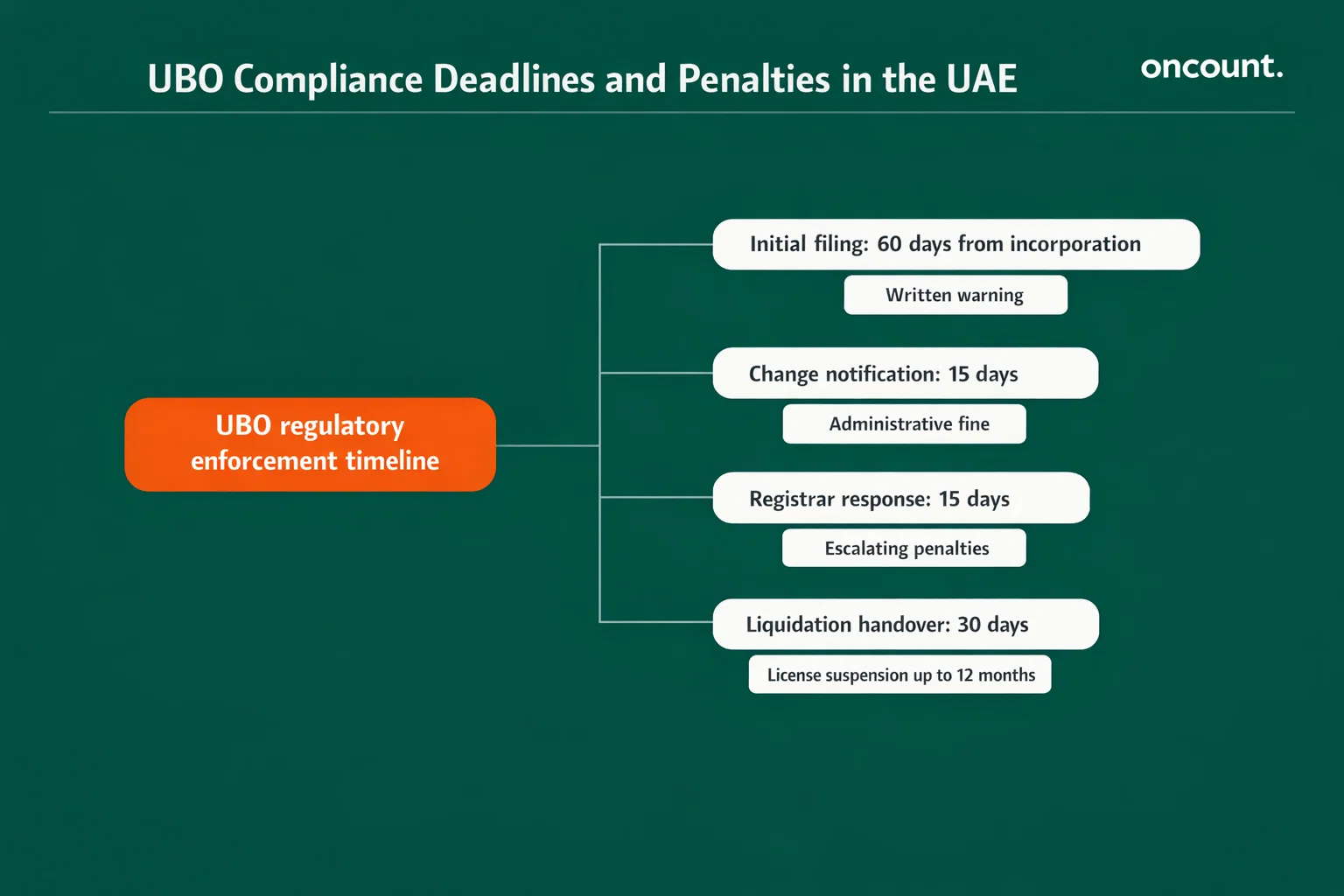
Initial Filing: 60 Days from Incorporation
New businesses must submit their UBO data to the Registrar within sixty days of incorporation or licensing. This window begins from the date your trade license is issued, not from when you begin operations. Failure to meet this deadline results in a written warning for first-time offenders, but subsequent delays can lead to substantial fines.
Change Notifications: 15 Days from Awareness
Any amendment to the information in your UBO registers must be reported within fifteen days. This fifteen-day clock starts either when the change occurs or when your company becomes aware of it, whichever is earlier. This requirement applies to changes in ownership percentages, control mechanisms, personal information of UBOs, and the appointment of new directors or managers.
Verification Response: 15 Days for Suspected UBOs
If you believe your UBO data may be incorrect or incomplete, you must issue a formal notice to the suspected UBO. That individual has fifteen days to respond with accurate information. After this period, you must update your register based on the information available, even if the response is incomplete or not received.
Liquidator Handover: 30 Days from Appointment
When your company enters liquidation, the official liquidator must receive the Register of Beneficial Owners and Register of Partners or Shareholders within thirty days of appointment. The liquidator must then submit updated copies to the Registrar within the same thirty-day window.
Administrative Penalties: Understanding the Consequences of Non-Compliance
Cabinet Resolution No. 132 of 2023 established a comprehensive penalty framework designed to encourage voluntary compliance while imposing increasingly severe consequences on repeat offenders.
The penalty structure follows a three-strike approach for most violations. First-time violations typically result in written warnings, giving companies the opportunity to rectify issues without financial penalty. Second violations trigger substantial monetary fines and short rectification periods. Third violations result in the highest fines and may include business license suspension for up to twelve months.
The following table outlines the key penalties:
| Violation | First Offense | Second Offense | Third Offense |
| Failure to create or maintain UBO Register | Written Warning | AED 50,000 + 30-day rectification | AED 100,000 + 12-month license suspension |
| Missing required data in UBO Register | Written Warning | AED 20,000 + 15-day rectification | AED 40,000 + 6-month license suspension |
| Failure to update within 15 days | Written Warning | AED 30,000 + 15-day rectification | AED 60,000 + 6-month license suspension |
| Not providing additional data to Registrar | Written Warning | AED 20,000 + 15-day rectification | AED 40,000 + restriction of board powers |
| Missing UAE resident contact person | Written Warning | AED 1,000 | AED 2,000 + 1-month license suspension |
| Liquidator fails to maintain 5-year records | Written Warning | AED 20,000 | AED 40,000 |
A business license suspension represents a critical enforcement tool that effectively halts your company’s operations. During suspension, you cannot clear goods through customs, renew employee visas, or execute new contracts. This makes UBO compliance an existential matter for UAE businesses rather than a mere administrative concern.
Special Considerations for Financial Free Zones
Entities registered in the Dubai International Financial Centre and Abu Dhabi Global Market operate under separate beneficial ownership frameworks tailored to international financial markets.
ADGM Beneficial Ownership Requirements
The ADGM Registration Authority oversees compliance through the Beneficial Ownership and Control Regulations 2022. ADGM has signaled intensified oversight for 2025–2026, with regulatory priorities including swift enforcement where inaccurate filings may trigger action within thirty days.
ADGM follows a similar cascading test: first identifying persons with 25% or more ownership or control, then identifying the natural person holding the position of officer if no one meets the primary criteria. You must establish your beneficial ownership record within one month of your ADGM establishment.
Any relevant change must be reported to the Registrar within fifteen days. Late filing fees apply automatically at USD 150 per month, up to a maximum of three months. Additional sanctions can reach USD 25,000 for serious violations.
DIFC Beneficial Ownership Framework
The DIFC mandates that all entities maintain a Register of Beneficial Ownership and submit details to the Registrar of Companies. The framework, revised in 2024, focuses particularly on “Prescribed Companies” and holding structures to ensure they are not used to obscure ultimate control in complex financing arrangements.
DIFC entities must balance compliance with the DIFC Data Protection Law while meeting anti-money laundering and know-your-customer requirements. This dual obligation requires careful attention to data handling procedures and cross-border information sharing protocols.
Integration with Anti-Money Laundering Obligations
Your UBO declaration connects directly to the UAE’s broader Anti-Money Laundering and Counter-Terrorism Financing framework under Federal Decree-Law No. 20 of 2018.
Designated Non-Financial Businesses and Professions—including real estate firms, dealers in precious metals and stones, and auditors—must adopt a risk-based approach when onboarding corporate clients. This requires verifying the identity of your client’s UBOs against original documents as part of customer due diligence.
Virtual Asset Service Providers face similar obligations with additional scrutiny given the heightened money laundering risks associated with digital assets. All DNFBPs must register on the goAML portal, an integrated platform used to file Suspicious Transaction Reports and Suspicious Activity Reports.
By 2025, the UAE has significantly enhanced enforcement by integrating ownership data into national risk assessments. The linking of UBO registries with financial institutions enables real-time due diligence and triggers red-flag systems within the goAML platform. This automated monitoring helps authorities identify Politically Exposed Persons or sanctioned individuals attempting to hide behind complex corporate layers.
For DNFBPs and regulated financial institutions, failure to register on the goAML portal or effectively use it to report suspicious activity involving identified UBOs can result in hefty penalties from the Ministry of Economy, separate from and in addition to UBO-specific fines.
Best Practices for Maintaining UBO Compliance
Sustainable compliance requires more than reactive responses to filing deadlines. The current enforcement climate demands a proactive lifecycle approach.
Designate a Compliance Officer
Appoint an individual within your organization to oversee all UBO filings, monitor ownership changes, and ensure the fifteen-day update rule is never violated. This person should have direct access to senior management and authority to request documentation from shareholders and board members.
Implement Annual Data Audits
Conduct comprehensive self-audits of your shareholder and control structures at least once annually. Time these audits to coincide with your license renewal process to streamline compliance activities. Verify that all UBO information remains current and that your registers accurately reflect your actual ownership structure.
Train Stakeholders on Their Obligations
Ensure that board members, managers, and significant shareholders understand their personal liabilities under the UBO framework. This includes the importance of disclosing nominee arrangements and promptly notifying the company of any changes to their status or personal information.
Leverage Technology for Tracking
As regulatory authorities move toward more sophisticated digital interfaces, utilize compliance software to track renewal dates and manage digital copies of UBO registers and supporting evidence. This technological approach ensures you can respond to Registrar data requests within the mandated timeframes, avoiding escalating fines.
Maintain Comprehensive Documentation
Keep copies of all documents used to verify UBO identities and control mechanisms. This includes passport copies, Emirates ID scans, organizational charts detailing ownership chains, shareholder agreements, and board resolutions. Retain these documents for at least five years from the date of any change or your company’s dissolution.
Conclusion: Embracing Transparency as Strategic Advantage
The Ultimate Beneficial Ownership declaration requirements in the UAE represent far more than a compliance burden. They form a pillar of the nation’s modern economic identity and its commitment to transparency and combat financial crimes like money laundering and terrorist financing.
For businesses operating in the region, the UBO framework has evolved into a core component of corporate governance that directly affects legal standing, access to financial services, and global credibility. The transition to the 2025–2026 regulatory era brings increased automation, tighter enforcement windows, and integration of ownership data into broader anti-money laundering and tax surveillance systems.
While the penalties for non-compliance are severe—potentially resulting in business license suspension for repeat offenders—the framework provides a clear and predictable path for compliant entities. By rigorously applying the Three-Tier Test, maintaining accurate internal registers, and adhering to the fifteen-day update rule, your company can ensure alignment with both domestic laws and international financial standards.
The regulatory authorities have made their expectations clear: transparency is not negotiable. Companies that embrace this principle and institutionalize robust UBO compliance procedures position themselves for long-term growth in a secure and transparent business environment. Your commitment to identifying and disclosing your ultimate beneficial owners demonstrates to partners, clients, and regulators that your company operates with integrity and in full compliance with UAE regulations.