Understanding the National ICV Program and Its Economic Impact
The National In-Country Value certification program evolved from a localized initiative at the Abu Dhabi National Oil Company into a nationwide economic policy. Originally pioneered by ADNOC in 2018 as a framework to stimulate the domestic economy through supply chain localization, this initiative introduced by the UAE government was expanded to national scale in 2021 as part of the “Projects of the 50.”
The program is managed by the Ministry of Industry and Advanced Technology (MoIAT). This transition reflects a sophisticated industrial policy aimed at enhancing productivity, sustainability, and global competitiveness across the UAE economy.
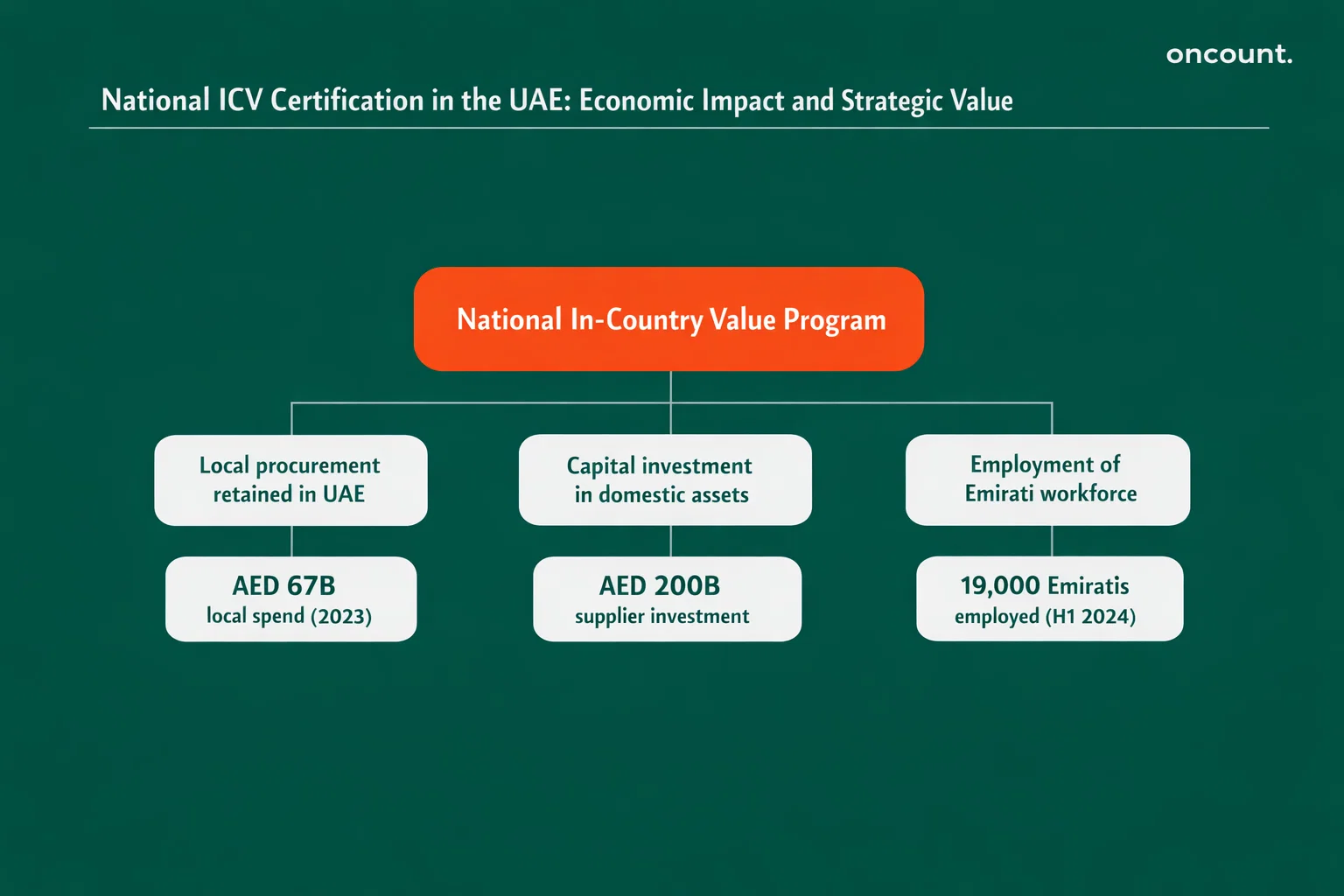
Since its national launch, the program has redirected substantial government procurement spending back into the national economy. Local spending reached AED 67 billion by the end of 2023, representing a 26% year-on-year growth rate. By H1 2024, registered suppliers had invested over AED 200 billion in the country, while the program facilitated employment for approximately 19,000 UAE nationals in the private sector.
Key Economic Impact Metrics:
| Metric | 2021 (Launch) | 2022 | 2023 | H1 2024 |
| Local Procurement Spend | AED 42.4B | AED 53B | AED 67B | AED 48B |
| Year-on-Year Growth | N/A | 25% | 26% | Projected >25% |
| Emiratis in Certified Firms | Baseline | Growth | ~15,000+ | ~19,000 |
| Total Supplier Investment | N/A | N/A | AED 200B | Ongoing |
The ICV certificate is an official document that measures and certifies the economic value a company contributes to the UAE. This contribution to the UAE economy is quantified through an ICV score, which is computed based on several factors including local procurement from local suppliers, investment within the UAE, and employment of Emiratis.
For the corporate entity operating in the UAE, the in-country value certificate has become a mandatory instrument for participating in major tenders issued by government entities and leading national companies.
Who Needs to Get an ICV Certificate in the UAE
Any business in the UAE seeking to bid for government contracts must obtain ICV certification. The program applies to manufacturers holding industrial licenses, service providers, and trading companies registered with the appropriate government authorities.
Whether your company operates in oil and gas, construction, logistics, real estate, or professional services, eligibility for ICV certification depends on having proper legal registration and audited financial statements.
The certificate for businesses in UAE is particularly critical for suppliers working with major participating entities. These organizations have integrated the ICV score as a mandatory evaluation criterion in their procurement processes. Companies without valid certification are effectively excluded from these high-value tender opportunities.
Major Participating Entities Requiring ICV Certification:
- ADNOC (Oil, Gas, and Petrochemicals) – Originator of the program and primary driver of industrial localization
- Mubadala (Global Investment) – Aligns large-scale investment portfolios with national economic goals
- Aldar Properties (Real Estate and Infrastructure) – Drives local content in construction and logistics
- ENEC (Nuclear Energy) – Focuses on specialized technical services and nuclear supply chain localization
- ADDED (Economic Development) – Integrates ICV with the Abu Dhabi Local Content Programme
- Abu Dhabi Ports (Logistics and Trade) – Enhances value retention within maritime and industrial zones
International companies establishing operations in the UAE market must also obtain your ICV certificate to compete effectively. The program incentivizes local investment, domestic procurement, and hiring of Emiratis.
Essential ICV Requirements: What You Need Before You Apply for ICV Certification
Understanding the specific ICV requirements is critical before beginning the certification process. The fundamental prerequisite for obtaining an ICV certificate involves having audited financial statements prepared according to International Financial Reporting Standards.
Audited Financial Statements and IFRS Compliance
The fundamental requirement for ICV certification is the submission of audited financial statements prepared according to International Financial Reporting Standards (IFRS). These statements must be audited by a licensed UAE-based auditor following International Standards on Auditing.
The reliance on IFRS ensures that the data used for scoring is credible, transparent, and consistent across all applicants. Financial statements must not be older than two years from the date of the certification year.
For instance, a certification sought in 2025 would typically rely on financial statements from the 2023 or 2024 fiscal year. This ensures that the ICV score reflects the most recent economic contribution of the entity.
Special Provisions for New Companies and SMEs
Recognizing the challenges faced by startups, the MoIAT guidelines provide flexibility for newly established entities. Companies that are less than 10 months old and have not yet completed a full fiscal year may use unaudited management accounts for a period of up to 9 months for their initial ICV calculation.
Any financial period exceeding 9 months triggers the requirement for a formal audit. This provision is vital for SMEs looking to enter the government procurement market early in their lifecycle.
Legal Entity and Branch Certification Rules
The ICV certificate is tied to a specific legal entity, typically defined by its trade license. If a business group operates through multiple separate licenses, each entity must generally obtain its own individual certificate.
However, the program allows for consolidation in specific instances. Branches located within the same Emirate, possessing identical ownership and conducting the same business activities, may be covered by a single combined certificate. Companies that hold both manufacturing and commercial trading licenses must maintain separate accounting records for each activity, and a separate ICV certificate will be issued for each license.
Step-by-Step Certification Process
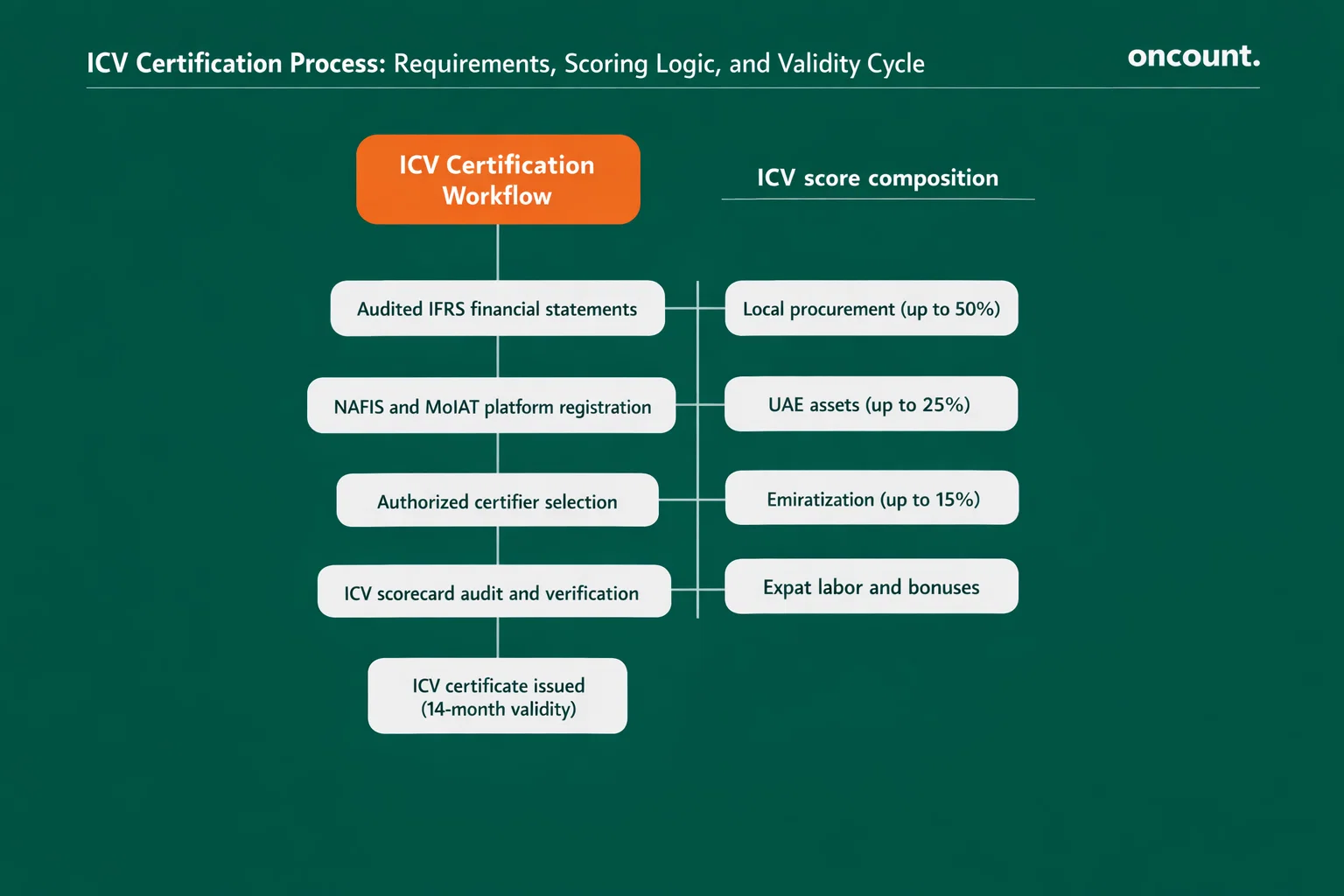
Obtaining an ICV certificate involves a five-stage process that integrates digital registration, financial analysis, and third-party verification. Understanding how to apply for an ICV certificate requires careful attention to each step.
Step 1: Digital Platform Registration and NAFIS Compliance
The first step for any supplier is to register on the official MoIAT ICV platform at https://icv.moiat.gov.ae/. Access is managed through UAE Pass, the national digital identity system.
A significant update introduced in the October 2023 guidelines is the mandatory registration on the NAFIS platform. Before proceeding with the ICV application, private sector enterprises must register as Partners on NAFIS at https://nafis.gov.ae. This requirement underscores the program’s role in promoting employment of UAE nationals in the private sector.
Step 2: Selecting an Authorized Certifying Body
Once registered, the company must select a certifying body from the MoIAT-approved list. It is recommended that firms solicit quotations from several certifiers, as fees are not fixed by the government and depend on the complexity and size of the entity.
Upon selection, the firm must sign an engagement letter with the certifier. Suppliers are generally prohibited from changing their certifier during the same certification year without valid and documented justification.
Step 3: Completion of the ICV Scorecard
The supplier must populate the official MoIAT ICV Template, also known as the ICV Scorecard. This Excel-based tool is structured to automatically compute the score based on the data entered.
Accuracy is paramount, as every figure must be traceable to the audited financial statements or the supporting ledgers used to prepare them.
The template requires the following core data points:
- Company Information including license details, financial period, and contact information
- Manufacturing Costs and Third-Party Spend with detailed breakdown of local versus imported spending
- Investment showing net book value of UAE-based assets
- Manpower data including headcount and salary data for Emiratis and expatriates
- Sustainability and Technology metrics for bonus points
Step 4: The Audit and Factual Finding Report
The appointed certifying body conducts a technical audit of the completed template. This involves verifying evidence for local procurement, check-testing payroll against WPS reports, and confirming the location and value of assets.
For complex manufacturing entities, the certifier may perform an on-site visit to verify stock and operational processes. Following the review, the certifier drafts a Factual Finding Report, which outlines the audit methodology and confirms the accuracy of the calculated ICV score.
Step 5: Certificate Generation and Validity
The final score and Factual Finding Report are uploaded by the certifier to the MoIAT platform. After a final review by the Ministry of Industry and Advanced Technology (MoIAT), the ICV Certificate is generated.
The ICV certificate shall be valid for 14 months from the date of issuance of the audited financial statements. During this period, the supplier can use the certificate for any tender issued by the Participating Entities.
If the company wishes to renew their ICV certificate mid-year, perhaps due to a major new investment or surge in Emirati hiring, it can undergo recertification using the same audited statements. However, the 14-month expiry remains tied to the original audit date, ensuring the validity of the ICV certificate remains consistent.
How the ICV Score is Calculated: Understanding the National ICV Formula
The ICV score is a weighted percentage representing the value a company retains within the UAE economy. The ICV formula differentiates between manufacturers who have an industrial license and service providers or traders.
Understanding how to calculate their ICV score based on these components is essential for businesses to maximize their performance.
Primary Scoring Components
The score is derived from six primary attributes, each carrying specific weightage. The local procurement component, worth up to 50%, is the most significant element. For manufacturers, it measures the local cost of production. For others, it measures procurement of goods and services from UAE-based suppliers.
The score is multiplied by the ICV score of the vendors, incentivizing firms to buy from other certified entities. This cascading effect means that the ICV program incentivizes deep local supply chain development.
Investments in the UAE account for up to 25% of the total score. This reflects the net book value of physical and intangible assets located in the country, including property, plant, equipment, and even capitalized software development costs.
Emiratization contributes up to 15% and is calculated based on total compensation paid to UAE nationals through the Wage Protection System. This rewards companies for hiring and developing local talent.
ICV Scoring Components and Weightage:
| Attribute | Primary Metric | Maximum Weightage | Formula Logic |
| Local Procurement | Total Spend × Supplier ICV% | Up to 50% | Incentivizes local supply chain depth |
| UAE Assets | Net Book Value | Up to 25% | Encourages infrastructure and R&D investment |
| Emiratization | WPS Salaries (UAE Nationals) | Up to 15% | Supports national human capital goals |
| Expat Labor | 60% of WPS (Expats) | Up to 10% | Recognizes local consumption by residents |
| Bonuses | Export, ITTI, Sustainability | Top-up | Rewards innovation and sustainability |
Expatriate workforce contribution accounts for up to 10% and represents the portion of expatriate salaries spent within the domestic economy. It is generally calculated as 60% of the expatriate labor cost.
Bonus Criteria and Advanced Scoring
Beyond the core components, companies can earn bonus points for activities that align with high-level national strategies. Export bonuses reward revenue generated from outside the UAE. Emirati headcount bonuses recognize increases in the absolute number of UAE national employees.
Investment growth bonuses reward year-on-year increases in local capital expenditure. These bonus criteria allow high-performing companies to exceed baseline expectations and demonstrate exceptional commitment to the UAE market.
The Farmer Score for Service Providers
Under the 2023 revised guidelines, third-party service providers must undergo a more rigorous review that includes implementation of a Farmer Score. This mechanism differentiates between high-value service providers and those who act as mere intermediaries with minimal local value addition.
The Farmer Score ensures that the ICV certification program maintains integrity by preventing companies from inflating scores through pass-through arrangements without genuine economic contribution.
Key Constraints and Allowable Deductions in ICV Score Calculation
To maintain program integrity, MoIAT has established specific caps and exclusions that prevent artificial inflation of ICV scores. Understanding these constraints is critical when businesses learn how to get their certification optimized.
Owner Salary Caps and WPS Requirements
A critical constraint concerns compensation of business owners. Owner salaries are eligible for the ICV calculation only if they are registered and paid through the Wage Protection System. Furthermore, these salaries are capped at AED 120,000 per month for each owner.
Any amount paid above this threshold, or through non-WPS channels such as dividends or bonuses, is excluded from the score. This ensures that the program measures genuine employment contributions rather than artificial salary inflation.
Excluded Internal Costs
Most internal costs are excluded from the ICV calculation. This includes intra-group management fees, overhead allocations, and general administrative expenses. The program aims to measure the external economic impact of the company, and thus internal transfers do not count as value addition.
Depreciation on UAE-based assets is a notable exception, as it is factored into the investment score.
Mainland Supplier Advantages
Suppliers based in mainland UAE receive structural advantages in the scoring system. When a company procures from a mainland supplier, it may receive a 10% reward or credit in its ICV score calculation.
Furthermore, spending on government-owned utilities such as water and electricity is often assigned a deemed ICV percentage, recognizing the 100% local nature of these services. This creates a compelling incentive for companies to prioritize mainland vendors over free zone alternatives when implementing the ICV program strategies.
Advanced Technology and Sustainability in the National ICV Program
The most recent policy shifts demonstrate that the UAE government is leveraging the ICV program to drive its broader Make it in the Emirates and Net Zero 2050 agendas. These updates are reshaping how companies approach obtaining ICV certification in the UAE.
The Industrial Technology Transformation Index
For goods manufacturers, MoIAT has introduced the Industrial Technology Transformation Index bonus. This rewards companies that invest in advanced technologies like artificial intelligence, robotics, and the Internet of Things.
The ITTI score is integrated into the National ICV Formula as an Advanced Technology and Sustainability Bonus. This transition marks a shift from rewarding simple manufacturing to incentivizing smart manufacturing.
Companies that demonstrate adoption of Industry 4.0 solutions can earn additional points beyond the standard formula, providing a competitive advantage when participating in government tenders across the UAE.
Sustainability and Environmental Stewardship
Sustainability is now a formal component for both manufacturers and service providers. Companies can earn bonus points for environmentally responsible practices, such as reducing carbon emissions, optimizing water usage, or utilizing sustainable raw materials.
This alignment ensures that firms wishing to win large government contracts must also be leaders in environmental compliance. The certification shows not only economic contribution but also commitment to long-term sustainability goals.
University Partnerships and Education Investment
The guidelines recognize the importance of human capital development through academic partnerships. Donations made to specific government-linked universities are included in the ICV calculation as a form of social and economic investment.
Eligible institutions include United Arab Emirates University, Higher Colleges of Technology, Zayed University, Khalifa University, Petroleum Institute, and New York University Abu Dhabi. Companies making strategic donations to these institutions can enhance their scores while supporting national education priorities.
Cost Breakdown for Obtaining ICV Certification in the UAE
The financial commitment for obtaining an ICV certificate involves two primary components. Understanding these costs helps businesses budget appropriately when they apply for an ICV certificate.
Government Service Fees
While the digital platform itself is generally listed with zero AED fee for the basic transaction, there are administrative costs associated with prerequisites. The Initial Approval Certificate service is priced between AED 500 and AED 10,000, depending on company size and facility capital.
These fees are typically non-refundable and represent the government’s administrative processing costs.
Professional Certifier Fees
The most significant expense is the fee paid to the authorized certifying body. Because this is a professional service, prices are subject to market forces and the complexity of company operations.
For an SME, fees might range from AED 5,000 to AED 10,000, while for large multi-license corporations, fees can exceed AED 20,000 per license. These fees cover the cost of the technical audit, the Factual Finding Report issuance, and the data validation.
Companies should solicit quotations from multiple certifying bodies to ensure competitive pricing while maintaining quality service.
Strategic Recommendations for Maximizing Your ICV Score
To use the ICV program as a competitive tool rather than a compliance burden, companies must integrate ICV metrics into their core business strategies. These recommendations help businesses maximize their contribution to the UAE economy while improving their competitive position.
Supply Chain Optimization
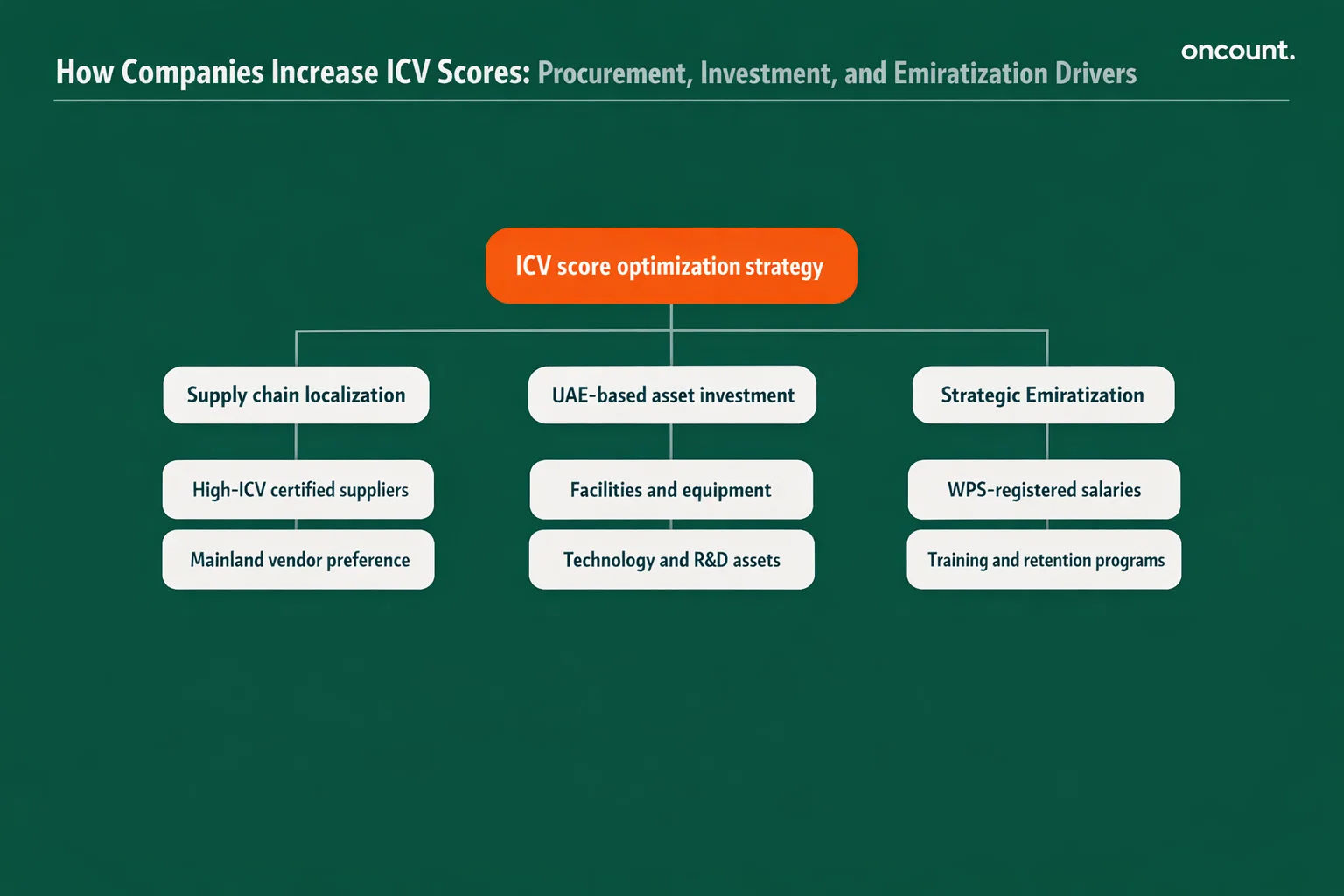
The single most effective way for a service provider or trader to improve their score is to mandate ICV certification for their own suppliers. Since the score is calculated as a weighted average of vendor ICVs, replacing a low-score vendor with a high-score one can cause immediate and significant improvement.
Procurement departments should include ICV scores as a mandatory criterion in vendor evaluation processes. This creates a virtuous cycle where the entire supply chain elevates its local value contribution.
Strategic Emiratization Beyond Quotas
Beyond simply meeting NAFIS quotas, companies should focus on quality and longevity of Emirati employment. High salaries for UAE nationals contribute more to the score than lower-level roles.
Furthermore, investing in certified training programs for Emiratis can provide bonus points that offset other cost areas. Companies that view Emiratization as a strategic advantage rather than a compliance obligation will find greater success in government tenders and contracts.
Physical Asset Investment for Long-Term Value
For companies with long-term horizons, investing in physical infrastructure represents the most reliable way to boost the 25% investment component of the score. This includes local manufacturing plants, warehouses, or proprietary technology.
This is particularly relevant for international firms looking to establish a permanent footprint in the UAE. Such investments signal serious commitment to the UAE market and provide sustained competitive advantages.
Early Engagement for Startups
Startup entities should leverage the nine-month management account rule to obtain an ICV certificate as early as possible. This allows them to bid for government contracts from their first year of operation, providing revenue necessary to support future growth and formal audits.
Early certification also builds relationships with certifying bodies and establishes the company’s credibility with participating entities from the outset.
Conclusion: The Future of In-Country Value in the UAE
The National In-Country Value Program is more than a certification process. It is a manifestation of the UAE’s strategic vision for a diversified, technologically advanced, and sustainable economy.
By redirecting AED 67 billion into local industries by 2023 and facilitating employment of 19,000 Emiratis in the private sector by mid-2024, the program has proven its effectiveness as a tool of national industrial policy.
As the program continues to evolve, the integration of sustainability and AI-driven technology through the ITTI index will define the next generation of certified companies. For the corporate strategist, the message is clear: the ICV score is the definitive metric of a company’s commitment to the UAE.
Those who view the certificate as a strategic asset, investing in local talent, building physical infrastructure, and fostering deep local supply chains, will find themselves with a permanent competitive advantage in the UAE’s high-value government procurement market. The 14-month validity cycle ensures a continuous loop of improvement, pushing the private sector to ever-higher levels of value retention and economic contribution.