Strategic Jurisdictional Selection to Reduce Operational Costs
The choice of business location represents the most impactful decision for controlling expenses when running a business in the UAE. Different emirates and free zones offer vastly different cost structures, and selecting the appropriate jurisdiction can save tens of thousands of dirhams annually while helping businesses establish the right foundation.
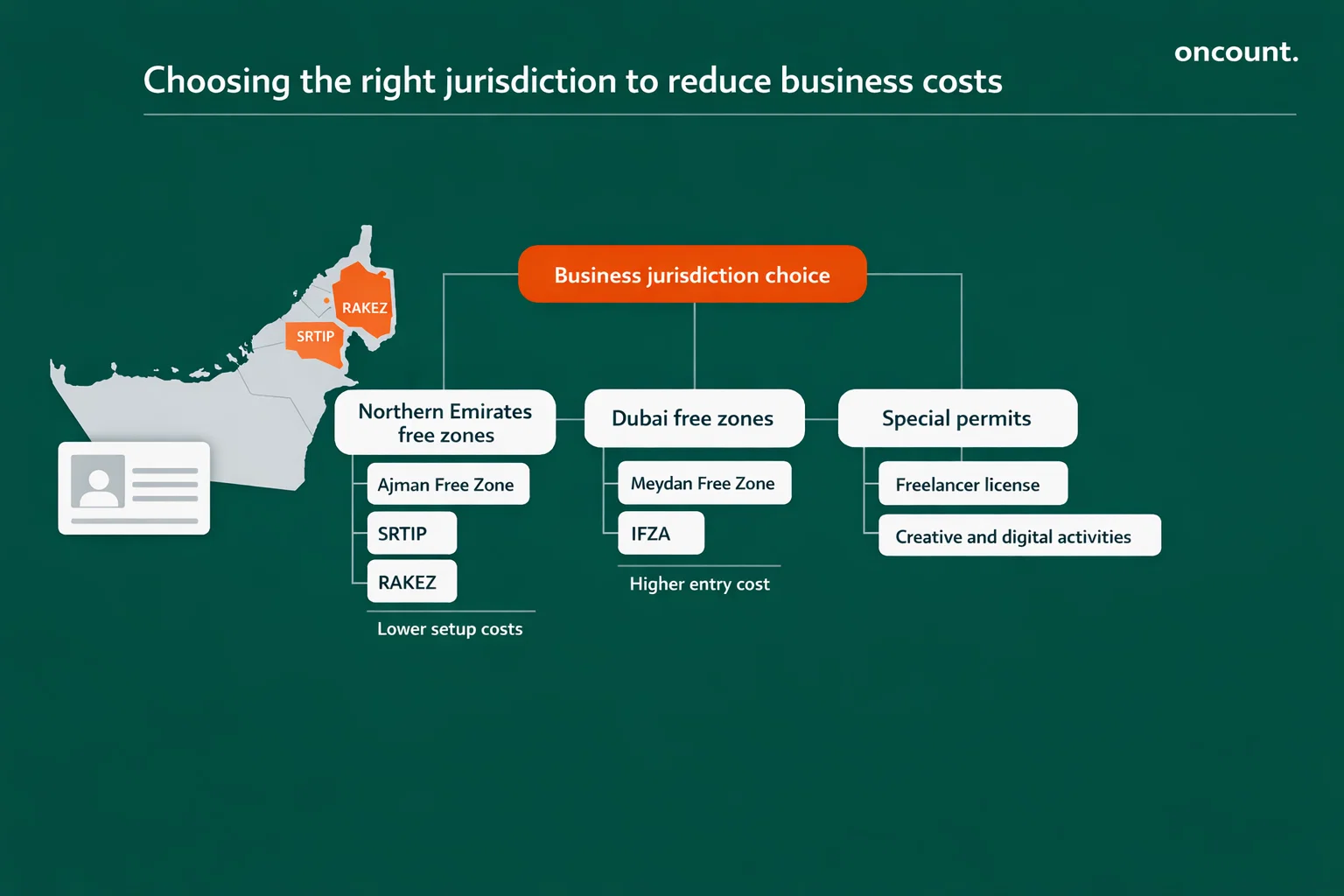
For startups and small businesses, the Northern Emirates have emerged as premier destinations for absolute cost minimization. Sharjah, Ajman, and Ras Al Khaimah leverage lower operational overheads to offer competitive entry points. The Sharjah Research, Technology and Innovation Park and the Ajman Free Zone currently lead with packages starting around AED 5,000 to AED 5,500, making them especially attractive for startups seeking to minimize expenses during critical early stages.
These packages work well for digital nomads, consultants, and e-commerce founders who do not require physical office space or local teams. Dubai-based options such as Meydan Free Zone and IFZA offer premium perception for international clients but require higher initial investment, with licenses starting between AED 11,000 and AED 15,000. The Freelancer License option has become widely used for reducing setup costs, particularly in creative and professional services sectors.
Free Zone License Cost Comparison
| Free Zone / Permit | Location | Starting License Cost (AED) | Target Activity |
| Ajman Free Zone (AFZ) | Ajman | 5,000 | Trading, Services |
| SRTIP Free Zone | Sharjah | 5,500 | Tech, R&D |
| SHAMS | Sharjah | 5,750 | Media, E-commerce |
| RAKEZ | Ras Al Khaimah | 6,000 | Manufacturing, SMEs |
| DIFC (Non-Financial) | Dubai | 10,000 | Fintech, Retail |
| Meydan Free Zone | Dubai | 12,500 | Digital Business |
| GoFreelance | Dubai | 7,500 | Media, Tech, Design |
| Twofour54 | Abu Dhabi | 0 (First 2 Years) | Content, Gaming |
Jurisdictions like GoFreelance in Dubai and Twofour54 in Abu Dhabi provide specialized permits for creative professionals. GoFreelance maintains a stable annual package of AED 7,500, while Twofour54 has waived licensing fees for the first two years. This represents one of the most effective ways to minimize your business costs during company formation and initial operations.
Free zones often provide benefits beyond lower setup costs, including simplified regulatory requirements and streamlined workflows that reduce administrative burden. These advantages help businesses allocate resources more efficiently and avoid overspending on compliance and administration.
Navigating Corporate Tax: Fiscal Strategies for Cost Efficiency
The introduction of the federal corporate tax has transformed expense management from purely operational concern into a strategic accounting necessity. With the standard nine percent rate applying to taxable income exceeding AED 375,000, businesses must proactively manage revenue recognition and deductible expenditures to maintain profitability and cash flow.
Small Business Relief as a Cost Management Tool
Under Ministerial Decision No. 73 of 2023, the UAE government provides critical support for SMEs through the Small Business Relief scheme. For tax periods ending on or before December 31, 2026, resident persons with annual revenue of AED 3 million or less can elect to be treated as having no taxable income. This relief eliminates corporate tax obligations and simplifies compliance through simplified returns and cash-basis accounting.
The application of Small Business Relief requires strategic analysis. Businesses opting for this relief cannot deduct net interest expenses or carry forward tax losses to future years. The current business lifecycle stage dictates the optimal fiscal choice that will support your business objectives.
For profit-making SMEs with low debt, Small Business Relief provides immediate tax savings that improve cash flow and reduce administrative complexity. For loss-making startups or infrastructure-heavy firms, foregoing Small Business Relief to carry forward tax losses for up to ten years may prove more beneficial long-term. This decision requires consultation with accounting firms in Dubai or professional service providers who can benchmark your situation against industry standards and identify areas for optimal tax positioning.
Qualifying Free Zone Person Status Requirements
For entities in free zones, achieving zero percent corporate tax requires meeting stringent criteria for Qualifying Free Zone Person status. This status depends on maintaining adequate substance in the UAE, including qualified personnel, physical premisess, and operating expenditure within the zone.
The question in 2026 is whether the business structure properly handles tax requirements. Passive companies lacking real business operations face high rejection risks during visa renewals and may be reclassified as non-qualifying, subjecting them to the standard nine percent rate. Maintaining proper substance is essential for keeping costs under control and preserving tax benefits.
Interest Deduction and Transfer Pricing Compliance
Managing debt-related expenses has become more complex. Interest deductions are subject to limitations based on Earnings Before Interest, Tax, Depreciation, and Amortization. For borrowings initiated after December 9, 2022, interest on loans up to AED 12 million is fully deductible, while amounts exceeding this are limited to thirty percent of EBITDA.
Transactions with related parties, such as loans from shareholders or parent companies, must adhere to the arm’s length principle, meaning they must reflect fair market rates. Non-compliance with transfer pricing rules can lead to disallowance of major expenses, effectively increasing tax burden and creating unexpected costs that could slow down growth.
Workforce Cost Optimization: Effective Ways to Control Labor Expenses
Workforce costs remain the largest variable expense for most UAE enterprises. The strategy for labor cost minimization has shifted from simple salary negotiation to sophisticated hybrid models integrating in-house talent, specialized freelancers, and Employer of Record services.
Understanding the True Cost of Employment
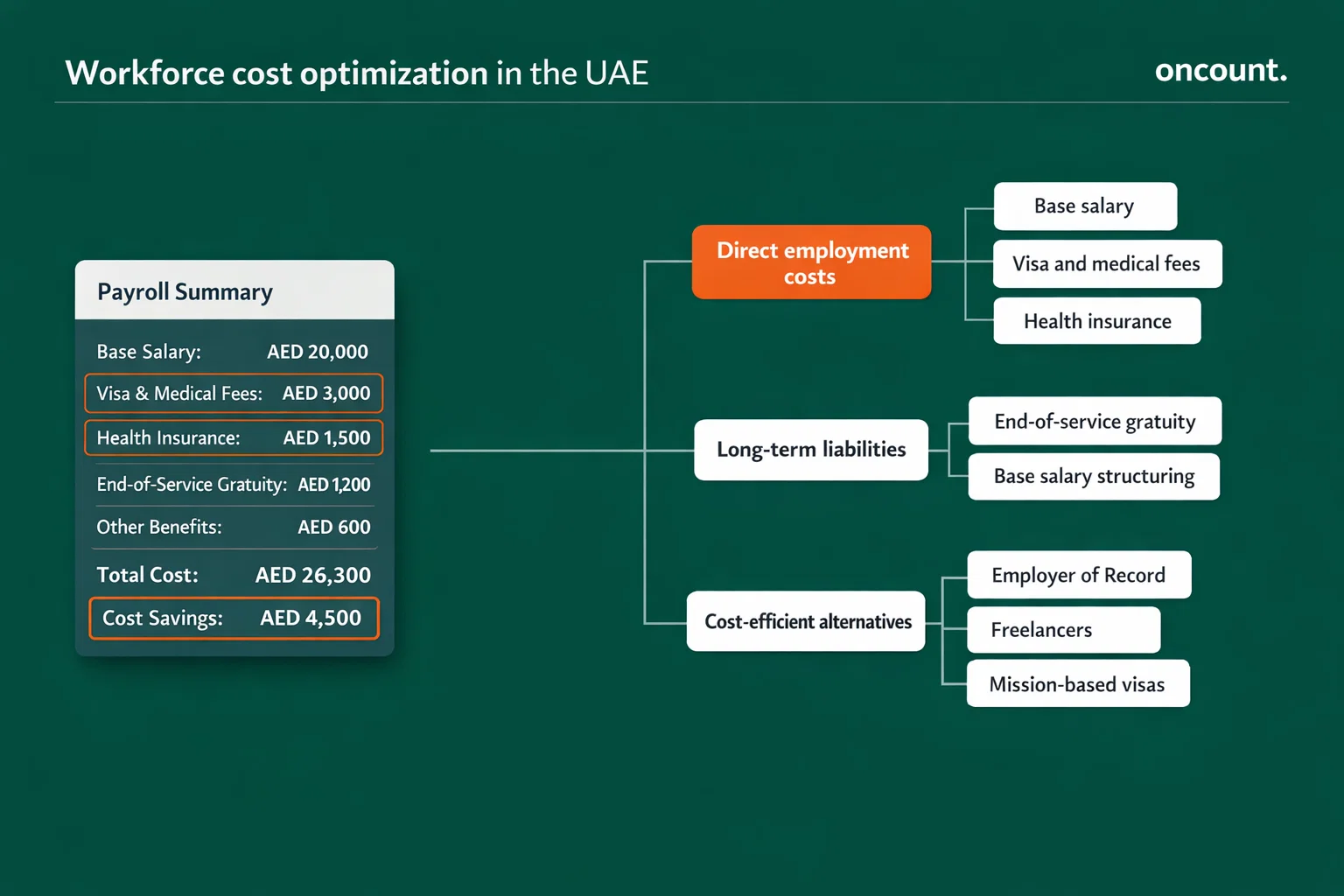
The financial obligation of hiring an employee extends far beyond base salary. Employers must factor in a burden rate that increases total employment cost by twenty to forty percent. Mandatory costs include visa and immigration fees (typically AED 3,070 to 6,270 in the first year), medical fitness tests, Emirates ID registration, and annual health insurance premiums (AED 2,000 to 6,000).
End-of-service gratuity represents a critical long-term liability accruing based on service length and final base salary. Many businesses strategically structure compensation packages with lower base salary and higher allowances for housing and transport, since gratuity is calculated only on the base component. This approach reduces terminal payout liability without impacting employee take-home pay, helping control costs while maintaining competitive compensation.
Employment Cost Analysis by Role
| Professional Role | Average Monthly Salary (AED) | Employer Uplift (8%-20%) | Estimated Total Monthly Cost (AED) |
| Software Engineer | 22,000 | 2,200 | 24,200 |
| Product Manager | 27,000 | 2,700 | 29,700 |
| Marketing Specialist | 14,000 | 1,400 | 15,400 |
| Senior Developer | 30,000 | 5,000 (Higher Benefits) | 35,000 |
| HR Manager | 25,000 | 2,500 | 27,500 |
| Customer Support | 8,000 | 800 | 8,800 |
Employer of Record as Cost-Effective Alternative
For international firms or startups testing the market without entity setup overhead, the Employer of Record model provides highly efficient alternative. Establishing a legal entity can cost between AED 9,000 and AED 40,000 upfront, plus ongoing monthly PRO fees of AED 5,500 or more. An EOR eliminates these costs by acting as legal employer, allowing businesses to focus on operations while paying fixed monthly fees per employee.
This model proves particularly effective for non-core functions. Companies can outsource HR functions through EOR arrangements, reducing operational costs by up to fifty percent compared to maintaining in-house departments. This represents significant opportunities to save while maintaining service quality.
Leveraging 2026 Visa Reforms to Cut Costs
The 2026 visa framework introduces pathways to lower administrative costs and improve talent retention while avoiding unnecessary expenses on sponsorship and compliance.
Mission-Based Work Visas allow companies to bring technical specialists or consultants for short-term projects without issuing full three-year residency visas, providing significant savings on long-term sponsorship and insurance. The Blue Visa offers ten-year residency for exceptional contributors to environmental protection, reducing recurring costs of visa renewals and medical fitness tests every two to three years.
AI Specialist Permits provide purpose-built pathways for tech sector, streamlining application procedures and reducing time-to-hire, which represents critical hidden cost in fast-moving industries. The updated Remote-Work Visa, now requiring monthly earnings of only USD 3,500, allows businesses to maintain staff in UAE who remain on home-country payroll, effectively shifting administrative and tax burden away from the UAE entity.
Real Estate and Infrastructure: Minimize Business Expenses Through Smart Space Management
The 2026 regulatory environment strictly enforces the relationship between office space and business growth. The Department of Economic Development and free zone authorities typically allocate one visa for every eighty to one hundred square feet of office space. This creates a ceiling where workforce scaling ability is directly tied to monthly office rent.
Startups and solopreneurs often begin with flexi-desks or shared workspaces included in low-cost free zone packages. While these provide affordable entry points, they are capped at two to three visas. Scaling beyond a team of three requires upgrading to serviced or private office, which can increase annual expenses from AED 5,000 for shared desk to upwards of AED 50,000 for small private office.
Businesses must plan infrastructure needs twelve to twenty-four months in advance to avoid scaling shock of mandatory office upgrades. This forward planning helps manage these costs effectively and prevents disruption to business operations when expansion becomes necessary. Hybrid work models can also help reduce office space requirements while maintaining productivity.
Digital Transformation: Boost Your Bottom Line Through Automation
Digital-first operations are no longer optional. Cloud-based accounting and ERP systems form the backbone of efficient cost management in 2026. These tools automate labor-intensive aspects of business management, including VAT reconciliation, invoice tracking, and audit trail generation.
Zoho Books and QuickBooks Online are most widely adopted solutions for UAE SMEs due to FTA-accredited status and seamless integration with local banking feeds. These platforms allow business owners to monitor financial performance in real-time, identifying cost leakages and managing cash flow more effectively than traditional software. Proper bookkeeping service integration helps reduce errors and improve efficiency across financial operations.
Cloud Accounting Solutions Comparison
| ERP/Accounting Tool | Pricing Tier (AED/Mo) | Best Use Case | Key Cost Benefit |
| Zoho Books | From AED 49 | General SME / Freelance | Direct VAT filing; Bilingual UI |
| QuickBooks Online | From AED 70 | Multi-user SMEs | Massive 3rd-party app ecosystem |
| Wave | Free | Early-stage Startups | Zero cost; basic bookkeeping |
| Xero | From AED 60 | Global/Tech Startups | Strong international currency support |
| NetSuite | High (Custom) | Rapid-growth / Enterprise | AI-powered financial consolidation |
| TallyPrime | AED 400+ (One-time) | Retail / Wholesale | Advanced inventory & batch tracking |
Implementing CRM systems alongside accounting platforms creates integrated workflow that reduces manual data entry and minimizes errors. This integration helps businesses save costs through improved productivity and better resource allocation while maintaining historical cost data for strategic planning.
Operational Resource Management: Strategies to Reduce Utility and Supply Costs
Energy and water costs represent significant recurring expenses, particularly during summer months when cooling demands peak. Implementing authority-approved conservation measures can lead to substantial annual savings without compromising quality of operations.
DEWA and SEWA Efficiency Strategies
The Dubai Electricity and Water Authority suggests maintaining thermostat settings of 24°C (75°F) for optimal cooling efficiency. Every degree lower can increase energy consumption by up to ten percent. For businesses with physical premises, retrofitting lighting infrastructure with LED units has reduced lighting-related consumption by up to seventy-six percent, with investment costs typically recouped within three years.
The Shams Dubai initiative provides long-term capital preservation strategy through rooftop photovoltaic solar panel installation. This allows businesses to generate clean energy, significantly reducing monthly bills and providing hedge against future utility price fluctuations. These measures improve efficiency while demonstrating environmental responsibility.
Supply Chain and Logistics Optimization
For businesses involved in trading or e-commerce, logistics optimization drives profitability. The shift toward shared warehousing and Third-Party Logistics partnerships has become standard method for reducing fixed costs while maintaining operational flexibility.
Shared warehousing allows SMEs to avoid burden of long-term private warehouse leases, utilities, and staffing. Companies pay only for space and fulfillment services actually used, scaling storage costs with seasonal demand, particularly during peak periods like Ramadan or year-end shopping season. Implementing GPS-based route optimization for last-mile delivery can reduce fuel consumption by an average of eighteen percent, critical savings given high transportation component of logistics costs.
Working with reliable supplier networks and negotiating volume-based pricing helps businesses reduce costs on office supplies and inventory. Regular audit of supplier contracts can identify areas for savings and ensure competitive pricing without quality compromise.
Strategic Financing: Government Support Programs to Help Businesses
One of most effective ways to minimize expenses involves utilizing non-dilutive capital and interest-free loans provided by UAE government to support entrepreneurial ecosystem. These programs help businesses avoid debt burdens while accessing necessary capital.
Flagship Funding Programs
The Mohammed Bin Rashid Innovation Fund offers interest-free loans up to AED 2 million for innovative companies in priority sectors including fintech, health, and renewable energy. This federal fund is nationality-agnostic, focusing on technical viability and innovation potential.
For Emirati entrepreneurs, the Khalifa Fund for Enterprise Development provides specialized financing for diverse sectors including agriculture and light manufacturing. The fund offers microfinance loans up to AED 500,000 for projects with costs up to AED 1 million, small loans up to AED 2 million for manufacturing ventures, and expansion loans up to AED 3 million to support growth of established SMEs.
Beyond direct capital, programs like Dubai SME provide grants up to AED 200,000 for home-based businesses and facilitate access to government procurement contracts through the Emirati Supplier Programme. For tech and creative startups, incubator packages from entities like in5 offer one hundred percent license fee waivers and subsidized visas for first twelve months, effectively eliminating setup costs during critical incubation phase.
Market Presence: Cost-Effective Growth Strategies
Expanding business in UAE often requires substantial marketing spend. However, the most cost-effective growth relies on hyper-localized SEO and strategic community engagement rather than expensive traditional advertising.
Localized SEO and Social Commerce
Local SEO, optimizing business to appear in near-me searches, has conversion rate of approximately twenty-eight percent, significantly higher than three to five percent typical of traditional digital advertising. By managing Google Business Profile, building local citations in directories like UAE Yellow Pages, and encouraging customer reviews, businesses can capture high-intent local traffic without significant advertising budget.
Social commerce on platforms like Instagram and TikTok allows UAE brands to sell directly to consumers. This bypasses need for complex e-commerce platforms and high-fee marketplace commissions, providing leaner path to market for small-scale retailers and service providers. These practical strategies to reduce marketing costs deliver measurable results.
Business Councils and Networking
Networking through Dubai Chamber of Commerce or country-specific business councils provides low-cost mechanism for business development. These organizations offer members access to policy advocacy, market intelligence, and networking events that are often free or highly subsidized.
Membership can provide Virtual Office services, allowing companies to maintain prestigious business address and secretarial support without cost of full physical office. This helps businesses project professional image while keeping costs under control and avoiding unnecessary expenses on premium locations.
Comprehensive Approach: Ways to Minimize Your Business Costs in UAE
Minimizing business costs in the UAE requires transition from simple cost-cutting to total operational optimization. The regulatory landscape maturity means non-compliance costs more than professional setup and management. Understanding what UAE requires for compliance prevents costly penalties and disruptions.
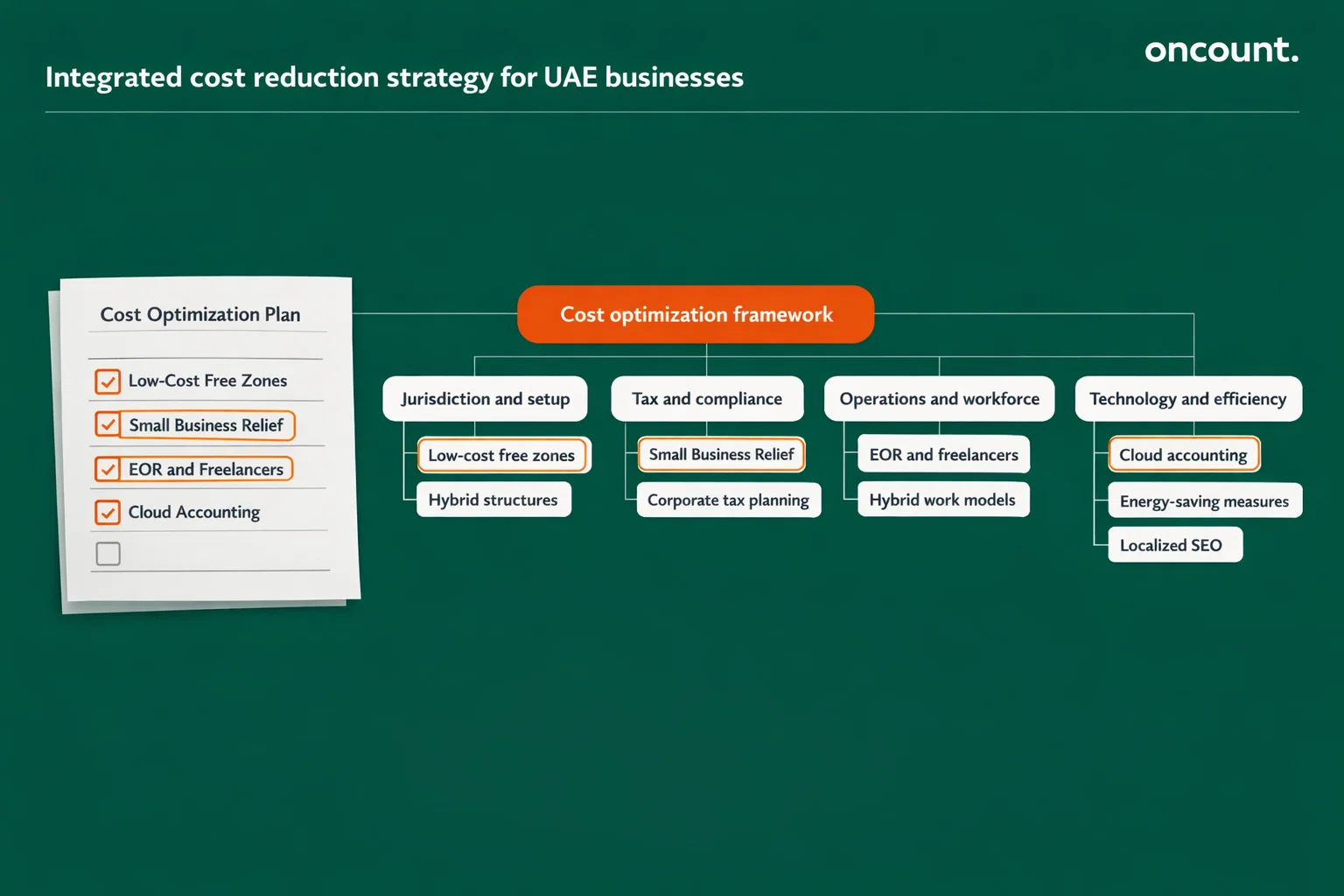
To achieve maximum cost efficiency, enterprises should implement integrated approach addressing jurisdictional selection, fiscal optimization, and operational excellence. Northern Emirate free zones provide initial low-cost setup, but businesses must maintain clear pathway toward Mainland incorporation or hybrid structures if growth involves direct UAE market access or government contracts.
Small businesses must strategically evaluate eligibility for Small Business Relief to maximize current liquidity. Companies should leverage EOR models and specialized mission visas to keep core headcount lean while using shared warehousing and flexi-desk options to minimize real estate costs. Gratuity liabilities should be managed through strategic salary structuring from day one.
Automating finance through cloud-based ERP systems and implementing energy-saving measures approved by DEWA and SEWA are essential for long-term operational sustainability. Localized SEO and government-backed grants provide cost-effective mechanisms for both funding and market expansion.