Strategy: Relocate vs Expand Your Business to Dubai
Before committing to business relocation, entrepreneurs and business owners must determine whether they plan to fully relocate their existing company or establish a UAE entity as an additional hub. This strategic decision shapes every subsequent step in the process.
Understanding Your Options for Business Owners
Full relocation entails closing or winding down the home-country entity and transferring contracts, intellectual property, and operations into a new UAE company. This approach suits businesses ready to make Dubai their primary base.
Expansion represents the more common path for moving a UK business or any international company to the Emirates. The original entity remains active while a UAE subsidiary or sister company serves Middle East, Africa, and Asian markets. This structure allows companies to maintain their existing operations while gaining access to what makes Dubai attractive as a regional business hub.
Representative or branch office functions as an extension of a foreign company, primarily for service delivery or marketing activities. FTA guidance stipulates that such branches carry no separate legal personality, meaning the parent company retains full liability for all operations.
Key Strategic Questions When Planning to Move
Several fundamental considerations determine the optimal approach for relocating your business to Dubai UAE:
- Where are your clients located (local UAE vs international markets)?
- Do you need to trade directly within the UAE mainland market without intermediaries?
- How many staff will physically work in the UAE?
- Do founders and families need to obtain a UAE residency visa?
- What business activities will the Dubai entity conduct?
These questions directly influence jurisdiction choice, licensing requirements, and the overall cost structure of your business setup.
Choosing the Right Business Jurisdiction: Mainland vs Free Zone
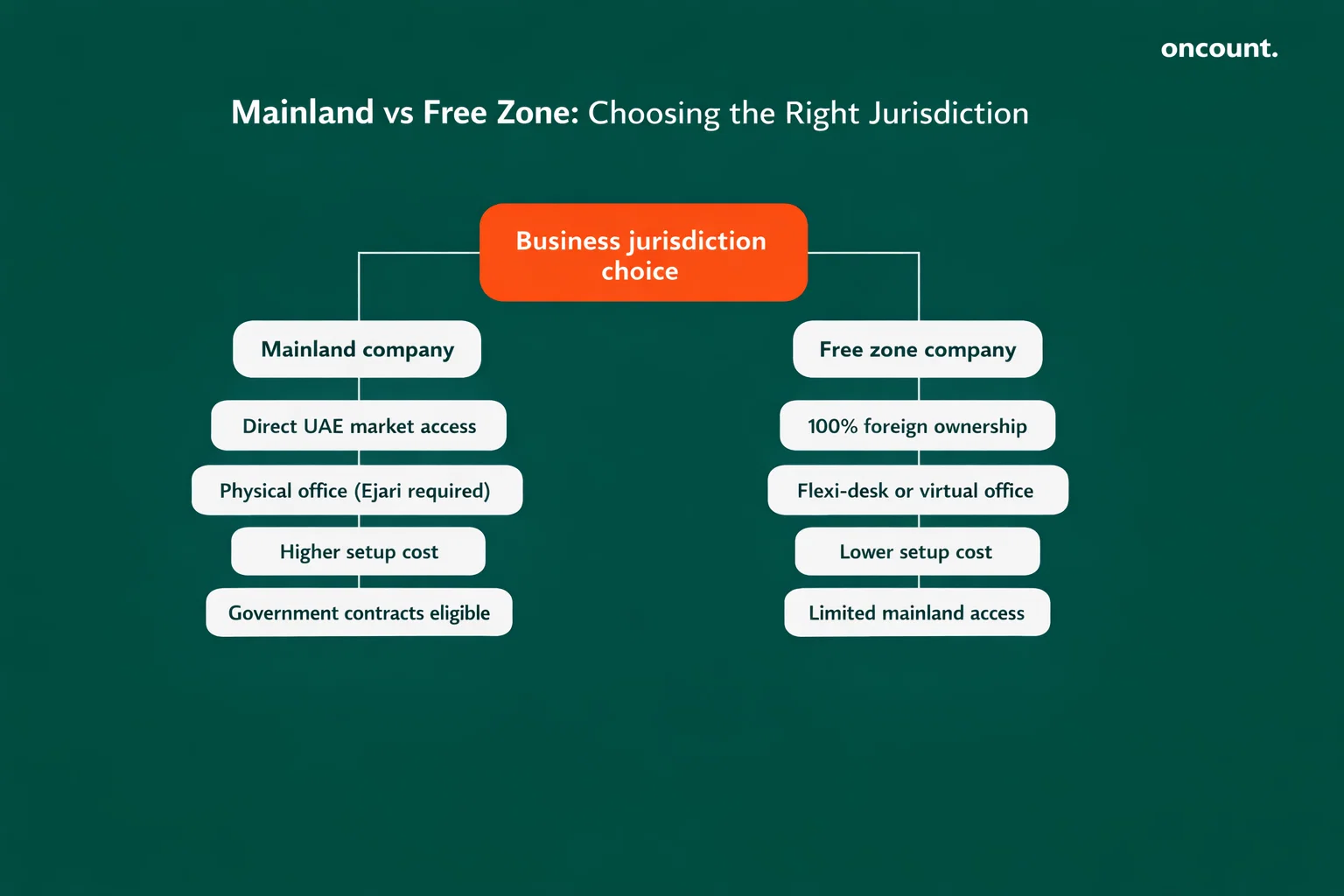
Dubai offers two principal routes for business setup, each with distinct advantages aligned with different business models and market access requirements.
Mainland Business Setup in Dubai
Mainland companies, registered through Dubai Economy and Tourism, gain unrestricted access to the entire UAE market including government contracts. In practice, free zone entities often face restrictions when attempting to serve mainland clients directly.
The mainland structure requires a physical office with a registered Ejari tenancy contract. Setup and ongoing costs typically exceed those of low-cost free zones, with first-year expenses commonly ranging from AED 25,000 to AED 40,000 or more depending on the nature of the business and office requirements.
A trade license in Dubai mainland format provides legitimacy when working with large local corporations and government entities, who often prefer vendors holding mainland licenses. This preference stems from procurement regulations and established local business etiquette.
Free Zone Companies and Their Advantages
Free zone establishment offers 100% foreign ownership without UAE national partners. Each zone operates under its own commercial laws while remaining subject to UAE federal regulations.
Free zones typically offer lower costs, with flexi-desk or virtual office options enabling faster setup. Many zones allow business registration without substantial physical presence, though this approach faces increasing scrutiny under 2026 substance requirements.
The limitation for free zone companies centers on mainland market access. Direct trading within the UAE market may require appointing a local distributor or establishing a mainland branch, adding complexity and cost.
Popular Dubai Free Zones (2026 Snapshot)
Different zones cater to specific sectors and business types:
- DMCC – commodities, trade, crypto, and general trading; one of the largest zones
- DIFC – financial services, fintech, funds, and holding companies
- Meydan Free Zone – low-cost general trading and professional activities
- Dubai Internet City / Media City – IT, digital, media, and marketing
- DAFZA / Dubai Airport Free Zone – logistics and trading linked to DXB airport
Cost Comparison: Mainland vs Free Zone
The following table illustrates typical first-year costs for business setup in Dubai:
| Setup Type | License Cost | Office Requirement | Total First Year |
| Free Zone (basic) | AED 5,750–15,000 | Flexi-desk option | AED 10,000–25,000 |
| Free Zone (premium) | AED 15,000–30,000 | Serviced office | AED 30,000–50,000 |
| Mainland | AED 14,900–27,000 | Physical Ejari office | AED 25,000–40,000+ |
Costs vary significantly depending on your business activities, visa quota needs, and chosen zone or mainland location.
Plan Corporate Structure and Business Activities
Clearly defining what the new UAE entity will do and how it fits within your global structure prevents costly restructuring later.
Choose the Right Legal Form
Typical legal structures include:
- Free Zone FZ-LLC / FZE (single-owner entity) – suited for subsidiaries or independent operations
- Mainland LLC – required for direct mainland market access
- Branch of foreign company – extension of parent without separate legal personality
- DIFC/ADGM special-purpose entities – for regulated financial services
The choice depends on shareholder composition, regulated license requirements, and whether external approvals from authorities such as the Central Bank, Securities and Commodities Authority, or sector regulators are needed.
Determine Business Activities
Use the official activities list of the chosen free zone or mainland authority. Listed activities determine license type (professional, commercial, industrial), mandatory office size, minimum capital requirements, and any external approvals needed.
Selecting activities carefully proves essential. Adding activities later typically requires amendment fees and additional approvals. Conversely, listing activities you do not perform can trigger unnecessary compliance obligations.
Step-by-Step Process to Relocate Your Business to Dubai
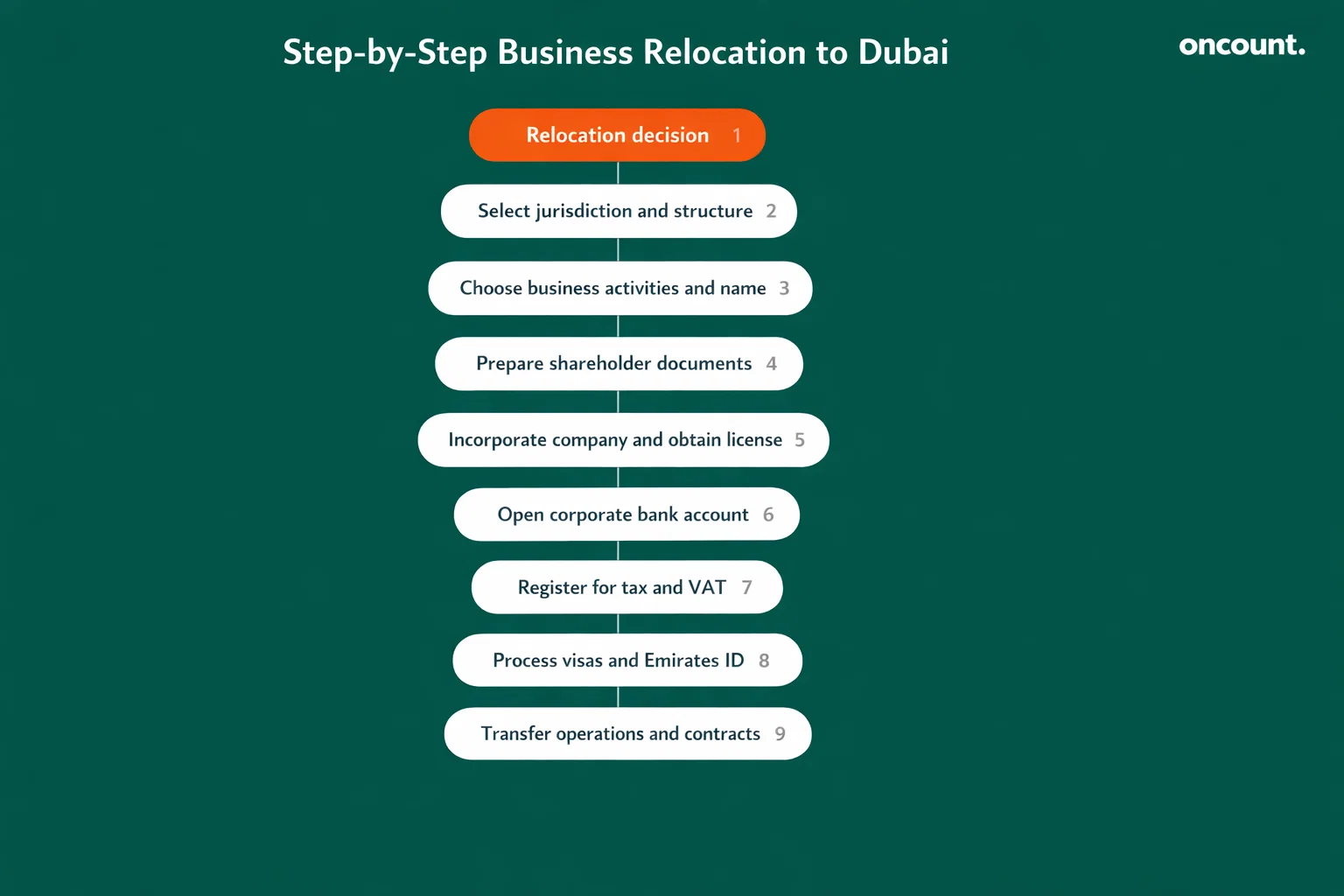
The following sections outline the operational steps for setting up a Dubai entity and migrating operations from your existing business.
Pre-Incorporation Phase (2–4 Weeks)
- Select jurisdiction and zone
Compare three to four free zones or mainland packages based on your business activities, visa needs, and budget. Consider future scalability and whether you plan to trade across the UAE or focus on international markets.
- Choose your trade name
The name must follow UAE naming rules: no offensive terms, religious sensitivity respected, and certain words like “bank” or “insurance” prohibited without regulatory approval.
- Prepare shareholder documents
Gather passport copies, proof of address, and existing company documentation for corporate shareholders (certificate of incorporation, board resolution, shareholder register).
- Engage a corporate service provider
Professional assistance coordinates approvals, immigration processing, and document attestations. This investment typically saves weeks of delays and procedural confusion.
Company Formation (1–3 Weeks)
The exact sequence varies slightly by jurisdiction. The typical flow includes:
- Initial approval
Submit the application with shareholder KYC documentation, proposed name, business activities, and sometimes a detailed business plan outlining revenue projections and operational model.
- Sign incorporation documents
Execute the Memorandum of Association, Articles of Association, and board resolutions for corporate shareholders.
- Lease office space
Mainland requires an Ejari-registered office with typical minimums around 200 square feet. Free zones often allow flexi-desk or smart office arrangements for small teams.
- Trade license issuance
After documents and lease approval, the licensing authority issues the trade license and registration certificates.
Banking and Payments (2–6 Weeks)
Opening a corporate bank account often represents the longest and most challenging step in business relocation to Dubai.
Required documentation includes:
- Trade license and company registration documents
- Memorandum and Articles of Association
- Passport, visa, and Emirates ID for shareholders and authorized signatories
- Office lease or Ejari certificate
- Detailed business plan and expected transaction profile
Bank selection
Local banks (Emirates NBD, Mashreq, First Abu Dhabi Bank) offer comprehensive services but maintain strict onboarding criteria. International banks with UAE branches provide continuity for established relationships. Fintech and electronic money institution alternatives offer faster account opening if traditional banking proves delayed.
KYC and compliance requirements
Banks often require founders to attend onboarding meetings in person Expect requests for proof of real operations including website, contracts, invoices, team composition, and sometimes home-country bank statements demonstrating business activity.
The banking landscape in 2026 reflects heightened AML standards and increased scrutiny of cross-border payments. Some banks now require minimum balance commitments starting from AED 50,000, particularly for new entities without established transaction history.
Tax, VAT and E-Invoicing Setup
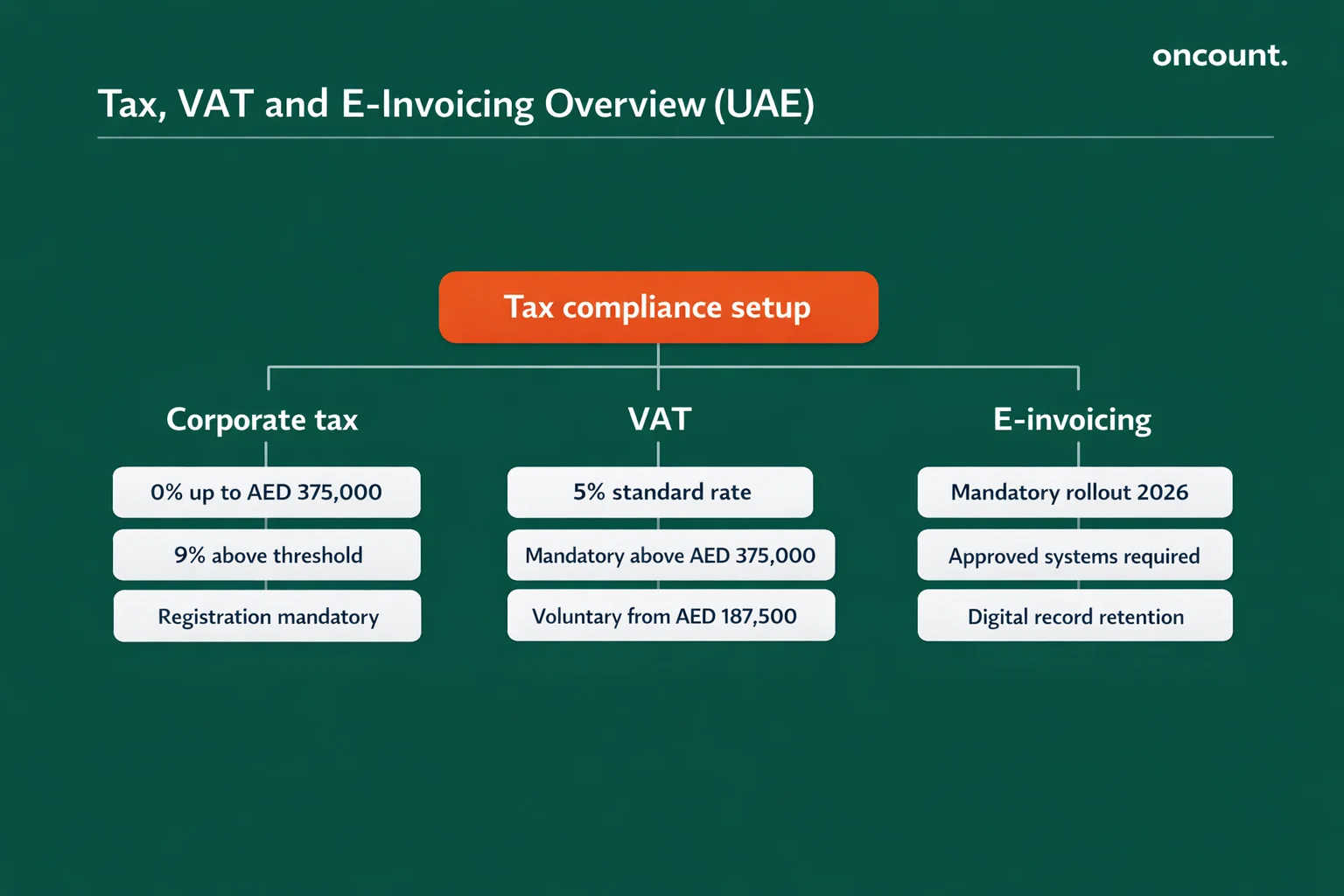
Corporate tax and VAT compliance now affect virtually all UAE entities, including many small businesses and free zone companies.
Corporate tax registration
The UAE corporate tax framework applies a 0% rate on taxable income up to AED 375,000, with a 9% rate on income exceeding this threshold. Free zone entities may qualify for 0% tax on qualifying income if they meet Qualifying Free Zone Person criteria, which require genuine substance, audited accounts, and qualifying business activities.
VAT registration
The standard VAT rate across the UAE stands at 5%. Mandatory registration applies when taxable turnover exceeds AED 375,000 over 12 months, with voluntary registration available from AED 187,500. Registration requires your trade license, bank account or financial proof, and corporate documentation.
E-invoicing compliance (2026)
The UAE is implementing mandatory e-invoicing, with business-to-business and business-to-government phases rolling out through 2026. Businesses must adopt approved invoicing systems and maintain digital records that align with VAT and corporate tax returns.
The following table summarizes key tax thresholds:
| Tax Type | Threshold | Rate | Registration Requirement |
| Corporate Tax | First AED 375,000 | 0% | Mandatory for most entities |
| Corporate Tax | Above AED 375,000 | 9% | Mandatory for most entities |
| VAT (Mandatory) | AED 375,000 annual turnover | 5% | Mandatory registration |
| VAT (Voluntary) | AED 187,500 annual turnover | 5% | Optional registration |
Visas, Immigration and Relocating to Dubai
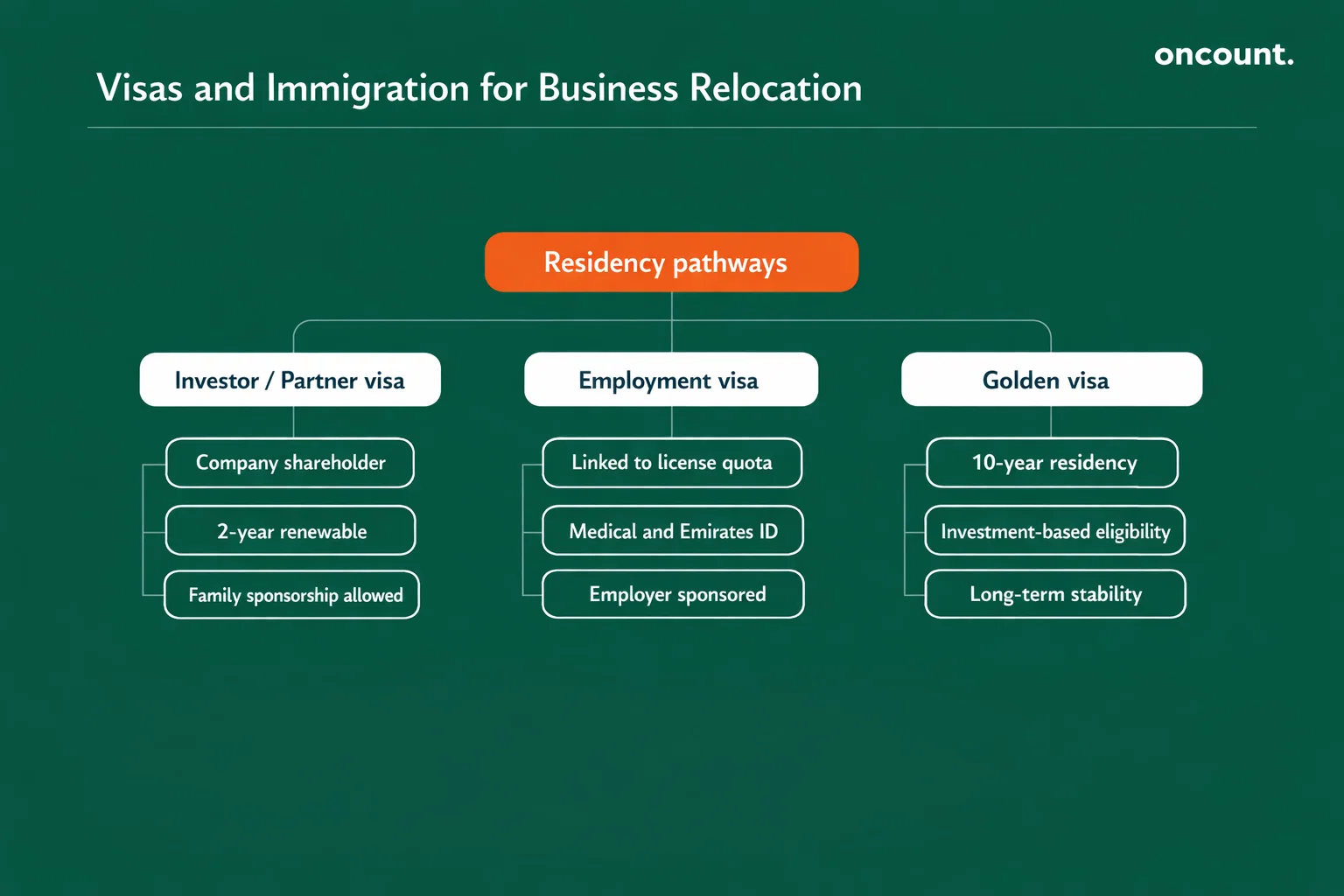
To physically move founders and staff to Dubai, you need residence permits linked to the UAE entity.
Investor and Partner Visa
Shareholders of the UAE company qualify for investor visas, typically valid for two years and renewable. The standard process involves obtaining an entry permit, completing a medical fitness test, providing biometrics for Emirates ID, and receiving visa stamping or digital residence permit.
Investor visas allow holders to sponsor spouses, children, and sometimes parents under specified financial conditions set by immigration authorities.
Employment Visas
Each license package includes a quota of employment visas, linked to office size or package tier. Employers handle work permits, medical examinations, Emirates ID, and residence formalities for each employee relocating to Dubai.
Golden Visa (10-Year Residency)
The Golden Visa program offers long-term residency for qualifying investors, entrepreneurs, high-earning professionals, and property investors. Typical routes include property investment of at least AED 2 million or operating an approved startup meeting specific revenue or investment thresholds.
This longer-term visa provides stability for business owners planning significant operations in Dubai and removes the uncertainty of standard visa renewals.
Office, Operations and Labor Law Compliance
Office Space Requirements
Mainland companies require a mandatory physical office presence with an Ejari tenancy contract. Common minimums start around 200 square feet, with visa quotas often linked to office area using approximately 80 square feet per visa as a guideline in some jurisdictions.
Free zone offices range from flexi-desks and serviced offices to dedicated premises, depending on your chosen package. Visa quotas typically depend on package type rather than square footage in most zones.
UAE Employment Law (2026 Essentials)
The updated UAE labor law applies across the emirates with some free zone variations. Key provisions include:
- Contracts: Fixed-term only, maximum three years, renewable
- Content requirements: Clear specification of salary, allowances, benefits, job role, and working hours
- Working hours: Maximum eight hours daily, 48 hours weekly, with overtime premiums
- Probation: Up to six months permitted
- Annual leave: 30 days paid leave after one year of service
Non-compliance penalties have increased substantially. Serious violations now attract fines reaching hundreds of thousands of dirhams, emphasizing the importance of proper HR structures when operating in the UAE.
Mandatory Insurance
Dubai requires mandatory health insurance for all residents, with employers responsible for employee coverage. Workers’ compensation and public liability insurance are strongly recommended and may be contractually required for certain business dealings.
Regulated professions including law, consulting, and engineering often need professional indemnity cover as a licensing prerequisite or client requirement.
Tax, Accounting and Ongoing Compliance
Accounting and Audit Requirements
Proper bookkeeping and annual financial statements are mandatory. Many free zones now require audited accounts, particularly for entities claiming Qualifying Free Zone Person status for corporate tax purposes.
Businesses must retain invoices and records according to UAE tax law retention periods, typically covering six to seven years from the end of the relevant tax period.
Corporate Tax Compliance
Register with the Federal Tax Authority for corporate tax where required. File corporate tax returns and remit any tax due on time to avoid penalties and interest charges that compound quickly.
VAT Compliance
File VAT returns quarterly or monthly depending on turnover and FTA allocation. Ensure correct output and input VAT treatment across all transactions, and implement compliant e-invoicing systems that meet 2026 technical standards.
2026 Compliance Environment
The business landscape in Dubai and across the UAE reflects enhanced compliance expectations. Implementation of structured e-invoicing and beneficial ownership reporting requirements means authorities now demand clearer proof of substance: active offices, local staff, and genuine business operations rather than shell structures.
Banks and regulators increasingly scrutinize entities lacking visible operations, creating practical pressure beyond mere legal compliance.
Relocating Business Operations to the UAE
Transferring Contracts and Clients
Determine whether clients will contract with the UAE company or remain with the original entity. Update contracts, invoices, and general terms to reflect the UAE entity’s details, tax registration numbers, and governing jurisdiction.
This transition requires careful client communication. Some international clients prefer contracting with EU or UK entities for legal familiarity, while UAE-based clients typically prefer local invoicing to simplify their own VAT compliance.
Moving IP and Assets
If intellectual property including software, trademarks, or brands will transfer to UAE ownership, arrange proper assignment agreements executed in accordance with both home-country and UAE requirements.
Consider where IP should reside from tax and legal perspectives. In many structures, IP remains in a holding jurisdiction while the UAE entity operates under license, providing flexibility for future restructuring or exit.
Staff Relocation
Plan which employees will relocate physically and which continue working remotely. Transition relocating staff to UAE employment contracts with appropriate benefits and allowances, or initiate new UAE contracts.
Arrange relocation packages, schooling guidance, and family visas where applicable. International schools in Dubai offer British, IB, and other curricula, with annual fees ranging from approximately AED 12,000 to AED 60,000 or more per child.
Tax Benefits and Financial Advantages
One compelling reason many entrepreneurs plan to move their company to the UAE centers on favorable tax treatment compared to most Western jurisdictions.
Personal Income Tax
The UAE levies no personal income tax on employment income, business profits, or investment returns for individuals. This creates substantial after-tax income advantages for business owners and employees relocating to Dubai.
Corporate Tax Structure
The 9% corporate tax rate on income exceeding AED 375,000 remains significantly lower than rates in the UK, EU, and most developed markets. Qualifying free zone entities can achieve 0% corporate tax on qualifying income, though substance requirements have strengthened considerably.
Tax Advantages for International Operations
The UAE maintains extensive double taxation treaty networks, facilitating efficient international business operations. The absence of withholding taxes on dividends, interest, and royalties in many circumstances enhances capital efficiency for global business structures.
These tax benefits contribute to what makes Dubai attractive for international entrepreneurs, though tax should never represent the sole consideration. Genuine business substance and commercial rationale remain essential for sustainable operations.
Family and Lifestyle Considerations
Relocating your business to Dubai UAE often involves moving families, which introduces lifestyle factors into business planning.
Education
Dubai offers extensive international school options covering British, American, IB, French, German, and other curricula. School quality varies significantly, and securing places at top-tier institutions requires early application, sometimes years in advance.
Healthcare
The UAE provides high-quality private healthcare typically accessed through employer-sponsored insurance. Medical facilities in Dubai meet international standards, with many doctors trained in Western medical schools.
Housing
The rental market remains active, with typical requirements of one to three months’ rent plus deposit paid upfront. Popular expatriate areas include Dubai Marina, Downtown Dubai, Arabian Ranches, and various villa communities, each offering distinct lifestyle characteristics.
Understanding local business etiquette and cultural norms accelerates integration. While Dubai maintains a cosmopolitan business environment, awareness of Islamic customs, appropriate business dress, and communication styles supports professional relationships.
Exit and Contingency Planning
Even during setup, prudent business owners plan eventual exit scenarios whether through sale, restructuring, or closure.
Business Sale or Restructuring
UAE companies can be sold through share transfers or merged with other entities, subject to free zone or mainland regulatory approval. Professional valuation supports pricing negotiations and tax planning.
Share sale mechanics vary by jurisdiction. Free zone share transfers typically require zone authority approval, while mainland transfers may involve notarization and registration formalities.
Liquidation and Closure
Formal liquidation and deregistration are mandatory. Companies cannot simply cease trading and abandon licenses without completing proper closure procedures.
Typical liquidation steps include:
- Board resolution and appointment of liquidator where required
- Clearance from utilities, landlord, and relevant authorities
- Settlement of all debts and employee end-of-service benefits
- Final VAT and corporate tax returns and FTA deregistration
- Publication of notice period for mainland companies
Proper closure prevents ongoing obligations, potential penalties, and complications for shareholders in future business dealings or visa applications.
Practical Implementation Checklist
Use this sequence when executing your business relocation to Dubai:
- Strategic decision: Determine expansion versus full relocation; select jurisdiction (mainland or free zone)
- Activity planning: Select specific business activities, legal form, and trade name
- Documentation: Prepare shareholder and corporate documents; appoint service provider or PRO
- Application: Submit initial approval and sign incorporation documents
- Office: Secure office space or flexi-desk and obtain Ejari if mainland
- Licensing: Receive trade license and registration certificates
- Banking: Open corporate bank account and establish payment infrastructure
- Tax registration: Register for corporate tax and VAT where applicable; implement accounting and e-invoicing systems
- Immigration: Apply for investor or employment visas and Emirates IDs; arrange family visas as needed
- Operations transfer: Transition contracts, clients, intellectual property, and staff into UAE structure; ensure labor law and insurance compliance
This systematic approach minimizes delays and avoids costly mistakes that arise from incomplete planning.
Understanding the UAE Business Environment
Dubai and the wider UAE present a unique business landscape shaped by rapid development, strong government support for entrepreneurship, and positioning as a gateway between East and West.
Business Regulations and Governance
The UAE business environment combines federal oversight with emirate-level and free zone autonomy. Understanding which regulations apply to your specific setup in Dubai proves essential for compliance.
Federal authorities including the Federal Tax Authority, Ministry of Economy, and Central Bank set overarching frameworks, while Dubai-specific entities such as Dubai Economy and Tourism govern mainland operations. Each free zone maintains its own commercial regulations within federal parameters.
Business Transactions and Market Access
Dubai offers access to a market extending beyond the UAE itself. Businesses use Dubai as a platform for serving the broader GCC, Middle East, Africa, and South Asian markets, leveraging world-class logistics infrastructure and connectivity.
The city’s position as a global business hub stems from its free zone ecosystem, transparent regulatory frameworks relative to regional alternatives, and ability to facilitate cross-border business transactions with relative ease.
Future Business Landscape
The UAE continues evolving its regulatory framework. Recent years have seen introduction of corporate tax, enhanced beneficial ownership reporting, economic substance requirements, and strengthened AML protocols. These changes align UAE standards with international norms while maintaining competitive advantages through efficient implementation and business-friendly interpretation.
Business owners relocating to Dubai should expect this evolution to continue, requiring ongoing attention to regulatory developments and willingness to adapt operational structures as compliance expectations develop.