Key Takeaways
- A real estate company in Dubai requires a trade license from the Department of Economy and Tourism (DET) or a free zone authority, plus RERA registration.
- 100% foreign ownership is permitted on the mainland under Federal Decree-Law No. 32 of 2021.
- All brokers must hold a valid RERA Broker ID issued through the Dubai Real Estate Institute (DREI).
- Executive Council Resolution No. 11 of 2025 allows free zone companies to operate on the mainland without a redundant corporate structure.
- Total startup investment typically ranges from AED 150,000 to AED 250,000 depending on jurisdiction, office size, and team headcount.
- The Trakheesi system requires a permit for every property advertisement, with fines of up to AED 50,000 per violation.
- Corporate tax applies at 9% on taxable profits exceeding AED 375,000 under the UAE Corporate Tax Law (effective June 2023).
Why Start a Real Estate Business in Dubai
Dubai offers a combination of structural advantages that few global markets can replicate for real estate entrepreneurs. The emirate operates under a 0% personal income tax regime, provides a geographically strategic location bridging European and Asian capital flows, and has consistently ranked among the top five cities globally for real estate investment volume.
The Dubai Economic Agenda (D33) targets a doubling of Dubai’s GDP by 2033, with the real estate sector designated as a primary growth driver. Rental yields in prime districts such as Business Bay, Dubai Marina, and Jumeirah Village Circle range from 6% to 9% annually — significantly above comparable markets in London, New York, or Singapore.
The UAE’s ease of doing business reforms, including digital company registration, online RERA certification, and the integration of free zone and mainland licenses, have lowered operational barriers for new entrants. Combined with the 10-year Golden Visa program — available to property investors committing AED 2 million or more — Dubai continues to attract a growing base of investor-residents who require professional real estate services.
Market Opportunities for Real Estate Companies in Dubai
Dubai’s real estate sector encompasses a wide range of business activities beyond traditional residential brokerage. Understanding the segments within the market is essential for positioning a new company effectively.
- Residential Brokerage remains the most accessible entry point. The secondary market for apartments and villas generates thousands of transactions monthly, with the DLD recording over 180,000 real estate transactions in 2024 alone.
- Off-Plan Sales represent a high-growth segment. Dubai-based developers including Emaar, Nakheel, and DAMAC regularly launch projects requiring extensive sales networks. Brokerage firms with certified agents earn commissions typically ranging from 2% to 5% of the unit value.
- Commercial Real Estate encompasses office leasing, retail unit sales, and industrial warehouse transactions — a segment driven by the expanding base of foreign companies registering in Dubai.
- Property Management is one of the fastest-growing service categories. As the expatriate investor base expands, demand for third-party portfolio management — rent collection, maintenance coordination, and Ejari registration — has increased substantially.
- Real Estate Consulting and Valuation serves institutional clients, banks, and high-net-worth investors requiring technical appraisals and market intelligence. These activities carry higher certification thresholds but command premium fee structures.
Key Jurisdictions for Real Estate Business Setup in the UAE
Selecting the right jurisdiction is the first strategic decision when setting up a real estate company in Dubai. Three primary options exist, each with distinct regulatory and operational implications.
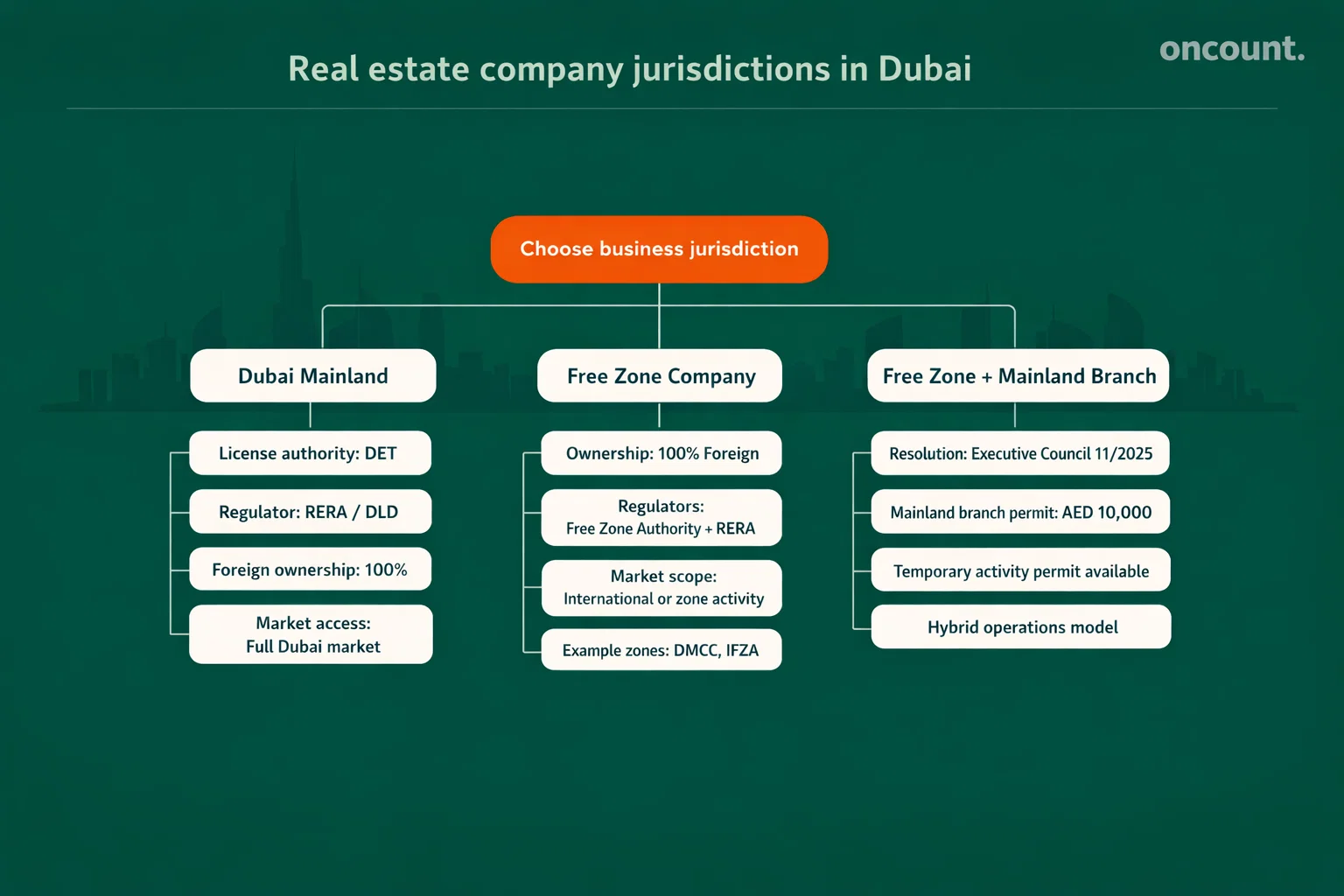
| Jurisdiction | Foreign Ownership | Market Access | Regulatory Body | Typical Use Case |
| Dubai Mainland (DET) | 100% (post-2021) | Unrestricted Dubai market | DET + RERA | Brokerage, management, development |
| Free Zone (e.g., DMCC, IFZA) | 100% | International or zone-specific | Free Zone Authority + RERA | International marketing, investment holding |
| Free Zone + Mainland Branch (Resolution 11/2025) | 100% | Full mainland access | DET + Free Zone Authority | Hybrid operations |
Mainland companies licensed by the Dubai Department of Economic Development (now operating as the Department of Economy and Tourism) have unrestricted access to the local property market, can open multiple branches, and are eligible for government tender participation. A mainland real estate brokerage license costs between AED 17,000 and AED 21,000 annually.
Free zone companies in jurisdictions such as DMCC or IFZA historically could not directly broker mainland properties. However, Executive Council Resolution No. 11 of 2025 introduced a formal pathway for free zone entities to obtain a mainland branch license (AED 10,000) or a temporary activity permit (AED 5,000 for up to six months), enabling full onshore operations without establishing a separate mainland entity.
Types of Licenses Required for a Real Estate Business in Dubai
A real estate license in Dubai is activity-specific. The DLD and RERA require companies to hold licenses that precisely match their intended business activities. Misclassification of activities is a common compliance error that results in regulatory penalties.
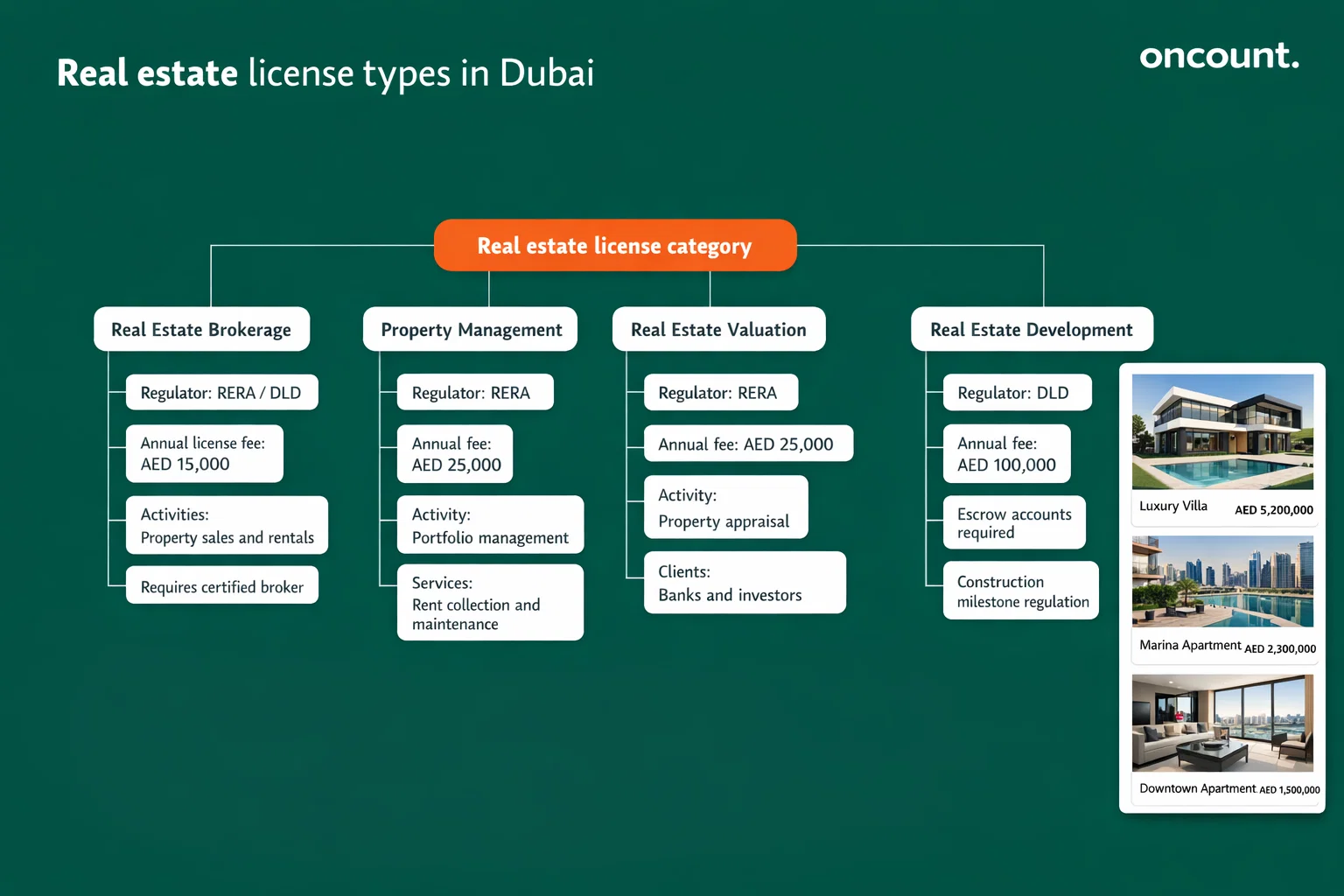
| Activity Type | Regulatory Body | Annual License Fee (AED) |
| Real Estate Brokerage (Sale & Purchase) | RERA / DLD | 15,000 |
| Real Estate Brokerage (Rental) | RERA / DLD | 15,000 |
| Property Management (Third-Party) | RERA / DLD | 25,000 |
| Real Estate Valuation | RERA / DLD | 15,000 |
| Mortgage Consultancy | RERA / DLD | 15,000 |
| Real Estate Development | RERA / DLD | 100,000 |
Real Estate Brokerage License is the standard entry-level license for firms facilitating property transactions. It requires at least one RERA-certified broker on staff and a registered physical office under the Ejari system.
Property Management License for third-party portfolios carries a higher fee and stricter financial reporting obligations. Firms managing owner-occupied portfolios under a “Private Real Estate Leasing and Management” classification operate under a separate, lower-cost license structure.
Real Estate Development carries the highest fee and regulatory burden, including mandatory escrow account management under Law No. 8 of 2007 and phased fund-release requirements tied to verified construction milestones.
Legal Structures Suitable for a Real Estate Business in the UAE
The legal structure of a real estate company in Dubai determines liability, governance, and administrative requirements. Three principal structures apply to mainland entities.
Limited Liability Company (LLC) is the most common structure for real estate brokerage and management firms. An LLC limits each partner’s liability to their share value, accommodates multiple shareholders, and is eligible for all RERA-regulated activities. Under Federal Decree-Law No. 32 of 2021, foreign nationals can hold 100% of an LLC engaged in real estate activities, removing the historical requirement for a UAE national majority shareholder.
Sole Establishment suits individual practitioners who wish to operate independently under their own name. This structure carries unlimited personal liability and is typically chosen by experienced brokers transitioning to independent operations.
Civil Company is appropriate for professional advisory firms offering real estate consultancy or valuation services. Civil companies require a local service agent to facilitate government interactions but are otherwise straightforward to administer.
For free zone entities, the Free Zone Limited Liability Company (FZ-LLC) is standard, offering 100% foreign ownership within the zone’s legal framework, with the option to extend mainland operations under Resolution No. 11 of 2025.
Step-by-Step Process to Start a Real Estate Company in Dubai
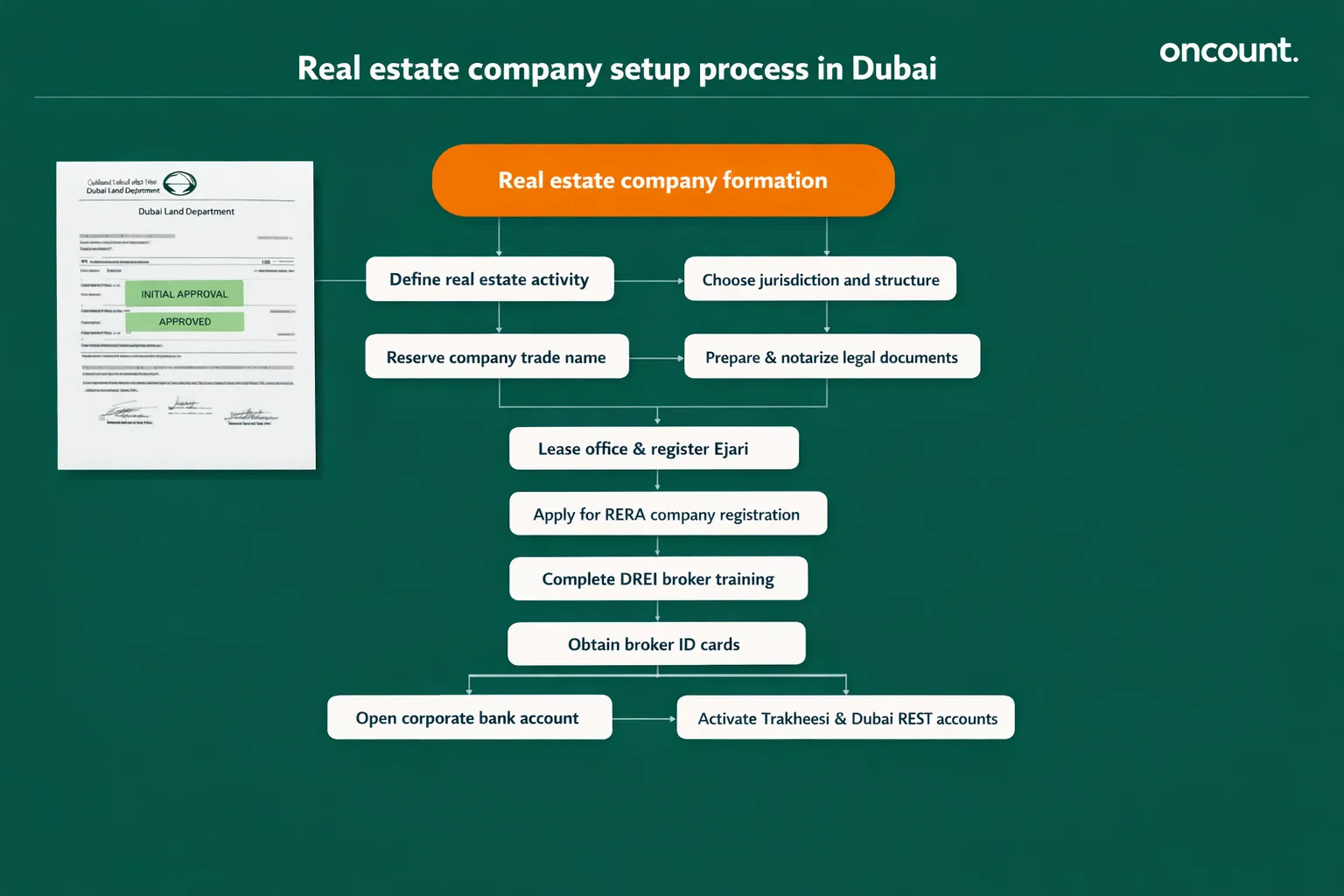
Step 1: Define Your Business Activity and License Type
Identify the specific real estate activities the company will conduct. RERA classifies activities in granular detail, and the trade license must reflect each intended service. Mixing unlicensed activities with licensed ones constitutes a regulatory violation.
Step 2: Select the Jurisdiction and Legal Structure
Determine whether a mainland DET license, a free zone license, or a hybrid structure under Resolution No. 11 of 2025 best serves the company’s market access requirements. Mainland structures offer broader operational scope; free zones offer administrative flexibility and simplified setup timelines.
Step 3: Reserve the Trade Name
Submit a trade name application through the DET’s online portal or the relevant free zone authority. The name must not conflict with existing registered entities and must comply with UAE naming conventions — religious references, geopolitical terms, and certain titles are prohibited. Trade name reservation costs approximately AED 620.
Step 4: Obtain Initial Approval
Initial approval from the DET confirms that the proposed business activities are permissible under UAE law. This approval costs approximately AED 120 and is a prerequisite for proceeding with document submission.
Step 5: Prepare and Notarize Legal Documents
Required documentation includes the Memorandum of Association (MOA) for LLCs, passport copies of all shareholders, residency visa copies (or entry stamps for new applicants), and a No Objection Certificate (NOC) if any shareholder is employed in the UAE. The MOA must be notarized at a UAE Notary Public.
Step 6: Secure a Registered Office and Ejari Registration
A physical commercial office is mandatory for mainland real estate companies. The office must be registered through the Ejari system, the DLD’s tenancy contract digitization platform. Office size directly determines the company’s visa quota allocation — a 200–240 sq. ft. office supports 2–3 employee visas, while spaces exceeding 2,000 sq. ft. support 25 or more.
Step 7: Submit the RERA Registration Application
Following trade license issuance, the company must register with RERA through the Trakheesi portal. This involves uploading the trade license, tenancy contract, and details of all certified brokers employed by the firm.
Step 8: Obtain Broker ID Cards for All Agents
Each employee engaging in real estate transactions must hold a valid RERA Broker ID. This requires completing the DREI “Certified Training for Real Estate Brokers” (a mandatory four-day program) and passing the RERA written examination. Exam fees range from AED 3,200 for degree holders to AED 15,750 for applicants without formal qualifications. A RERA processing fee of AED 3,520 applies to all categories.
Step 9: Open a Corporate Bank Account
Corporate banking for real estate companies in the UAE involves rigorous KYC procedures. Banks classify real estate firms as higher-risk due to large capital flows. Required documentation includes a 12-month cash-flow forecast, signed listing contracts or Letters of Intent, a comprehensive Anti-Money Laundering (AML) policy, and Ultimate Beneficial Owner (UBO) declarations as mandated under UAE Cabinet Resolution No. 58 of 2020.
Step 10: Activate Trakheesi and Dubai REST Accounts
The company’s full operational status is confirmed upon activation of its Trakheesi account and Dubai REST profile. All property listings, permit applications, and broker card renewals are managed through these platforms. Every property advertisement requires a unique Trakheesi permit number, linked to a signed Form A marketing agreement from the property owner.
Documents Required to Register a Real Estate Company in Dubai
| Document | Purpose | Issuing Authority |
| Passport copies (all shareholders/directors) | Identity verification | N/A |
| UAE residency visa or entry stamp | Residency status | UAE Immigration |
| Memorandum of Association (notarized) | Legal structure formalization | UAE Notary Public |
| Trade name reservation certificate | Name approval | DET / Free Zone Authority |
| Initial approval certificate | Activity permission | DET |
| Tenancy contract (Ejari-registered) | Office proof | DLD Ejari System |
| Good Conduct Certificate | Criminal record clearance | Dubai Police (AED 200) |
| DREI training completion certificate | Broker certification eligibility | Dubai Real Estate Institute |
| RERA exam pass certificate | Broker qualification | RERA |
| AML policy document | Banking and RERA compliance | Internal / Legal Advisor |
Cost of Starting a Real Estate Business in Dubai
The cost to start a real estate company in Dubai depends on jurisdiction, office location, team size, and the range of licensed activities. The following table outlines the primary cost components for a mainland brokerage.
| Cost Component | Estimated Amount (AED) | Frequency |
| Trade License (DET) | 12,000 – 20,000 | Annual |
| Trade Name Reservation | 620 | One-time |
| Initial Approval Certificate | 120 | One-time |
| RERA Broker Training and Exam (per employee) | 3,000 – 6,000 | Per employee |
| RERA Processing Fee (per broker) | 3,520 | Per employee |
| Office Rent (Business Bay / Downtown) | 40,000 – 80,000 | Annual |
| Ejari Registration | ~220 | Annual |
| AI Compliance Audit Fee | 2,100 | Per license cycle |
| RERA Smart Training Suite | 4,500 | Annual |
| Professional Indemnity Insurance | ~2,500 | Annual |
| Visa Processing (per employee) | 3,000 – 7,000 | Per employee |
| Good Conduct Certificate | 200 | Per broker |
| Initial Marketing Budget | 50,000+ | First year |
A well-capitalized real estate startup in Dubai should budget between AED 150,000 and AED 250,000 for the first year of operations. It is worth noting that the DLD abolished the previously mandatory AED 5,000 bank guarantee for brokerage firms in 2024, reducing the initial capital burden for new entrants.
Regulatory Compliance Requirements for Real Estate Businesses
RERA Advertising Compliance via Trakheesi Every property advertisement — whether published on portals such as Bayut or Property Finder, distributed via SMS, or displayed at a promotional stand — must carry a valid Trakheesi permit number. The annual permit fee is AED 1,020 per advertising category. Advertising without a permit, or listing properties without a signed Form A agreement from the owner, constitutes a violation. As of late 2024, the DLD imposes fines of AED 50,000 per violation, with repeat infractions subject to doubled penalties and potential license suspension.
Anti-Money Laundering (AML) Obligations Under UAE Federal Decree-Law No. 20 of 2018 on AML and Cabinet Decision No. 10 of 2019, real estate companies are classified as Designated Non-Financial Businesses and Professions (DNFBPs). This classification requires firms to maintain a formal AML compliance program, conduct customer due diligence (CDD) on all transaction parties, report suspicious transactions to the UAE Financial Intelligence Unit (FIU) via the goAML platform, and retain transaction records for a minimum of five years.
Economic Substance Regulations (ESR) Real estate holding companies and certain management entities may be subject to ESR under Cabinet Resolution No. 57 of 2020. Firms must demonstrate that their core income-generating activities are conducted in the UAE, that an adequate number of qualified employees are based locally, and that operating expenditures are proportionate to the business volume. Annual ESR notifications and reports must be filed through the Ministry of Finance’s ESR portal.
Ultimate Beneficial Owner (UBO) Registration All UAE-registered companies, including real estate firms, must maintain an accurate UBO register in accordance with Cabinet Decision No. 58 of 2020. UBO information must be filed with the relevant licensing authority and updated within 15 days of any change in beneficial ownership.
Taxation Rules for Real Estate Companies in the UAE
UAE Corporate Tax The UAE Corporate Tax Law (Federal Decree-Law No. 47 of 2022) applies to real estate companies with a financial year beginning on or after June 1, 2023. The Federal Tax Authority (FTA) administers corporate tax registration and filing through the EmaraTax platform.
- 0% rate applies to taxable income up to AED 375,000.
- 9% rate applies to taxable income exceeding AED 375,000.
- Qualifying free zone entities may benefit from a 0% rate on qualifying income, provided they meet substance requirements and do not derive income from mainland UAE sources above permitted thresholds.
Real estate companies must maintain audited financial statements prepared under International Financial Reporting Standards (IFRS) to support accurate tax determination, as stipulated in the UAE Ministry of Finance Corporate Tax Guide (2023).
Value Added Tax (VAT) VAT registration is mandatory for real estate businesses whose taxable supplies and imports exceed AED 375,000 annually. The Federal Tax Authority requires VAT-registered entities to file returns quarterly or monthly, depending on their tax group classification.
In the real estate context:
- Brokerage commissions are subject to VAT at 5%.
- Residential property rentals are generally exempt from VAT.
- Commercial property rentals and sales are subject to VAT at 5%.
- First-time sales of residential properties may qualify for zero-rating.
Corporate Banking for Real Estate Companies in Dubai
Opening a corporate bank account for a real estate company in Dubai involves a structured KYC process. UAE banks categorize real estate firms as higher-risk entities due to the volume and nature of capital flows associated with property transactions. Standard documentation requirements include:
- Notarized Memorandum of Association and trade license
- Passport copies and Emirates IDs of all shareholders and authorized signatories
- Proof of registered office (Ejari contract)
- 12-month projected cash-flow statement
- AML and Compliance Policy document
- UBO declaration aligned with Cabinet Decision No. 58 of 2020
- Signed property listing agreements or Letters of Intent to demonstrate operational activity
Major UAE banks serving real estate companies include Emirates NBD, Abu Dhabi Commercial Bank (ADCB), Mashreq Bank, and First Abu Dhabi Bank (FAB). Account opening timelines typically range from two to six weeks, depending on the bank’s internal compliance review.
Industry-Specific Regulations for Real Estate Companies in Dubai
RERA Broker Certification and the Broker ID System
Every individual conducting real estate transactions in Dubai must hold a valid RERA Broker ID (Real Estate Practice Card). Freelance or independent brokerage is prohibited — each broker must be formally sponsored by a RERA-registered agency, which assumes regulatory accountability for the broker’s conduct. The agency’s Office Registration Number (ORN) is publicly linked to each Broker Registration Number (BRN) in the DLD’s database.
Broker IDs are renewed annually and require completion of Continuing Professional Development (CPD) courses administered by DREI. Failure to renew constitutes unlicensed practice and exposes both the broker and the sponsoring firm to regulatory sanctions.
Off-Plan Development Escrow Requirements
Real estate companies entering the development sector are subject to Law No. 8 of 2007, which mandates that every off-plan project maintain a dedicated escrow account with a RERA-approved bank. Developer access to buyer funds is conditional on verified construction milestones:
| Milestone | Fund Release (%) |
| Foundation Completion | 20% |
| Structural Completion | 30% |
| Internal Finishes Completion | 30% |
| Final Handover | 20% |
Developers must achieve a minimum of 20% physical construction progress, or deposit an equivalent bank guarantee, before commencing marketing or sales. Independent engineering audits verify each milestone before fund release is authorized.
Tenancy Law and Property Management Operations
Real estate companies offering property management services must navigate the legal framework governing landlord-tenant relations. All tenancy contracts must be registered via the Ejari system to be legally enforceable. Rent increases are regulated by the RERA Rent Increase Calculator, which references the RERA Rental Index. Disputes between landlords and tenants are adjudicated by the Rental Dispute Center (RDC), a specialized tribunal operating under the DLD.
AI Compliance and PropTech Integration
The DLD’s “Paperless” strategy, implemented progressively since 2023, requires real estate firms to pass AI Compliance Audits verifying that their digital listings and data handling practices meet prescribed standards. Companies are assessed on the accuracy of their Trakheesi listings, data security practices, and alignment with the Dubai Data Law (Law No. 26 of 2015). Firms investing in PropTech infrastructure — including blockchain-based title verification, automated valuation models, and virtual property tour capabilities — demonstrate a stronger compliance posture and gain competitive advantage in attracting international investors.
Advantages of Establishing a Real Estate Company in Dubai
- 100% foreign ownership on the mainland eliminates the historical need for local majority partners.
- Tax-efficient environment with 0% personal income tax and a 9% corporate tax applicable only above AED 375,000 in profits.
- High rental yields of 6%–9% in prime districts sustain strong investor demand for brokerage and management services.
- Golden Visa linkage creates a stable base of investor-residents requiring ongoing professional property services.
- Digital governance infrastructure via Trakheesi and Dubai REST provides real-time compliance tools and transaction verification.
- Strategic geographic position makes Dubai the natural hub for cross-border real estate investment across the GCC, Africa, and South Asia.
- D33 agenda commitment ensures continued government investment in real estate-related infrastructure and incentives through 2033.
Common Challenges When Starting a Real Estate Business in Dubai
Corporate banking delays represent the most common operational bottleneck. UAE banks conduct multi-week KYC reviews for real estate entities. Incomplete AML documentation or insufficient cash-flow projections are the primary causes of account rejection or delay.
RERA examination failure rates remain a meaningful filter. Non-degree holders face a substantially higher exam fee (AED 6,300–15,750) and a more demanding testing standard, requiring dedicated preparation through DREI or approved partner institutes.
Trakheesi permit non-compliance continues to affect new entrants unfamiliar with the mandatory advertising regime. Every listing requires a permit, and the automated Madmoun QR verification system detects unlicensed advertisements in near-real time.
Office size limitations can constrain early growth. The MOHRE visa quota system ties team expansion directly to floor space, making undersized offices a bottleneck for firms seeking to scale quickly.
Free zone-to-mainland transition complexity has been reduced by Resolution No. 11 of 2025, but firms must still maintain separate financial records for mainland activities and comply with joint audit requirements from both the DET and the free zone authority.