Key Takeaways
- VARA is the primary regulator for crypto businesses in Dubai operating on the mainland and in most free zones
- The licensing process follows a mandatory two-stage structure: Approval to Incorporate (ATI), then the Full VASP License
- Paid-up capital requirements range from AED 100,000 for advisory activities to AED 1,500,000 for self-custody exchanges
- The DIFC (regulated by the DFSA) and ADGM (regulated by the FSRA) offer English common law alternatives for institutional operators
- VAT on virtual asset transactions has been formally eliminated, with retroactive effect from January 1, 2018
- The UAE corporate tax rate of 9% applies to profits exceeding AED 375,000, with free zone exemptions available under qualifying criteria
- Banking onboarding for crypto companies in the UAE typically takes 6–12 months through traditional banks; EMIs offer faster alternatives
Why Start a Crypto Business in Dubai
Dubai offers a combination of regulatory clarity, tax efficiency, and institutional infrastructure that few jurisdictions can match. The UAE government has made a deliberate and sustained effort to position the emirate as a global hub for cryptocurrency businesses, blockchain innovation, and digital asset trading.
Federal Decree Law No. 6 of 2025 brought payment-related virtual asset services under the supervisory authority of the UAE Central Bank, creating a “dual-key” regulatory system that reinforces systemic stability while preserving space for innovation at the emirate level. VARA, formally recognized by the UAE Ministry of Finance under Ministerial Decision No. (336) of 2025, now serves as the primary interlocutor between regulated crypto companies and the federal tax system.
The UAE’s zero personal income tax environment, combined with a 0% free zone corporate tax rate for qualifying entities, makes Dubai a financially efficient base for crypto trading operations. Strategic access to capital markets in Asia, Europe, and the Gulf Cooperation Council further reinforces Dubai’s value proposition for any crypto company seeking international reach.
Market Opportunities for Crypto Companies in Dubai
Dubai’s virtual asset market has transitioned from an experimental early-stage environment into a mature financial sector. Institutional adoption of digital assets is accelerating, with licensed custodians, regulated exchanges, and tokenized real-world assets (RWAs) forming the pillars of the next phase of growth.
The UAE government’s development of the “AE Coin,” a UAE dirham-backed stablecoin, signals an imminent integration of digital assets into retail payment infrastructure. This will expand the addressable market for crypto exchange operators, payment processors, and DeFi-adjacent businesses operating under a VARA license.
VARA’s March 2026 market alert against Kucoin for serving Dubai residents without authorization demonstrates active enforcement — confirming that licensed operators benefit from a significantly reduced competitive threat from unregulated foreign platforms. For compliant crypto businesses in Dubai, this enforcement posture creates a durable market advantage.
The DMCC Crypto Centre, housed within the Dubai Multi Commodities Centre free zone, has attracted over 600 crypto and Web3 companies and continues to grow as the preferred ecosystem for blockchain and cryptocurrency businesses seeking a free zone base with sector-specific support.
Key Jurisdictions for Crypto Business Setup in the UAE
Choosing the right jurisdiction is the single most consequential structural decision when you set up a crypto business in Dubai. Each authority has distinct regulatory philosophies, legal systems, and target audiences.
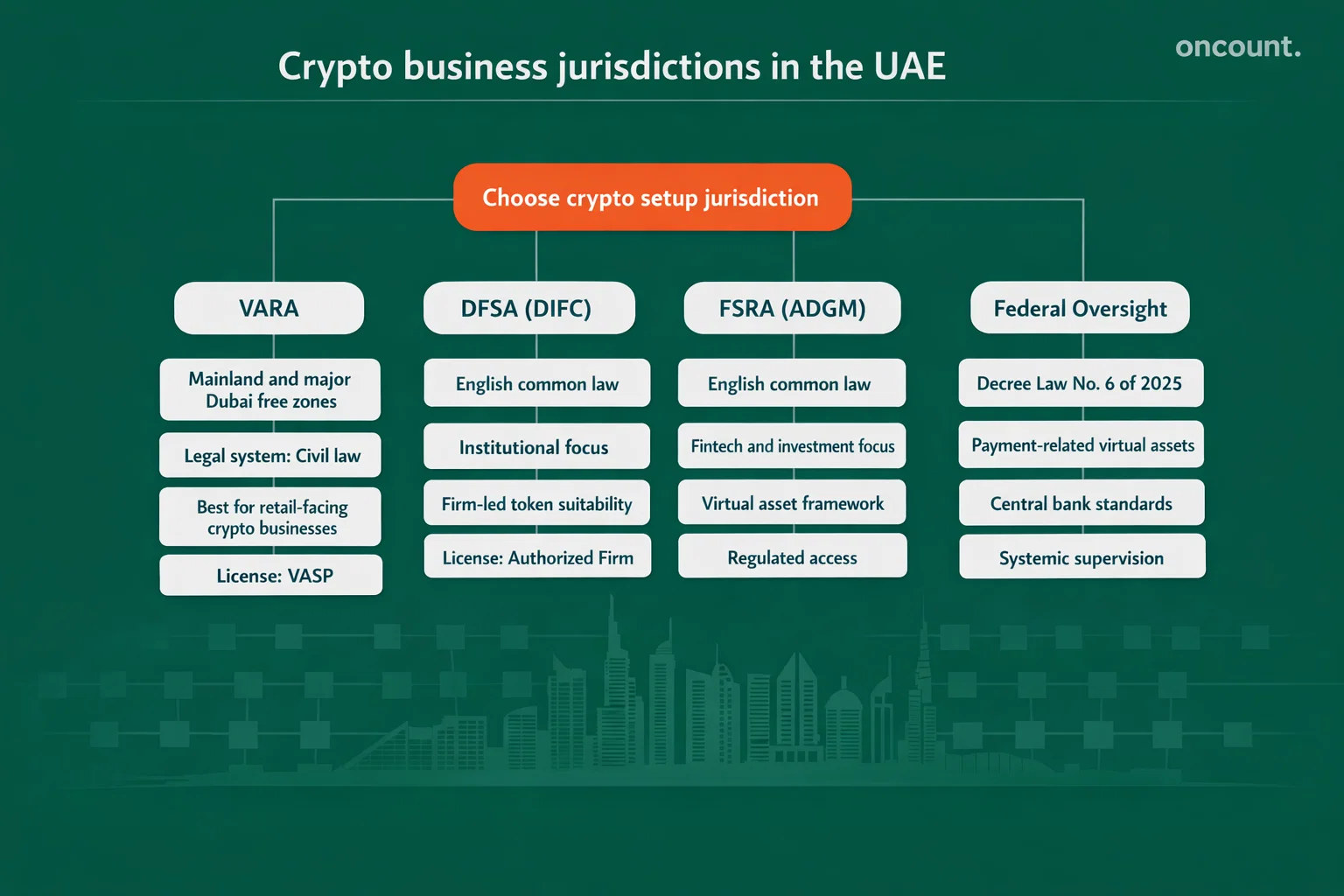
| Regulatory Metric | VARA (Onshore / Free Zones) | DFSA (DIFC) | FSRA (ADGM) | SCA (Federal) |
| Primary Legislation | Law No. 4 of 2022 | DFSA Crypto Regime | FSRA Regulations 2018 | Decree Law 6 of 2025 |
| Legal System | Civil Law | English Common Law | English Common Law | Civil Law |
| Mandatory License | VASP License | Authorized Firm (Crypto) | FSP (Virtual Assets) | Federal VASP License |
| Custody Rule | 95% Cold Storage | Strict Asset Segregation | Tier-1 Safeguarding | Central Bank Standards |
| Retail Trading | Permitted with Protection | Institutional Focus | Regulated Access | Federal Oversight |
VARA is the most appropriate regulator for retail-facing platforms, innovative crypto exchanges, and broker-dealers targeting a broad consumer base. Its digital-first framework, combined with the operational ecosystem of free zones like the DMCC Crypto Centre and the Dubai World Trade Centre (DWTC), makes it the dominant choice for most crypto business setups in Dubai.
DFSA (DIFC) suits institutional operators, global banks, and asset managers who require the legal certainty of English common law. As of January 12, 2026, the DFSA shifted to a firm-led token suitability model, requiring licensed entities to conduct and document their own assessment of every token they list or offer.
FSRA (ADGM) in Abu Dhabi mirrors the common law approach of the DIFC and is particularly aligned with fintech innovation and regulated investment management.
Types of Licenses Required for a Crypto Trading Business in Dubai
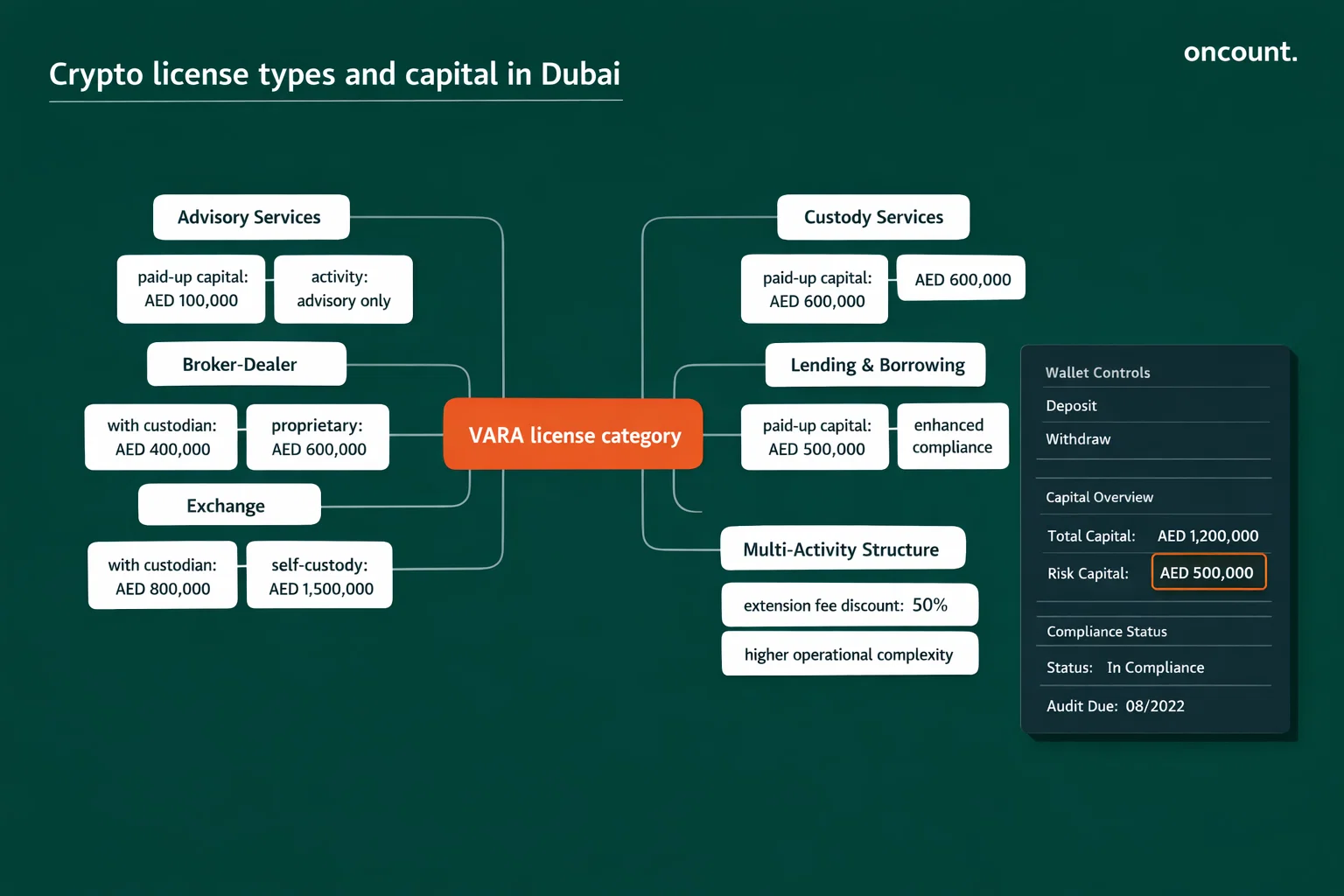
A crypto license in Dubai is not a single document but a category-specific authorization issued by VARA. The license categories directly determine the activities a firm can conduct, the capital it must hold, and the rulebooks it must follow.
| Licensed Activity | Base Paid-Up Capital (AED) | Alternative Metric |
| Advisory Services | 100,000 | N/A |
| Broker-Dealer (with Custodian) | 400,000 | 15% of annual fixed overhead |
| Broker-Dealer (Proprietary) | 600,000 | 25% of annual fixed overhead |
| Exchange (with Custodian) | 800,000 | 15% of annual fixed overhead |
| Exchange (Self-Custody) | 1,500,000 | 25% of annual fixed overhead |
| Custody Services | 600,000 | 25% of annual fixed overhead |
| Lending/Borrowing | 500,000 | 25% of annual fixed overhead |
Firms combining multiple activities — for example, operating both a crypto exchange and a custody service — benefit from a discounted “License Extension Fee” of 50% of the standard application fee for each additional license category. A firm holding both exchange and custody licenses would pay AED 150,000 in application fees rather than the full rate for each.
Proprietary trading entities that operate exclusively with their own or group capital, without client funds, are not required to obtain a full VASP license. However, any proprietary trader with a 30-day rolling trading volume exceeding USD 250 million must register with VARA and comply with applicable reporting requirements.
Legal Structures Suitable for a Crypto Business in the UAE
Virtual asset businesses in the UAE are most commonly established as one of three legal structures:
- Free Zone Limited Liability Company (FZ-LLC): The preferred structure for most crypto businesses in Dubai. Available through free zones such as the DMCC, DWTC, and Dubai Silicon Oasis. Offers 100% foreign ownership and access to VARA licensing.
- Mainland LLC: Allows direct engagement with UAE residents and businesses without free zone restrictions. Subject to VARA oversight and Dubai Department of Economy and Tourism (DET) registration.
- Branch of a Foreign Company: Suitable for established international crypto firms seeking a regulated Dubai presence. Requires parent company documentation and is subject to additional due diligence by VARA.
Free zone structures are strongly preferred due to their ability to qualify for the 0% corporate tax rate under the Qualifying Free Zone Person (QFZP) criteria, provided the entity maintains genuine economic substance within the free zone and limits qualifying income from UAE mainland sources.
Step-by-Step Process to Start a Crypto Trading Company in Dubai
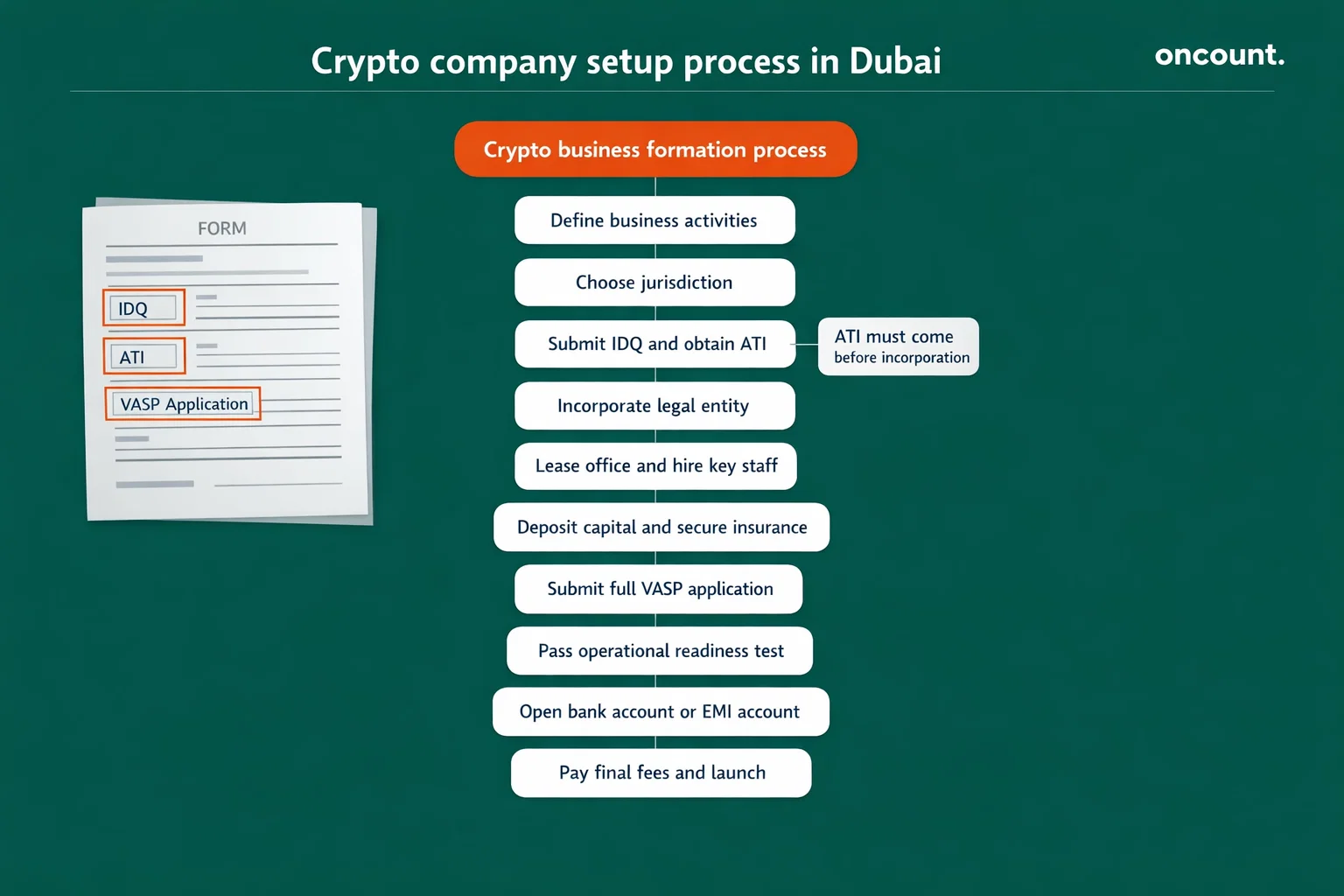
Step 1: Define Business Activities and License Categories
Before any application is submitted, founders must identify the precise license categories they require. The business model determines capital thresholds, rulebook obligations, and the appropriate jurisdiction. Mixing exchange and advisory activities in a single entity requires careful structuring to avoid regulatory ambiguity.
Step 2: Select the Jurisdiction
Choose between VARA (mainland or free zone), DFSA (DIFC), or FSRA (ADGM) based on target market, legal system preference, and institutional profile. For most retail-facing crypto trading companies, VARA with a DMCC or DWTC free zone base represents the optimal combination of regulatory support and cost efficiency.
Step 3: Submit the Initial Disclosure Questionnaire (IDQ) and Obtain ATI
The IDQ is submitted to the DET (mainland) or the relevant free zone authority. It discloses the business model, beneficial ownership structure, and senior management profiles. VARA issues an Approval to Incorporate (ATI) upon review. Applicants must pay 50% of the license application fee at this stage. The ATI permits legal entity formation — it is not a trading license.
Critical note: Incorporating a legal entity before receiving an ATI is a regulatory error that can permanently disqualify future license applications in 2026.
Step 4: Incorporate the Legal Entity
Once the ATI is issued, the entity is formally registered with the free zone authority or the DET. Company registration costs range from AED 15,000 to AED 60,000 depending on jurisdiction and structure.
Step 5: Build Physical Substance and Hire Key Personnel
VARA’s “auditable substance” rule requires a genuine physical presence. Licensed entities must lease a private, enclosed office — co-working spaces are generally insufficient for full VASP licensees. The firm must appoint at least two Responsible Individuals who are UAE residents, and the Compliance Officer must hold a minimum of five years of relevant financial compliance experience.
Step 6: Deposit Paid-Up Capital and Secure Insurance
Required paid-up capital must be deposited into a UAE trust account. The firm must simultaneously arrange three mandatory insurance lines: Professional Indemnity Insurance (PII), Directors’ and Officers’ Insurance (D&O), and Commercial Crime Insurance. Failure to maintain adequate insurance coverage is grounds for license suspension under VARA’s enforcement powers.
Step 7: Submit the Full VASP License Application
The full application includes a Regulatory Business Plan (RBP), financial projections, technology architecture documentation, and a complete suite of internal policies aligned with VARA’s four mandatory rulebooks: Company, Compliance & Risk Management, Technology & Information, and Market Conduct.
Step 8: Pass the Operational Readiness Test (ORT)
VARA conducts interviews with key personnel and may perform on-site inspections to verify that the firm’s technology infrastructure — including wallet management systems, cybersecurity controls, and transaction monitoring — is fully operational, not merely planned. This stage eliminates firms that are theoretically compliant but operationally unprepared.
Step 9: Open a Corporate Bank Account
Traditional UAE banks such as Emirates NBD, RAK Bank, and ADCB require a full VARA license before initiating onboarding for crypto businesses. Traditional bank onboarding typically takes 6 to 12 months. Most firms operate through Electronic Money Institutions (EMIs) in parallel — platforms such as Bankera, Wio Business, and Fyorin offer compliant multi-currency accounts with onboarding timelines of 7 to 10 business days.
Step 10: Pay Final Fees and Launch Under Regulatory Supervision
Annual supervision fees are paid in advance. For exchanges and broker-dealers, the annual supervision fee is AED 200,000 per licensed activity. VARA retains discretion to increase supervision costs for firms with complex cross-border operations or high retail volumes. Regulated operations may then commence under continuous VARA oversight.
Documents Required to Register a Crypto Company in Dubai
- Completed Initial Disclosure Questionnaire (IDQ)
- Passport copies and proof of residence for all Responsible Individuals and Ultimate Beneficial Owners (UBOs)
- Detailed Regulatory Business Plan (RBP) including financial projections for three years
- Technology architecture diagrams covering wallet management, cybersecurity, and transaction monitoring
- AML/CFT policy framework aligned with FATF standards
- Internal policies for market conduct, compliance, and risk management
- Lease agreement for physical office space within the chosen jurisdiction
- Evidence of paid-up capital deposited in a UAE trust account
- Certificates of insurance for PII, D&O, and Commercial Crime coverage
- CVs and professional references for the Compliance Officer and other key personnel
Cost of Starting a Crypto Trading Business in Dubai
Total startup costs vary significantly based on the license category, number of activities, and chosen jurisdiction.
| Expense Category | Typical Cost (AED) | Frequency |
| VARA Application Fee | 40,000 – 300,000 | One-time |
| Company Registration | 15,000 – 60,000 | One-time |
| Annual License Renewal | 20,000 – 50,000 | Annual |
| Annual Supervision Fee | 80,000 – 200,000 | Annual |
| Office Space (Physical) | 20,000 – 100,000+ | Annual |
| Visa (Per Employee) | 3,500 – 7,000 | Per instance |
| Security Deposit (Free Zone) | 3,500 | One-time (Refundable) |
A basic crypto advisory firm can expect total first-year expenditure of approximately AED 100,000. A fully operational crypto exchange, including paid-up capital, licensing, office, and compliance infrastructure, requires an investment of AED 1,000,000 to AED 2,000,000. Net Liquid Assets (NLA) must be maintained at a minimum of 1.2 times monthly operating expenses at all times, reconciled daily and reported to VARA monthly.
Regulatory Compliance Requirements for Crypto Businesses in the UAE
VARA’s Compliance and Risk Management Rulebook is aligned with the Financial Action Task Force (FATF) standards for virtual asset service providers. Compliance in 2026 is dynamic and behavior-based, not static or checklist-driven.
AML/CFT obligations require all VASPs to implement customer due diligence (CDD) for standard clients and enhanced due diligence (EDD) for high-risk clients, politically exposed persons (PEPs), and counterparties in high-risk jurisdictions. The Travel Rule is mandatory for all virtual asset transfers, requiring the secure transmission of originator and beneficiary data.
Transaction monitoring must be automated. Platforms such as MyComplianceOffice (MCO) and the Defy API are used by Dubai-based crypto firms for real-time wallet screening against global sanctions watchlists and to detect patterns consistent with market manipulation, wash trading, or insider trading.
Marketing conduct is subject to VARA’s Marketing Rulebook. All promotional material must include prominent risk disclosures confirming that virtual assets are not covered by investor protection schemes. Content must be clearly identifiable as marketing and must present a balanced view of risk alongside any reference to returns. Guaranteed return claims — such as “1% daily profit” — constitute red flags for fraudulent activity and trigger immediate regulatory scrutiny.
VARA’s fining power reaches up to AED 10 million for violations related to capital adequacy, insurance obligations, and AML breaches.
Taxation Rules for Crypto Businesses in the UAE
VAT on Virtual Assets
The UAE Federal Tax Authority (FTA) formally eliminated VAT on virtual asset transactions through an amendment to UAE VAT Article 42. Virtual asset transfers, conversions, and management activities are classified as financial services and are therefore exempt. This exemption applies retroactively to January 1, 2018, relieving established firms from historical VAT liabilities. However, the FTA has initiated a wave of audits to ensure that firms correctly separate exempt virtual asset transfers from taxable service fees, which remain subject to the standard 5% VAT rate.
Corporate Tax
The UAE Federal Tax Authority administers a 9% corporate tax on taxable profits exceeding AED 375,000, effective for financial years beginning on or after June 1, 2023. A 0% rate applies to the first AED 375,000 of taxable profit. Free zone entities can qualify for the 0% rate on qualifying income by meeting the Qualifying Free Zone Person (QFZP) criteria, which include maintaining adequate economic substance within the free zone and restricting mainland UAE revenue.
Crypto businesses in Dubai must maintain audited financial statements prepared in accordance with IFRS standards. The UAE Ministry of Finance requires that taxable income is determined from audited figures, not management accounts.
Corporate Banking for Crypto Businesses in Dubai
Banking access remains the most operationally challenging aspect of establishing a cryptocurrency business in Dubai. UAE banks classify virtual asset firms as high-risk clients, requiring enhanced due diligence and a full regulatory license prior to account opening.
Traditional UAE Banks
Emirates NBD, RAK Bank, and Abu Dhabi Commercial Bank (ADCB) have developed dedicated crypto desks for VARA-licensed firms. These banks provide AED-denominated accounts integrated with local payment rails, enabling seamless fiat on-ramps and off-ramps. Minimum balance requirements range from AED 50,000 to AED 500,000, and onboarding typically requires 6 to 12 months after license issuance.
Electronic Money Institutions (EMIs)
- Bankera: Offers Business+ and Premium plans for high-risk and crypto entities, with dedicated IBANs and support for transfers with global exchanges. Onboarding completes in 7 to 10 business days.
- Wio Business: A UAE-based digital bank preferred by Web3 startups for its remote onboarding and crypto-friendly account structure.
- Fyorin: A multi-currency platform connecting firms to a global banking network with compliance-ready solutions for high-risk operators.
The industry standard in 2026 is a dual-banking structure: a local UAE account for operational expenses such as rent, salaries, and VAT payments, and an international EMI or European institutional account (such as Bank Frick in Liechtenstein) for global trading liquidity and cross-border settlements.
Industry-Specific Regulations for a Crypto Trading Company
VARA Custody and Cold Storage Requirements
VARA mandates that licensed custodians maintain a minimum of 95% of client assets in cold storage (offline wallets). Hot wallet exposure is limited to operational necessity, and Commercial Crime Insurance must cover the full value of assets held in hot wallets. Licensed custodians may also offer staking services to clients under VARA’s “Staking from Custody” framework, provided asset segregation is maintained and full disclosures regarding lock-up periods are provided.
DIFC Token Suitability Framework (2026)
As of January 12, 2026, the Dubai Financial Services Authority (DFSA) eliminated its regulator-maintained Recognized Token List. DFSA-licensed firms now bear full responsibility for assessing token suitability before listing or offering any digital asset. Required assessment criteria include governance transparency, real-world utility, regulatory precedent in other Tier-1 jurisdictions, and supply concentration among founding holders. Firms must publish their approved token lists and conduct formal reassessments at minimum every six months.
Proprietary Trading Thresholds
Crypto trading entities operating exclusively with proprietary capital are not required to obtain a full VASP license but must secure a No Objection Certificate (NOC) from VARA. Proprietary traders whose 30-day rolling trading volume exceeds USD 250 million (approximately AED 918 million) are required to formally register with VARA and submit to ongoing reporting obligations.
Advantages of Establishing a Crypto Business in Dubai
- Regulatory credibility: A VARA license signals compliance with one of the world’s most rigorous virtual asset frameworks, generating immediate trust with institutional counterparties, banking partners, and global exchanges
- Tax efficiency: Zero personal income tax, VAT exemption on virtual asset transactions, and 0% free zone corporate tax for qualifying entities significantly reduce the overall tax burden relative to European or North American jurisdictions
- Strategic location: Dubai’s time zone, infrastructure, and proximity to emerging markets across the Middle East, Africa, and South Asia provide unmatched access for a crypto exchange or broker-dealer with global ambitions
- Active enforcement: VARA’s enforcement actions against unlicensed foreign operators — including the March 2026 action against Kucoin — protect licensed businesses from unfair competition
- Ecosystem depth: The DMCC Crypto Centre and DWTC host a concentrated cluster of crypto and Web3 companies, compliance providers, legal advisors, and banking partners, reducing operational friction for new entrants
Common Challenges When Starting a Crypto Business in Dubai
Banking delays remain the most cited operational obstacle. Even fully licensed crypto businesses face 6 to 12 months of due diligence before a traditional UAE bank account is approved. Founders who do not plan for this timeline risk operational paralysis between license issuance and banking access.
Premature incorporation is a recurring structural mistake. Founders who form a legal entity before receiving VARA’s Approval to Incorporate (ATI) create a regulatory conflict that can result in application rejection. The ATI must precede incorporation without exception.
Substance compliance is frequently underestimated. VARA’s auditable substance requirements mean that virtual offices or minimal staffing arrangements will fail the Operational Readiness Test. Firms must demonstrate a genuine operational footprint with qualified resident staff, a physical office, and functional compliance infrastructure.
Insurance procurement presents challenges for early-stage firms with no operating history. Commercial Crime Insurance, in particular, may be declined or priced prohibitively by underwriters unfamiliar with the digital asset sector. Engaging specialist Lloyd’s of London brokers with virtual asset experience is advisable at the earliest stage.
Token suitability (DIFC firms): The DFSA’s shift to firm-led token assessment requires a materially higher caliber of in-house legal and risk management talent than the previous regulator-maintained list model. Firms that underinvest in this function face significant liability if an unsuitable token causes client losses.