Key Takeaways for Starting a Forex Trading Company in Dubai
- Three regulators govern forex licensing: CMA (mainland), DFSA (DIFC), and FSRA (ADGM) — each with distinct capital, legal, and operational requirements
- Capital requirements vary widely: from AED 50,000 (DMCC proprietary) to AED 30,000,000 (CMA Category 1 full brokerage)
- 100% foreign ownership is permitted across all major Dubai jurisdictions following 2021 legislative reforms
- Three UAE-resident hires are mandatory for licensed brokerages: Senior Executive Officer, Compliance Officer, and MLRO
- Corporate banking is the most common operational bottleneck — high-risk categorization means account opening can take up to six months for full-service entities
- UAE Corporate Tax of 9% applies to profits above AED 375,000; qualifying free zone income may attract a 0% rate, subject to substance compliance
- Client funds must be legally segregated from operational accounts and reconciled daily under both CMA and DFSA rules
- DFSA Category 3A is the preferred structure for institutional and cross-border forex operations; CMA Category 5 suits firms operating a UAE marketing or referral function only
Why Dubai Is a Premier Destination for Forex Trading Companies?
The UAE’s position as a Tier-2 regulatory jurisdiction — recognized by both the Financial Action Task Force (FATF) and the International Organization of Securities Commissions (IOSCO) — gives forex companies licensed in Dubai a credible standing when engaging international liquidity providers and institutional counterparties.
Several structural factors make Dubai one of the leading locations globally for forex business setup:
- Zero personal income tax on trading profits for individual forex traders and business owners
- 100% foreign ownership permitted across most financial service activities following the 2021 legislative reforms
- UAE residency visas available to founders and key personnel through the company formation process
- Access to the DGCX (Dubai Gold and Commodities Exchange) and deep FX liquidity pools via regional and international prime brokers
- Proximity to Forex Expo Dubai, held annually at the Dubai World Trade Centre, which is one of the largest forex industry gatherings in the MENA region
According to the Dubai International Financial Centre (DIFC) Authority’s 2023 annual report, the DIFC alone hosts over 4,000 active registered companies, with financial services — including forex and commodities trading — representing the largest segment by revenue contribution.
Market Opportunities for Forex Companies in Dubai
The UAE forex market sits at a confluence of wealth. High-net-worth individuals, family offices, sovereign wealth funds, and a rapidly growing retail trading population create a multi-tiered client base that few jurisdictions can replicate. The UAE’s retail forex trading segment has grown substantially since 2020, driven by increased smartphone penetration, the proliferation of online trading platforms, and greater financial literacy among younger professionals.
Dubai’s demographics support this expansion. Over 88% of the UAE population is expatriate, representing nationalities from South Asia, Europe, East Africa, and East Asia — groups with active interest in currency hedging and personal forex trading as a supplemental income strategy.
At the institutional level, Dubai functions as a regional treasury hub. Multinational corporations with Middle East operations use UAE-licensed forex brokers for hedging currency exposure arising from cross-border procurement, payroll, and capital repatriation. This creates a steady demand for forex services beyond speculative retail activity.
The forex industry in Dubai is also benefiting from regulatory convergence with virtual assets. The Virtual Assets Regulatory Authority (VARA) has opened a pathway for forex brokers to extend their trading platforms into tokenized currency pairs, a development that positions Dubai ahead of many competing financial centers in adapting to digital market infrastructure.
Key Jurisdictions for Forex Business Setup in the UAE
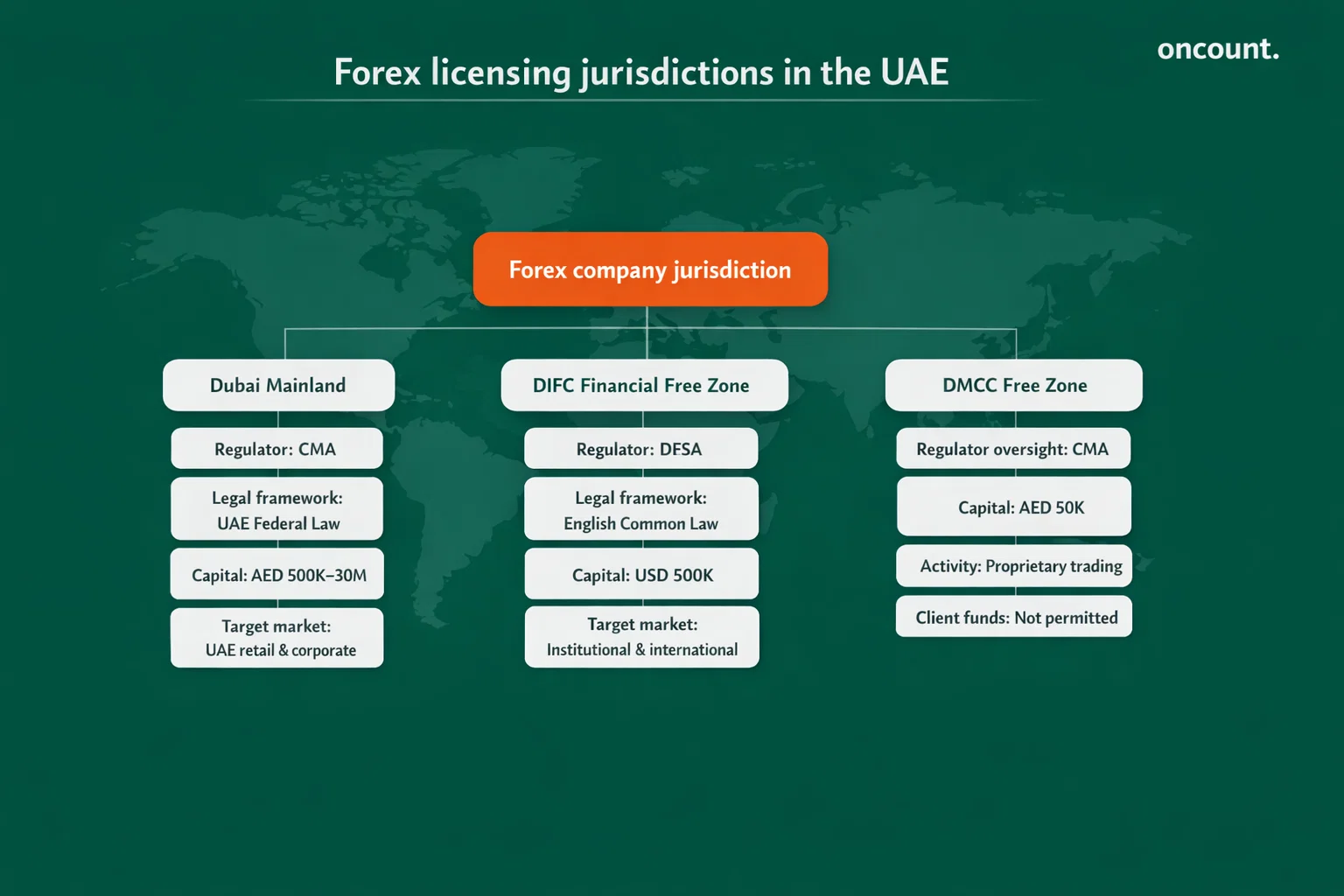
UAE company formation for a forex trading business involves a foundational choice between three regulatory environments, each governed by a separate authority and legal system.
| Jurisdiction | Regulator | Legal Framework | Min. Capital | Foreign Ownership |
| Dubai Mainland | CMA (formerly SCA) | UAE Federal Civil Law | AED 500K–30M | 100% |
| DIFC Free Zone | Dubai Financial Services Authority (DFSA) | English Common Law | USD 500,000 | 100% |
| DMCC Free Zone | CMA Oversight | UAE Federal Civil Law | AED 50,000 | 100% |
| ADGM (Abu Dhabi) | FSRA | English Common Law | Varies | 100% |
Dubai Mainland suits firms targeting the local UAE retail and corporate market. The Capital Market Authority (CMA), established under Federal Decree-Laws No. 32 and 33 of 2025 to replace the Securities and Commodities Authority (SCA), governs all mainland financial services activity.
The Dubai International Financial Centre (DIFC) operates under an independent legal system based on English Common Law, administered by the Dubai Financial Services Authority. The DIFC is the preferred jurisdiction for institutional brokers, international fund managers, and firms seeking cross-border operational flexibility. The DIFC’s framework aligns closely with UK FCA standards, making it highly recognizable to European and North American counterparties.
The Dubai Multi Commodities Centre (DMCC) provides a cost-efficient pathway for proprietary trading firms — entities that trade forex with their own capital and do not manage client funds. DMCC licenses are issued under CMA oversight and carry significantly lower setup costs.
Types of Forex Trading Licenses in Dubai
Selecting the correct license category is the single most consequential decision in establishing a forex trading company in Dubai. Each category defines what activities the firm is legally permitted to conduct, the minimum capital it must hold, and the organizational structure it must maintain.
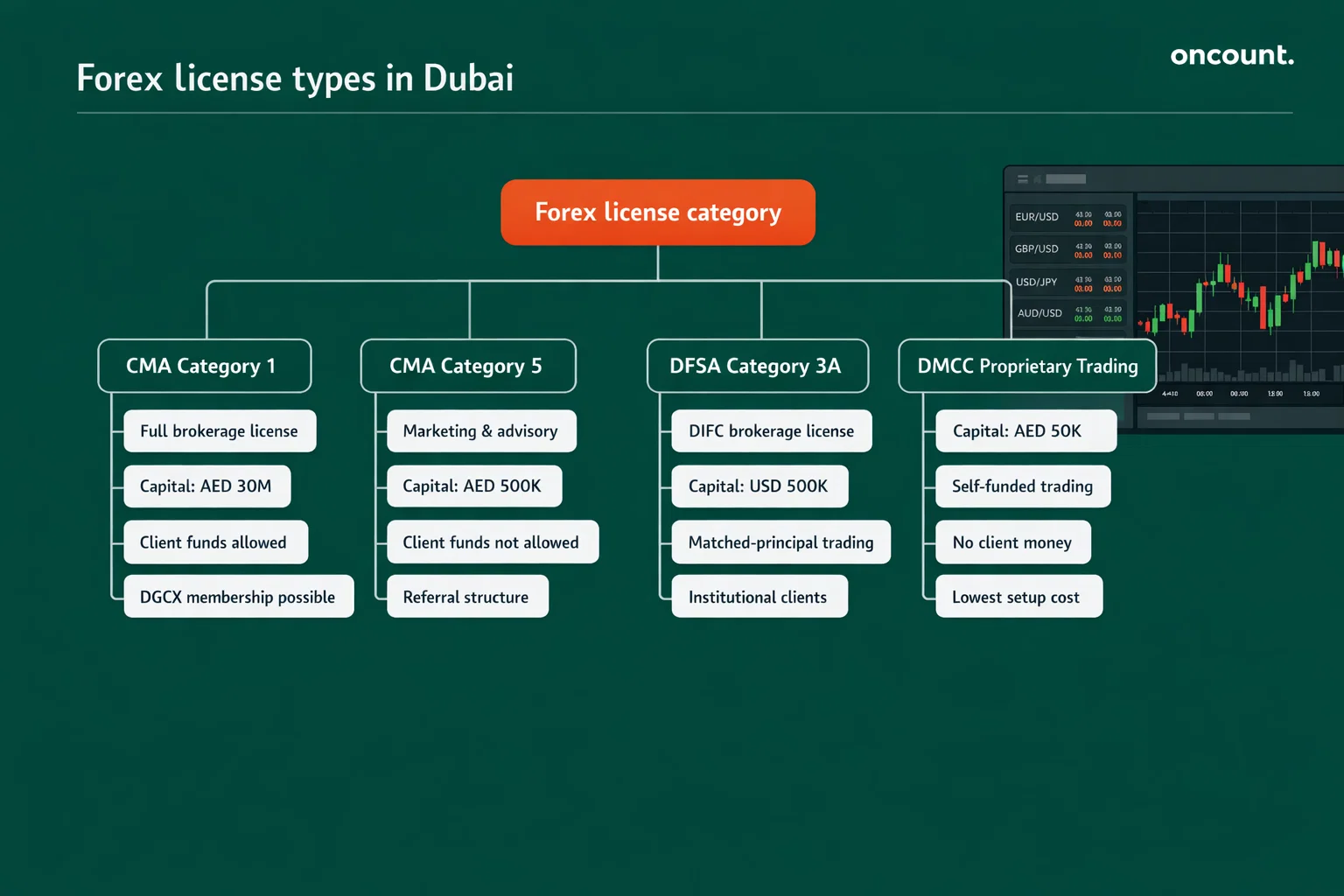
CMA Category 1 — Full Brokerage License
The CMA Category 1 license authorizes the full spectrum of forex brokerage services: trade execution on behalf of clients, custody of client funds, clearing, and settlement. This license is required for firms seeking membership at the Dubai Gold and Commodities Exchange (DGCX) and those intending to offer OTC derivatives or spot forex execution to UAE residents.
Minimum capital requirement: AED 30,000,000, fully paid-up and deposited in a UAE bank account before the license is issued. Category 1 firms must also maintain institutional-grade risk management infrastructure, independent audit committees, and advanced cybersecurity controls.
CMA Category 5 — Promotion and Advisory License
The Category 5 license is designed for firms that wish to operate a marketing, advisory, or client referral function in Dubai without executing trades or holding client money locally. This structure is common among international brokerage groups that wish to establish a UAE presence for business development while booking trades through their offshore regulated entity.
Minimum capital requirement: AED 500,000, plus operating expense-based capital buffers determined by the CMA. Category 5 licensees are explicitly prohibited from holding client funds or executing transactions on their own balance sheet.
DFSA Category 3A — DIFC Brokerage License
The DFSA Category 3A license is the primary vehicle for forex trading companies operating within the Dubai International Financial Centre. It permits the firm to deal in investments as agent or on a matched-principal basis — meaning the broker facilitates transactions between counterparties without carrying net market risk on its own book.
Base capital requirement: USD 500,000. The DFSA applies a nuanced capital formula: the firm must hold the higher of the base capital, a risk-based capital requirement, or an expenditure-based minimum. For firms that hold or control client assets, the expenditure-based minimum equals 18/52 of annual operating costs.
By default, DFSA Category 3A licensees are authorized to serve Professional Clients and Market Counterparties only. Serving retail clients requires a separate Retail Endorsement, which mandates enhanced disclosure standards, suitability assessments, and participation in an approved dispute resolution scheme.
DMCC Proprietary Trading License
The DMCC proprietary trading license is appropriate for entities conducting forex trading with their own capital. It carries a share capital requirement of AED 50,000 and does not authorize client fund management. This is the lowest-cost entry point for a forex trading business in Dubai and is favored by family offices and professional traders establishing a formal legal structure around personal trading activity.
| License Type | Regulator | Capital Required | Client Money Permitted | Typical Use Case |
| CMA Category 1 | CMA | AED 30,000,000 | Yes | Full-service UAE broker |
| CMA Category 5 | CMA | AED 500,000 | No | Marketing/referral arm |
| DFSA Category 3A | DFSA | USD 500,000 | With endorsement | Institutional/international broker |
| DMCC Proprietary | CMA (oversight) | AED 50,000 | No | Self-funded trading desk |
Legal Structures for a Forex Trading Company in the UAE
The choice of legal structure affects liability, governance requirements, and the ease of future shareholder changes.
Private Company Limited by Shares (Ltd) is the standard structure for DIFC-incorporated forex companies. It provides limited liability protection, allows for multiple share classes, and is recognized internationally. The DIFC Registrar of Companies (ROC) administers the incorporation process.
Limited Liability Company (LLC) is the standard mainland structure. Following the 2021 amendments to UAE Commercial Companies Law, 100% foreign ownership of LLCs is permitted for most financial activities, removing the previous requirement for an Emirati local partner holding 51% of shares.
Branch of a Foreign Company is available for international brokerages that wish to establish a regulated presence in Dubai without creating a separate legal entity. The branch remains part of the parent company’s balance sheet and is subject to both UAE and home-country regulation.
Step-by-Step Process to Start a Forex Trading Company in Dubai
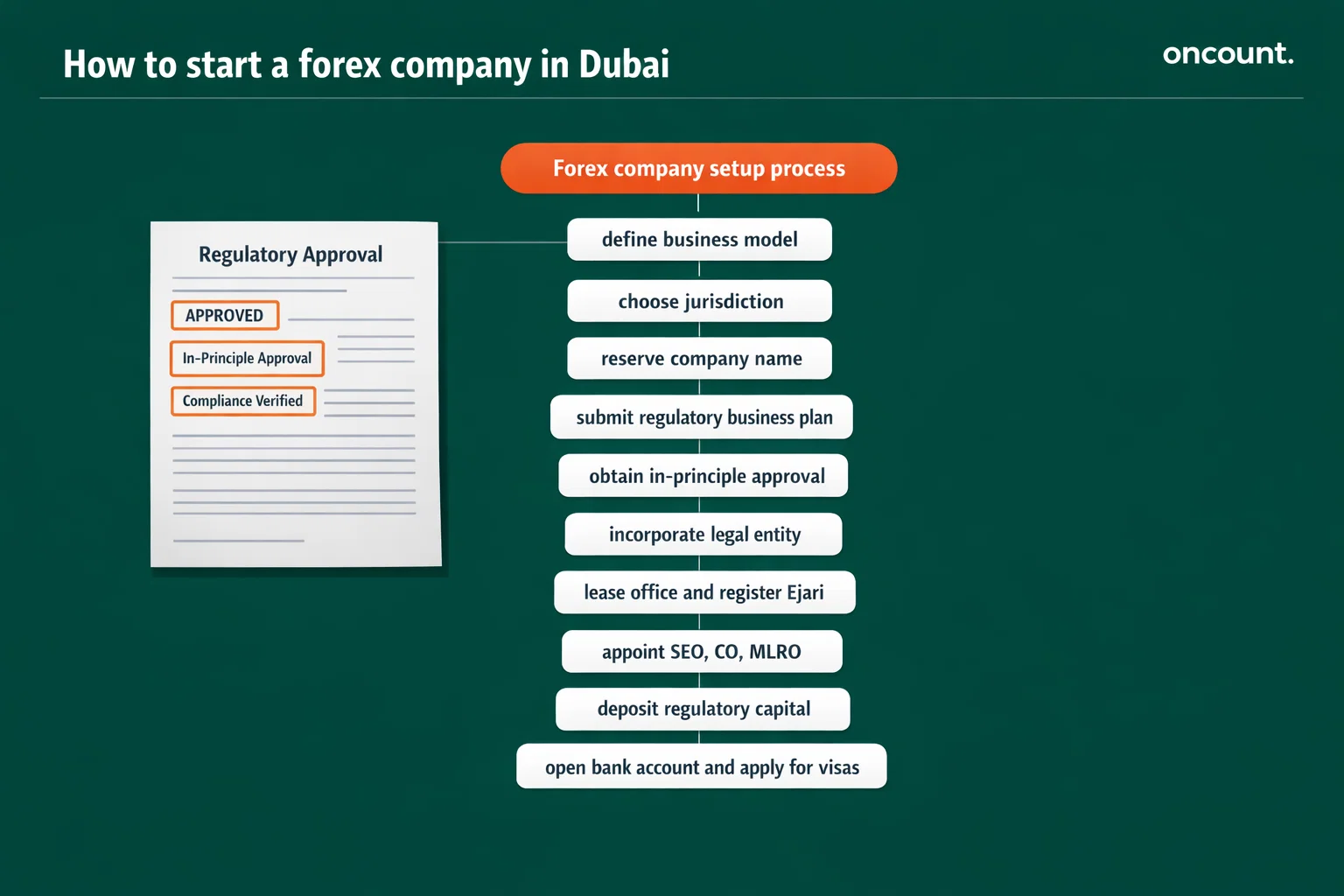
Step 1: Define the Business Activity and License Category
Before initiating any regulatory or legal process, the founding team must determine whether the business will operate as a full broker (Category 1 or DFSA 3A), a marketing entity (Category 5), or a proprietary trading desk (DMCC). This decision determines every downstream requirement including capital, personnel, and office infrastructure.
Step 2: Select the Jurisdiction
Evaluate the target client base, capital availability, and long-term business plan. Founders targeting institutional clients and cross-border operations typically select the DIFC. Those focused on the UAE domestic retail and corporate market select the mainland under CMA oversight.
Step 3: Reserve the Trade Name
In the DIFC, name reservation is conducted through the DIFC Client Portal at a cost of approximately USD 800. On the mainland, the Department of Economy and Tourism (DET) manages name reservation through its online portal.
Step 4: Submit the Regulatory Business Plan
Both the CMA and the DFSA require a detailed Regulatory Business Plan (RBP). This document — typically 15 to 25 pages — outlines the revenue model, target market segments, risk management approach, technology infrastructure, and projected capital adequacy. The quality of the RBP directly influences the speed of regulatory approval.
Step 5: Obtain In-Principle Approval (IPA)
The DFSA issues an In-Principle Approval once it is satisfied with the RBP and the fitness and propriety of the proposed leadership team. CMA issues an equivalent preliminary approval. The IPA is the regulatory signal to proceed with full incorporation.
Step 6: Incorporate the Legal Entity
In the DIFC, incorporate through the ROC by submitting the Articles of Association and shareholder documents. On the mainland, a Memorandum of Association must be drafted and notarized by a UAE-registered notary.
Step 7: Lease Office Space and Register Ejari
Both the CMA and DFSA require proof of a physical office in their respective jurisdictions. In Dubai, all commercial tenancy contracts must be registered through the Dubai Land Department’s Ejari system. The office lease must be in place before the trade license is issued.
Step 8: Appoint Mandatory Authorized Individuals
Appoint the Senior Executive Officer (SEO), Compliance Officer (CO), Money Laundering Reporting Officer (MLRO), and Finance Officer (FO). All UAE-resident roles must be filled before final license issuance.
Step 9: Deposit Capital and Obtain Final License
Transfer the required capital into the UAE corporate bank account and provide the regulator with evidence of the deposit. Upon confirmation, the CMA or DFSA issues the final business license.
Step 10: Open Corporate Bank Account and Apply for Visas
Submit corporate banking applications and initiate UAE residency visa processing for the founding team and key personnel through the company’s established HR channel.
Documents Required to Register a Forex Company in Dubai
| Document | Mainland (CMA) | DIFC (DFSA) |
| Regulatory Business Plan | Required | Required |
| Passport copies (all shareholders) | Required | Required |
| Proof of source of funds | Required | Required |
| CV and professional history (SEO, CO, MLRO) | Required | Required |
| Memorandum / Articles of Association | MoA (notarized) | Articles of Association |
| Office lease (Ejari registered) | Required | Required |
| Bank reference letters | Required | Required |
| AML/Compliance policy framework | Required | Required |
| Technology and platform architecture overview | Required | Required |
Cost of Starting a Forex Trading Business in Dubai
The total cost of establishing a forex trading company in Dubai varies significantly based on the license category and jurisdiction. The figures below represent typical ranges for a mid-market operation and exclude the minimum capital deposit, which must be maintained as regulatory capital rather than spent on setup costs.
| Cost Component | CMA Mainland (Cat. 5) | DFSA DIFC (Cat. 3A) |
| Regulatory application fees | AED 15,000–40,000 | USD 15,000–40,000 |
| Trade name reservation | AED 620 | USD 800 |
| Incorporation / legal fees | AED 10,000–25,000 | USD 8,000–20,000 |
| Office lease (annual) | AED 60,000–200,000 | USD 30,000–150,000 |
| Minimum capital deposit | AED 500,000 | USD 500,000 |
| Compliance technology setup | AED 20,000–80,000 | USD 25,000–100,000 |
| Annual audit (external auditor) | AED 25,000–60,000 | USD 20,000–50,000 |
| Estimated Year 1 Total | AED 700K–1.1M | USD 650K–1M+ |
For professional support with business setup and cost optimization, business setup service providers provide end-to-end guidance on UAE company formation, regulatory applications, and banking introductions.
Regulatory Compliance Requirements for Forex Companies in the UAE
AML and KYC Obligations
All forex trading companies licensed in the UAE are subject to Federal Decree-Law No. 20 of 2018 on Anti-Money Laundering and Combating the Financing of Terrorism. The UAE Financial Intelligence Unit (FIU) administers the goAML platform, through which licensed firms must submit Suspicious Activity Reports (SARs) and Suspicious Transaction Reports (STRs).
The MLRO holds primary responsibility for the firm’s AML program. KYC procedures must include identity verification, source of funds documentation, and ongoing transaction monitoring for all client accounts.
Ultimate Beneficial Owner (UBO) Registration
The UAE Cabinet Resolution No. 58 of 2020 mandates that all UAE-incorporated companies register their Ultimate Beneficial Owners — individuals holding 25% or more of shares or exercising effective control — with the relevant authorities. For DIFC entities, UBO disclosures are filed with the ROC. Non-compliance carries administrative penalties of up to AED 100,000.
Economic Substance Regulations (ESR)
Forex companies holding a brokerage or investment business license in the UAE must satisfy Economic Substance Regulations, introduced under Cabinet Resolution No. 57 of 2020. ESR compliance requires the firm to demonstrate that its core income-generating activities are conducted in the UAE, that it has an adequate number of qualified employees locally, and that it incurs operating expenditure proportionate to its activities.
Conduct of Business Standards
The DFSA’s Conduct of Business (COB) Module and the CMA Rulebook both establish detailed obligations governing how forex firms interact with clients. These include best execution duties, transparent pricing disclosures, leverage restrictions, and prohibition of misleading marketing. For retail clients, major currency pair leverage is capped at 1:50 under CMA guidelines and 1:30 under DFSA rules, consistent with ESMA and ASIC frameworks.
Taxation Framework for Forex Trading Companies in the UAE
UAE Corporate Tax
The UAE Federal Corporate Tax Law (Federal Decree-Law No. 47 of 2022), administered by the Federal Tax Authority (FTA), applies a 9% corporate tax rate to taxable profits exceeding AED 375,000 for financial years beginning on or after 1 June 2023. Profits up to AED 375,000 are taxed at 0%.
A Dubai mainland forex trading company exceeding AED 375,000 in net taxable profits must register for UAE Corporate Tax through the EmaraTax portal and file an annual tax return within nine months of the financial year end.
Free zone entities — including DIFC and DMCC-incorporated forex companies — may qualify for a 0% corporate tax rate on qualifying income, provided they satisfy the substance requirements set out by the UAE Ministry of Finance and do not earn income from mainland UAE sources that falls outside the qualifying income definition.
VAT Considerations
The UAE introduced a 5% Value Added Tax (VAT) under Federal Decree-Law No. 8 of 2017. Most financial services supplied by forex companies — including brokerage commissions, spread income, and management fees — are classified as exempt or zero-rated under FTA guidance, depending on the nature of the supply and the counterparty’s residency status.
Forex companies with taxable supplies exceeding AED 375,000 annually must register for VAT with the FTA. Mandatory VAT registration thresholds and category classifications should be reviewed with a UAE-qualified tax advisor, as the treatment of financial instruments involves nuanced interpretations under the Executive Regulations.
Corporate Banking for Forex Businesses in Dubai
Opening a corporate bank account is routinely cited as the most operationally challenging stage of establishing a forex trading company in Dubai. UAE banks categorize forex and financial services businesses as high-risk under Central Bank of the UAE AML guidelines, which triggers Enhanced Due Diligence (EDD) procedures.
Banks conducting EDD will typically request: audited financial statements of the parent entity (if applicable), a detailed business plan, evidence of the firm’s regulatory license, full UBO disclosure, source of funds documentation for the initial capital deposit, and projected transaction volumes and counterparty profiles.
Recommended banking approach by firm stage:
- Early-stage / startup DMCC or Cat. 5 firms: Digital-first banks such as Wio Business and Mashreq NeoBiz offer faster onboarding (1–5 days) with minimal balance requirements, though cross-border transfer functionality may be limited.
- Mid-market firms with a CMA or DFSA license: RAKBANK and Commercial Bank of Dubai offer a pragmatic middle ground — traditional compliance standards with more responsive relationship management than the largest UAE institutions.
- Institutional / full-service brokerages: Emirates NBD, First Abu Dhabi Bank (FAB), and HSBC UAE provide robust global correspondent relationships, multi-currency accounts, and SWIFT infrastructure. Minimum balances range from AED 100,000 to AED 500,000+, and review cycles can extend to six months.
Industry-Specific Regulations for a Forex Brokerage in Dubai
Client Fund Segregation Requirements
Forex trading companies in Dubai authorized to hold client money must operate segregated client accounts — accounts held at a UAE-licensed bank that are legally separate from the firm’s operational funds. The DFSA Client Money module and the CMA Client Assets rules both require daily reconciliation of segregated balances and monthly or quarterly reporting to the regulator. In the event of brokerage insolvency, segregated client funds are protected and must be returned to clients in priority over other creditors.
Mandatory Personnel Standards
The CMA and DFSA apply a “Fit and Proper” standard to all individuals performing Licensed Functions within a forex brokerage. The Senior Executive Officer must be UAE-resident and typically demonstrates 10 to 15 years of leadership experience in regulated financial markets. The Compliance Officer and MLRO must also be UAE-resident senior professionals with relevant qualifications.
On the mainland, compliance officers and financial consultants are required to pass the UAE Financial Rules and Regulations examination administered by the Chartered Institute for Securities & Investment (CISI). In the DIFC, authorized individuals must complete a minimum of 15 hours of Continuing Professional Development (CPD) every 12 months, covering topics such as market abuse, operational resilience, and virtual asset regulation.
Technology and Platform Governance
Regulators require forex companies to submit a Technology Governance and Risk Assessment Framework as part of the licensing application. This framework must address trading platform architecture and bridge technology, liquidity provider integration protocols, cybersecurity controls including multi-factor authentication and data encryption, penetration testing schedules, and Business Continuity Planning (BCP) with documented disaster recovery procedures.
For firms operating algorithmic or high-frequency trading strategies, additional governance controls are required to demonstrate that automated systems are regularly tested, parameter-bounded, and cannot generate disruptive order flow.
The DFSA maintains a list of 15 recognized external auditors. Forex companies licensed in the DIFC must appoint from this list for their annual statutory audit. Both the CMA and DFSA also require an internal audit function, which may be outsourced to a qualified professional services firm.
Advantages of Establishing a Forex Business in Dubai
Dubai’s appeal to forex industry participants is the product of both structural advantages and deliberate regulatory positioning:
- Regulatory credibility: DFSA authorization is recognized by international prime brokers, institutional investors, and global correspondent banks as a mark of compliance quality comparable to FCA or MAS licensing.
- Tax efficiency: UAE corporate tax at 9% — with a 0% rate for qualifying free zone income — represents a materially lower tax burden than most G20 financial centres.
- Time zone advantage: Dubai’s UTC+4 timezone allows a single team to cover Asian market opens through to the end of the European trading session, maximizing trading desk utilization.
- Visa infrastructure: UAE residency visas for founders and senior staff can be processed concurrently with company formation, enabling rapid team deployment.
- Access to Forex Expo Dubai 2026: The annual event at the Dubai World Trade Centre connects licensed brokers with liquidity providers, technology vendors, and institutional clients across the MENA, South Asian, and East African markets.
Common Challenges When Starting a Forex Company in Dubai
Capital intensity: The gap between a DMCC proprietary trading license (AED 50,000 capital) and a CMA Category 1 full brokerage (AED 30,000,000 capital) is substantial. Many founders underestimate total capital requirements when accounting for operational costs, technology infrastructure, and staffing before revenue is generated.
Banking delays: High-risk categorization by UAE banks can delay corporate account opening by four to six months for full-service brokerage entities. Founders should initiate banking applications in parallel with the regulatory licensing process rather than sequentially.
Regulatory Business Plan quality: The DFSA and CMA both reject incomplete or generic RBPs. Applications that fail to articulate a credible revenue model, a defined risk framework, and a realistic client acquisition strategy are frequently returned for revision, adding months to the timeline.
Hiring qualified UAE-resident personnel: The requirement for a UAE-resident SEO, CO, and MLRO can be challenging for startups without an existing local presence. Recruiting experienced candidates in a competitive UAE financial services talent market, particularly for compliance roles, involves significant lead time and cost.
Unauthorized solicitation risk: Offshore forex brokers operating in the UAE without a CMA or DFSA license face enforcement action. All digital marketing, social media promotion, and cold outreach targeting UAE residents constitutes a regulated financial promotion under UAE law and requires prior compliance approval.