Key Takeaways
- UAE retail companies must maintain accounting records for a minimum of five years under Federal Tax Authority regulations
- IFRS standards apply to all retail financial reporting, with IFRS 15 governing revenue recognition and IAS 2 covering inventory valuation
- VAT registration becomes mandatory when taxable supplies exceed AED 375,000 annually, with quarterly filing deadlines 28 days after each period
- Corporate tax applies at 9% on taxable profits exceeding AED 375,000, with annual returns due nine months after fiscal year-end
- Inventory accounting must use FIFO or weighted average methods, as LIFO remains prohibited under IFRS
- Retailers must accrue end-of-service gratuity for employees and maintain UAE national pension contributions through GPSSA
- Point-of-sale systems must generate compliant VAT invoices containing supplier TRN, customer details, and itemized tax amounts
Overview of Accounting Requirements in the UAE For Retail Businesses
The UAE Commercial Companies Law mandates that all retail establishments maintain complete accounting records documenting financial transactions. According to Federal Tax Authority guidance, retailers must preserve these records for at least five years from the end of the relevant tax period, ensuring availability for audit or inspection. This requirement extends beyond traditional ledgers to include supporting documentation such as purchase invoices, sales receipts, inventory records, employment contracts, and bank statements.
Retail companies operating in Dubai mainland areas fall under the Department of Economic Development (DED) jurisdiction, while those in free zones such as JAFZA or DMCC follow zone-specific regulations that generally align with federal standards. The Federal Tax Authority requires retailers to maintain books of account showing income, expenses, assets, liabilities, and equity in accordance with internationally recognized accounting principles. Failure to maintain proper records can result in administrative penalties ranging from AED 10,000 to AED 50,000 depending on violation severity.
IFRS Application for Retail Store Companies
International Financial Reporting Standards represent the primary accounting framework for retail businesses operating in the UAE, as no separate national GAAP exists. Application of IFRS ensures consistency, comparability, and compliance with regulatory expectations, including requirements from the Federal Tax Authority and financial institutions.
Revenue Recognition Under IFRS 15
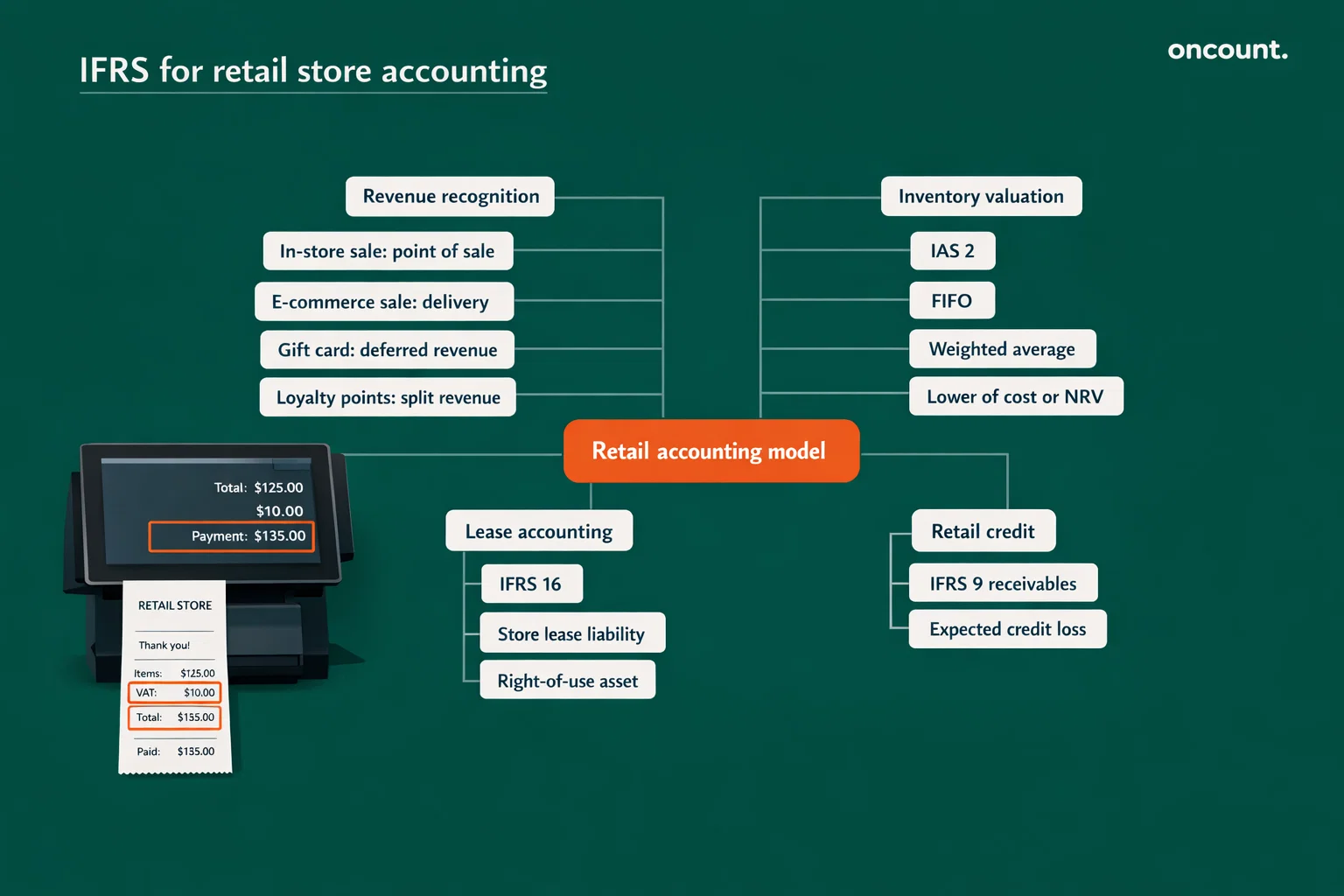
IFRS 15 establishes the principles for recognizing retail revenue based on the transfer of control to customers. In physical stores, revenue is typically recognized at the point of sale, while in e-commerce transactions, recognition occurs upon delivery or when control passes to the buyer.
The standard applies a structured five-step model:
- identification of contracts with customers
- determination of performance obligations
- calculation of transaction price
- allocation of price to obligations
- recognition of revenue upon fulfillment
This framework ensures accurate timing of revenue reporting and reduces inconsistencies across sales channels, including omnichannel retail operations.
Inventory Valuation Under IAS 2
IAS 2 requires inventory to be measured at the lower of cost or net realizable value. Cost determination must follow either FIFO (First-In-First-Out) or weighted average methods, both of which are compliant with IFRS and widely used in UAE retail environments.
The standard explicitly prohibits the use of LIFO (Last-In-First-Out), which remains accepted in certain jurisdictions but conflicts with IFRS valuation principles. This restriction ensures more transparent inventory reporting and prevents artificial manipulation of profit margins through cost allocation methods.
Financial Instruments and Retail Credit Under IFRS 9
IFRS 9 applies when retail companies provide customer financing, installment plans, or store credit facilities. The standard requires classification of receivables, measurement based on expected credit loss models, and ongoing impairment assessment.
Accurate application of IFRS 9 enhances risk management and ensures that receivables are not overstated, particularly in retail segments with extended credit terms or loyalty financing programs.
Lease Accounting for Retail Locations Under IFRS 16
IFRS 16 significantly impacts retail businesses operating physical stores under long-term lease agreements. The standard requires recognition of lease liabilities and corresponding right-of-use assets on the balance sheet, replacing the previous distinction between operating and finance leases.
This change increases balance sheet transparency and affects key financial ratios, including EBITDA and leverage metrics. Retailers with multiple locations must carefully assess lease portfolios to ensure accurate financial reporting and compliance.
IFRS for SMEs as an Alternative Framework
IFRS for SMEs provides a reduced reporting framework suitable for smaller retail entities without public accountability. The simplified structure decreases disclosure requirements while maintaining essential recognition and measurement principles aligned with full IFRS.
Adoption of IFRS for SMEs remains acceptable in the UAE for license renewals and banking requirements, making it a practical option for small and medium-sized retail businesses seeking cost-efficient compliance.
Bookkeeping Framework and Financial Records Structure
Retail accounting systems must capture high-volume transactions efficiently while maintaining audit trails. A typical retail chart of accounts includes asset categories (cash on hand, bank accounts, accounts receivable, inventory, prepaid expenses, store equipment, accumulated depreciation), liability accounts (accounts payable, VAT payable, accrued expenses, employee gratuity provisions, gift card liabilities), equity sections (owner’s capital, retained earnings), revenue accounts (sales revenue by category, sales returns and allowances), cost of goods sold, and operating expenses (rent, utilities, salaries, marketing, depreciation).
Modern point-of-sale systems integrate directly with accounting software, automatically posting daily sales summaries to general ledgers. Each transaction generates multiple entries: debiting cash or accounts receivable, crediting sales revenue and VAT output tax liability, while simultaneously debiting cost of goods sold and crediting inventory. Retailers must reconcile POS data against physical cash counts daily, investigating discrepancies that may indicate theft, processing errors, or system malfunctions.
Supporting documentation requirements include numbered tax invoices for all sales, supplier invoices showing VAT input tax, bank statements reconciled monthly, inventory count sheets, payroll registers with employee salary details and statutory deductions, and contracts for significant transactions. According to FTA regulations, retailers must retain these documents in Arabic or English, whether in physical or electronic format, ensuring accessibility during potential audits.
Financial Statements Preparation Requirements
Retail companies operating in the UAE are required to prepare structured financial statements in accordance with IFRS, ensuring transparency, comparability, and regulatory compliance. Proper financial reporting supports tax filings, audit processes, and access to external financing, particularly for businesses seeking bank funding or investor participation.
Core Financial Statements Structure
UAE retail entities must prepare four primary financial statements on an annual basis, each serving a distinct analytical and regulatory purpose:
- statement of financial position (balance sheet)
- statement of profit or loss
- statement of cash flows
- notes to the financial statements
Publicly listed retailers and companies engaging with institutional lenders are often required to produce interim financial reports on a quarterly basis. This enhanced reporting frequency improves financial monitoring and aligns with investor expectations.
Statement of Financial Position (Balance Sheet)
The balance sheet presents the financial position at the reporting date by classifying assets, liabilities, and equity into structured categories. Current assets, including cash, trade receivables, and inventory expected to be realized within 12 months, are disclosed separately from non-current assets such as store equipment, leasehold improvements, and long-term deposits.
Inventory typically represents a significant portion of total assets in retail businesses. Detailed disclosures, including product category segmentation and inventory aging analysis, are required to ensure accurate valuation and support decision-making. Liabilities are also divided into current obligations, such as trade payables and accrued expenses, and non-current liabilities, including long-term borrowings and lease liabilities recognized under IFRS 16.
Statement of Profit or Loss
The income statement provides a structured overview of financial performance by presenting revenues, cost of goods sold, and operating expenses. Retail businesses must clearly distinguish between gross profit and operating profit, allowing assessment of pricing strategies, cost control, and overall profitability.
Accurate classification of expenses, including rent, payroll, marketing, and depreciation, ensures compliance with IFRS and supports performance benchmarking across retail segments. Consistent reporting enables comparison across reporting periods and improves financial analysis.
Statement of Cash Flows
The cash flow statement categorizes cash movements into operating, investing, and financing activities. This classification provides insight into liquidity management, operational efficiency, and capital structure decisions.
Retail businesses rely heavily on cash flow monitoring due to inventory cycles and supplier payment terms. Strong alignment between profit reporting and actual cash generation is essential to maintain solvency and support expansion strategies.
Notes to Financial Statements and Disclosures
Financial statement notes provide detailed explanations of accounting policies, assumptions, and key judgments applied in financial reporting. Required disclosures include revenue recognition methods under IFRS 15, inventory valuation approaches under IAS 2, depreciation policies, and provisions for doubtful receivables.
Related party transactions must be disclosed separately, particularly for retail groups operating with centralized procurement, shared services, or intercompany inventory transfers. These disclosures enhance transparency and ensure compliance with IFRS reporting standards.
Audit Requirements and Regulatory Expectations
Most UAE retail businesses are subject to audit requirements, particularly when operating in free zones, maintaining corporate tax registration, or engaging with financial institutions. External auditors assess whether financial statements present a true and fair view in accordance with IFRS and applicable UAE regulations.
Audit verification strengthens credibility with stakeholders, reduces regulatory risk, and supports compliance with licensing authority requirements. Increasing regulatory focus on financial transparency indicates continued expansion of audit obligations across the UAE retail sector.
VAT Compliance for Retail Store Companies in the UAE
Federal Decree-Law No. 8 of 2017 establishes Value Added Tax obligations for UAE retailers. Mandatory VAT registration applies when taxable supplies exceed AED 375,000 in the trailing 12 months or are expected to exceed this threshold in the coming 30 days. Voluntary registration becomes available when taxable supplies exceed AED 187,500, beneficial for retailers with significant VAT-bearing expenses seeking input tax recovery. The Federal Tax Authority assigns a Tax Registration Number (TRN) upon successful registration through the EmaraTax portal.
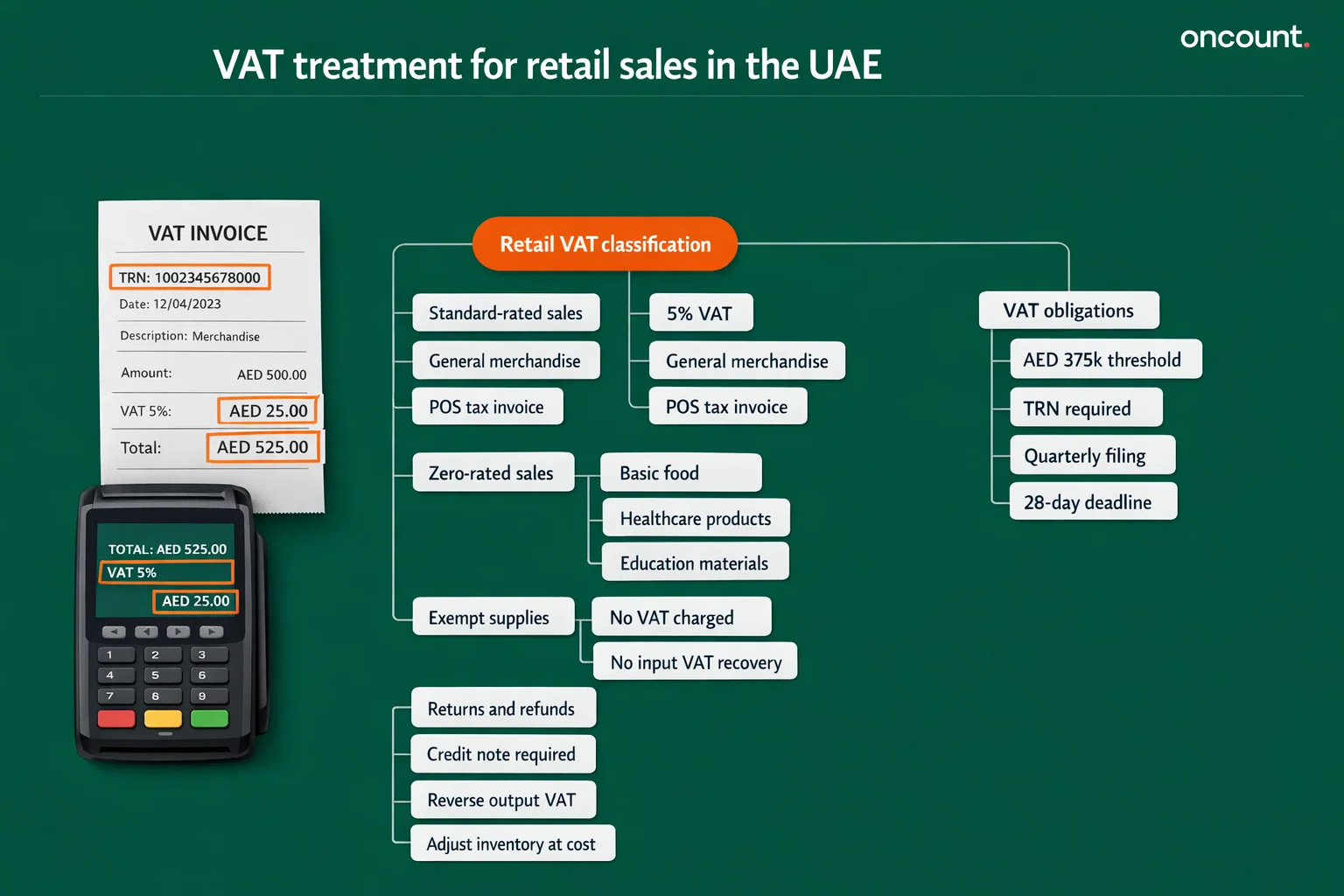
Retailers charge 5% VAT on standard-rated supplies while certain categories receive special treatment. Zero-rated supplies (0% VAT charged, input tax recoverable) include basic food items, healthcare products, education materials, and international transport services. Exempt supplies (no VAT charged, no input tax recovery) cover residential property sales, bare land, and certain financial services. Retailers selling both taxable and exempt supplies must apportion input VAT recovery based on taxable supply percentages.
VAT invoices must contain mandatory elements: supplier name, address, and TRN; invoice number and date; customer name and TRN (for B2B sales); description and quantity of goods; unit price excluding VAT; total amount excluding VAT; VAT rate and amount; and total amount including VAT. For retail B2C transactions under AED 10,000, simplified tax invoices suffice, containing fewer details. Electronic invoicing implementation began in phases from 2023, with retailers required to generate e-invoices through FTA-certified software for B2B transactions.
| VAT Filing Period | Filing Deadline | Payment Deadline | Penalties for Late Filing |
| Q1 (Jan-Mar) | April 28 | April 28 | AED 1,000 first offense, AED 2,000+ subsequent offenses |
| Q2 (Apr-Jun) | July 28 | July 28 | Plus 2% monthly late payment penalty |
| Q3 (Jul-Sep) | October 28 | October 28 | Plus 4% daily penalty (max 300%) for tax evasion |
| Q4 (Oct-Dec) | January 28 | January 28 | Business suspension for repeated violations |
Retailers must file quarterly VAT returns within 28 days after each tax period, summarizing output VAT collected from sales, input VAT paid on purchases, and net VAT payable or recoverable. According to Federal Tax Authority data from 2024, over 450,000 businesses maintain active VAT registration in the UAE, with retail trade representing approximately 15% of registrants.
Corporate Tax Framework For Retail Stores in the UAE
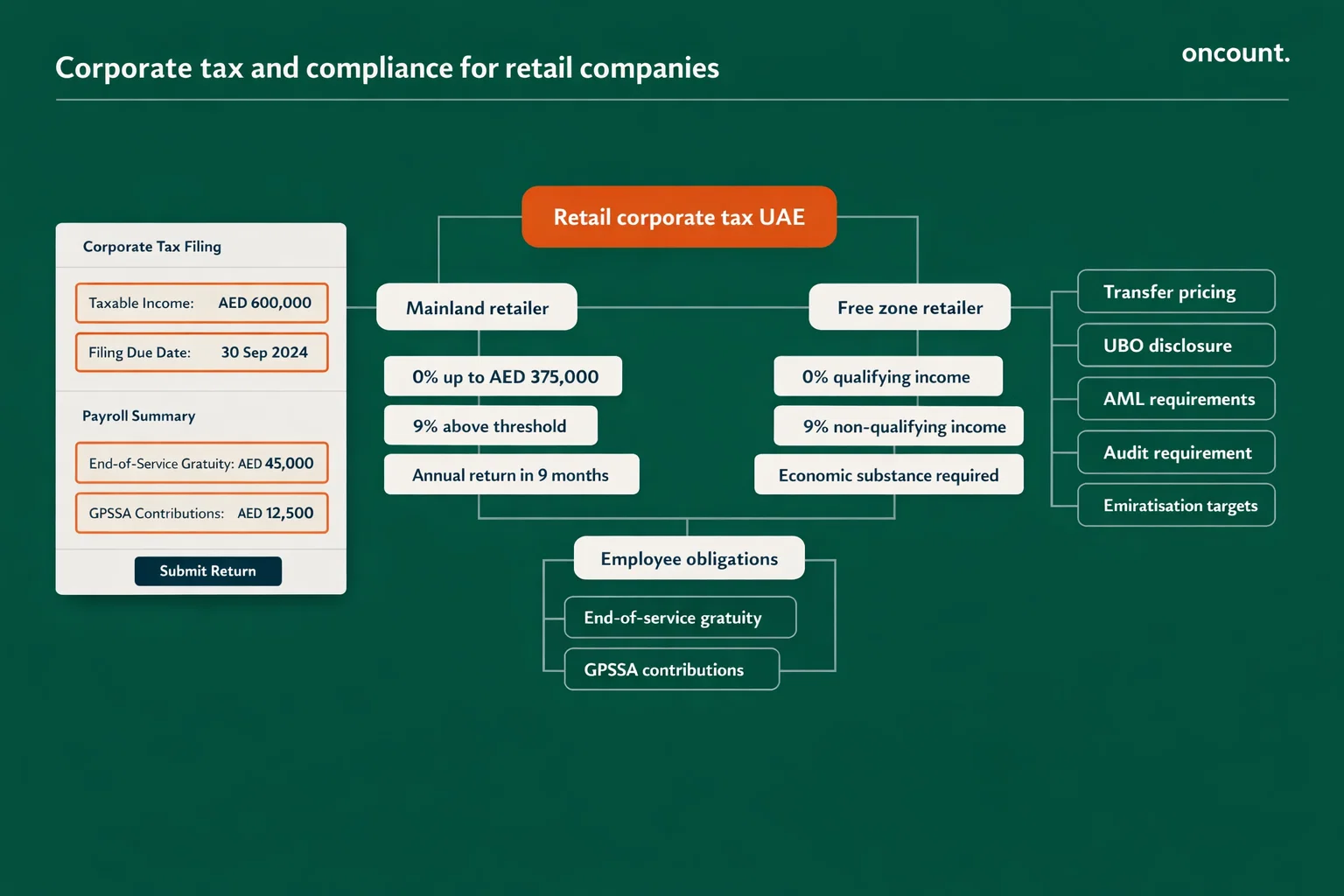
Federal Decree-Law No. 47 of 2022 introduced corporate tax, effective for financial years starting on or after June 1, 2023. UAE retail companies face a two-tier rate structure: 0% on taxable income up to AED 375,000 and 9% on taxable income exceeding this threshold. This progressive approach provides relief for small retailers while ensuring larger operations contribute to government revenues. Free zone retailers may qualify for 0% corporate tax on qualifying income derived from transactions with other free zone entities or foreign clients, provided they meet economic substance requirements and avoid mainland UAE business activities.
Taxable income calculation starts with accounting profit per IFRS financial statements, then applies tax adjustments for non-deductible expenses and exempt income. Non-deductible items include entertainment expenses beyond reasonable limits, fines and penalties, personal expenses charged to the business, and certain related-party payments lacking commercial substance. Retail companies can carry forward tax losses indefinitely to offset future taxable profits, subject to ownership continuity tests and anti-avoidance provisions.
Corporate tax registration through the FTA becomes mandatory for all UAE retail businesses generating taxable income. According to UAE Ministry of Finance guidance issued in 2023, retailers must register within three months after the start of their first taxable period or within three months after incorporation, whichever is later. The annual corporate tax return must be filed within nine months after the fiscal year-end, with tax payment due simultaneously. A calendar-year retailer ending December 31, 2024, must file and pay by September 30, 2025.
Transfer pricing regulations require retailers with related-party transactions to apply arm’s-length pricing principles aligned with OECD guidelines. The FTA Transfer Pricing Guide (October 2023) mandates documentation for cross-border related-party transactions and significant domestic transactions. Retailers importing inventory from affiliated foreign suppliers or paying management fees to parent companies must maintain functional analyses, comparability studies, and contemporaneous documentation justifying pricing methodologies.
Accounting for Revenue and Expenses in Retail Stores
Retail revenue recognition follows IFRS 15’s control-transfer principle. Point-of-sale transactions recognize revenue immediately upon customer payment and product delivery. E-commerce sales recognize revenue when goods are delivered to customers, with shipping charges treated as separate performance obligations if they represent distinct services. Retailers offering “click and collect” services recognize revenue when customers pick up orders from stores rather than at the time of online purchase.
Sales returns and refunds require estimation as variable consideration under IFRS 15. Retailers must estimate expected returns based on historical patterns, recording a refund liability and corresponding asset (right to recover returned goods) at period-end. For example, a retailer with AED 1,000,000 monthly sales and 3% historical return rate would record AED 30,000 refund liability and AED 18,000 asset (assuming 60% gross margin), reducing recognized revenue by AED 30,000.
| Transaction Type | Revenue Recognition Timing | VAT Treatment | Accounting Entry |
| Cash Sale | Point of checkout | 5% output VAT | Dr. Cash / Cr. Sales Revenue, VAT Output |
| Credit Card Sale | Point of authorization | 5% output VAT | Dr. Card Receivable / Cr. Sales Revenue, VAT Output |
| Gift Card Sale | Deferred until redemption | No VAT until redemption | Dr. Cash / Cr. Gift Card Liability |
| Loyalty Points | Allocated to deferred revenue | VAT on redemption | Dr. Sales / Cr. Loyalty Liability |
| Consignment Goods | When the end customer purchases | 5% when sold | Dr. Consignment Inventory (no revenue yet) |
Expense recognition follows the matching principle, with costs recorded in periods generating related revenues. Cost of goods sold equals beginning inventory plus purchases minus ending inventory, adjusted for shrinkage and write-downs. Operating expenses include rent (often significant for prime retail locations in Dubai malls), utilities, employee salaries and benefits, marketing and advertising, depreciation of store fixtures and equipment, and professional fees for accounting and audit services.
Retailers must accrue end-of-service gratuity for employees under UAE Labour Law (Federal Decree-Law No. 33 of 2021). The calculation provides 21 days’ basic salary per year for the first five years of service and 30 days’ salary for each additional year, capped at two years’ total salary. Monthly accrual entries debit gratuity expense and credit gratuity liability, building the provision until employee termination or retirement triggers payment.
Regulatory Compliance and Reporting Obligations
Retail businesses in the UAE operate within a structured regulatory environment that integrates tax compliance, corporate transparency, and financial crime prevention. Adherence to federal legislation ensures legal continuity, protects business reputation, and supports sustainable operations within both mainland and free zone jurisdictions.
Economic Substance Regulations (ESR) Status
Economic Substance Regulations previously required UAE entities engaged in specific activities, such as banking, insurance, and investment management, to submit annual notifications and reports. Following UAE Cabinet decisions, ESR filing obligations were отменены for financial years ending after December 31, 2022, significantly reducing the administrative burden for most retail businesses.
Despite this regulatory change, certain retail structures—particularly holding entities or businesses involved in regulated activities—may still require case-by-case assessment. Verification with legal advisors remains necessary to ensure alignment with any residual or indirect compliance expectations.
Anti-Money Laundering (AML) Compliance Requirements
Federal Decree-Law No. 20 of 2018 establishes mandatory AML obligations for businesses, including retail entities dealing in high-value goods such as jewelry, luxury watches, and premium consumer products. The regulation requires implementation of a risk-based AML framework supported by documented policies and internal controls.
Key compliance requirements include:
- customer due diligence for transactions exceeding AED 55,000
- verification of customer identity and source of funds, where applicable
- retention of transaction records for a minimum of five years
- reporting suspicious activities to the UAE Financial Intelligence Unit
Retail companies must appoint a designated compliance officer, conduct periodic risk assessments, and ensure staff training on identifying suspicious transaction patterns. These measures reduce exposure to financial crime risks and align operations with international AML standards.
Ultimate Beneficial Owner (UBO) Disclosure Obligations
UBO regulations require retail companies to identify individuals who ultimately own or control 25% or more of shares or voting rights. This information must be submitted to the relevant licensing authority, including the Department of Economic Development (DED) for mainland entities or the respective free zone authority.
Maintenance of an up-to-date UBO register is mandatory, ensuring accessibility for competent regulatory authorities. Non-compliance may result in administrative penalties ranging from AED 50,000 to AED 100,000, alongside potential suspension of the business license.
Emiratisation Requirements for Retail Companies
Ministry of Human Resources and Emiratisation enforces Emiratisation policies requiring private sector companies to increase employment of UAE nationals. Regulations effective from 2024 impose specific hiring thresholds based on company size and sector classification.
Current requirements include:
- Companies with 20–49 employees must employ at least two UAE nationals by 2025
- Larger organizations must increase Emirati representation in skilled roles by 2% annually
Failure to meet these targets results in financial penalties, starting from AED 96,000 per unfilled position in 2024 and increasing to AED 108,000 in 2025. Compliance contributes to workforce nationalization objectives and strengthens alignment with UAE economic policy priorities.
Audit Requirements for Retail Stores in the UAE
External audit requirements vary by jurisdiction and business structure. Dubai mainland retailers incorporated as Limited Liability Companies (LLCs) or Public/Private Joint Stock Companies must appoint licensed auditors to examine annual financial statements. Free zone retailers face zone-specific requirements, with DMCC, JAFZA, and DAFZA typically mandating annual audits for license renewal. Retail sole proprietorships and civil companies may avoid audit obligations unless their banking relationships or contract terms require audited financials.
Auditors verify that financial statements comply with IFRS, examining revenue recognition policies, inventory valuation methods, expense classifications, and tax provisions. Inventory verification represents a critical audit area, with auditors observing year-end physical counts, testing count procedures, and investigating significant variances between physical and book quantities. Auditors also assess internal controls over cash handling, examining segregation of duties between sales recording, cash custody, and bank reconciliation functions.
The audit opinion expresses whether financial statements present a true and fair view. Unqualified opinions indicate clean financials with no material misstatements. Qualified opinions note specific disagreements or scope limitations without undermining overall statement reliability. Adverse opinions state that financial statements are materially misstated, while disclaimer opinions indicate the auditor could not obtain sufficient evidence. Retailers should address audit findings promptly, as qualified or adverse opinions may trigger banking covenant violations or license renewal difficulties.
Industry-Specific Accounting Considerations for Retail Stores
Inventory Management and Valuation Methods
Retail inventory accounting requires choosing between FIFO (First-In-First-Out) and weighted average costing methods, both permitted under IAS 2. FIFO assumes older inventory sells first, resulting in ending inventory valued at recent purchase costs. During inflationary periods, FIFO produces higher ending inventory values and lower cost of goods sold, increasing reported profits. Weighted average calculates unit costs by dividing total inventory value by total units, smoothing price fluctuations but requiring system recalculation after each purchase.
Shrinkage from theft, damage, or administrative errors requires periodic adjustment. Retailers conduct cycle counts or full physical inventories, comparing actual quantities against perpetual system records. Identified shortages are expensed immediately: debit inventory loss expense, credit inventory. IAS 2 also mandates writing inventory down to net realizable value when selling prices fall below cost, common for seasonal merchandise or slow-moving items. Write-downs debit inventory write-down expense and credit inventory allowance, reducing asset values without physically disposing of goods.
Loyalty Programs and Gift Card Accounting
Customer loyalty programs granting points on purchases create deferred revenue obligations under IFRS 15. Retailers must estimate point fair values based on redemption probabilities and historical patterns, allocating portions of transaction prices to loyalty obligations. For example, a AED 100 sale earning points worth AED 3 recognizes AED 97 as immediate revenue and AED 3 as deferred loyalty revenue. When customers redeem points, the liability reverses to revenue with corresponding VAT output tax charged.
Gift card sales generate deferred revenue until redemption. Retailers record cash receipts against gift card liability accounts, recognizing revenue only when cardholders purchase merchandise. Breakage income from expired or unused gift cards can be recognized when redemption becomes remote, typically after statutory limitation periods expire. UAE consumer protection laws may restrict breakage recognition, requiring retailers to honor gift cards indefinitely or refund unredeemed balances.
Point-of-Sale Reconciliation and Cash Controls
Daily POS reconciliation matches system-recorded sales against actual cash, card receipts, and bank deposits. Variances exceeding tolerance thresholds require investigation and documentation. Retailers should implement dual-control procedures requiring managers to witness cash counts, segregate cashier and reconciliation duties, and use tamper-evident bank deposit bags. Regular surprise cash counts deter theft and identify process weaknesses.
Modern cloud-based POS systems integrate with accounting software, automatically posting daily sales summaries including revenue by category, VAT collected, payment method breakdowns, and discount redemptions. This integration reduces manual entry errors and provides real-time financial visibility. However, retailers must ensure POS configurations correctly apply VAT rates to different product categories, with basic foods at 0%, general merchandise at 5%, and exempt supplies properly coded.
Common Accounting Challenges for Retail Store Companies
Retail operations in the UAE are characterized by high transaction volumes, inventory dependency, and strict regulatory oversight. Systematic identification of accounting challenges enables implementation of targeted controls, improving accuracy, compliance, and financial performance.
- Inventory Accuracy and Multi-Location Tracking
Retailers frequently face discrepancies between recorded and physical inventory, particularly in multi-location operations involving warehouses and retail outlets. Weak cycle counts, insufficient controls over stock transfers, and POS system inconsistencies distort inventory data and impact gross margin calculations. Implementation of barcode scanning, RFID tagging, and perpetual inventory systems with regular reconciliations improves accuracy and operational control. - VAT Classification and Compliance Errors
Incorrect VAT treatment remains a common compliance issue, especially when retailers sell both zero-rated and standard-rated products. Misclassification at the POS level results in incorrect VAT reporting, leading to underpayments or overpayments and increased risk during Federal Tax Authority audits. Maintaining VAT mapping matrices by SKU and conducting periodic compliance reviews ensures correct tax application and minimizes penalties. - Transfer Pricing and Related-Party Transactions
Retail companies operating within group structures must comply with transfer pricing regulations when engaging in intercompany transactions. Importing inventory from related entities requires justification of arm’s-length pricing through recognized methods such as comparable uncontrolled price or resale price approaches. Absence of proper documentation increases exposure to adjustments and penalties, making annual transfer pricing documentation essential. - Cash Flow Management and Working Capital Pressure
Retail businesses often experience liquidity pressure due to inventory procurement cycles, where payments to suppliers occur well before revenue realization. This timing gap becomes more pronounced during peak seasons, increasing reliance on working capital. Implementation of rolling 13-week cash flow forecasts and scenario planning improves liquidity control, supports timely supplier payments, and stabilizes financial operations.
Best Practices for Accounting and Financial Management
Effective accounting and financial management within the UAE retail sector requires a structured combination of technology, internal controls, and professional oversight. Adoption of standardized practices improves compliance with regulatory requirements, enhances financial transparency, and supports long-term operational stability.
Cloud-Based Accounting Systems and Digital Integration
Implementation of cloud accounting solutions such as QuickBooks Online, Xero, and Zoho Books provides real-time financial visibility and strengthens coordination between retail operations and accounting functions. These platforms support multi-location management, POS integration, automated bank reconciliation, and advanced reporting dashboards, which are critical for high-volume retail transactions.
Industry data from 2024 indicates that more than 65% of UAE SME retailers have transitioned to cloud-based systems. The shift reflects measurable improvements in efficiency, reduced manual errors, and enhanced access to financial data compared to traditional accounting infrastructure.
Segregation of Duties and Internal Control Framework
Separation of responsibilities across transaction authorization, recording, and asset custody reduces the likelihood of fraud and accounting inaccuracies. Retail operations require clear role allocation, where sales personnel do not reconcile daily cash receipts, procurement staff operate independently from invoice approval, and inventory managers cannot adjust stock records without oversight.
Limited staffing in smaller retail businesses may restrict full segregation. In such cases, compensating controls, including owner-level reviews, independent reconciliations, and unannounced audits, provide an effective mechanism to maintain control integrity and reduce operational risk.
Engagement of Qualified Accounting Professionals
Involvement of certified accounting professionals ensures compliance with IFRS standards, UAE VAT regulations, and corporate tax requirements. Retail businesses may adopt in-house accounting teams, outsourced service providers, or hybrid models combining internal bookkeeping with external advisory support.
Professional accountants monitor regulatory updates, interpret complex financial standards, and support tax planning aligned with Federal Tax Authority requirements. Organizations such as the Association of Chartered Certified Accountants and the Institute of Chartered Accountants of England and Wales provide recognized qualifications and directories for selecting experienced specialists.
Periodic Internal Audits and Risk Assessment
Regular internal audits allow early identification of control weaknesses before detection by external auditors or regulatory authorities. Audit procedures typically cover cash handling processes, inventory controls, vendor payment approvals, expense authorization thresholds, and financial reporting accuracy.
Documented audit findings, combined with management responses, form structured improvement plans and demonstrate governance maturity. Consistent audit practices strengthen financial discipline and support long-term compliance within the UAE regulatory framework.
Comparison: Free Zone vs Mainland Accounting Requirements
| Aspect | Mainland Retailers | Free Zone Retailers |
| Accounting Standards | IFRS mandatory | IFRS mandatory |
| Audit Requirements | Annual audit for LLCs and joint stock companies | Zone-specific (typically annual for license renewal) |
| VAT Registration | Mandatory if taxable supplies exceed AED 375,000 | Mandatory if taxable supplies exceed AED 375,000 |
| Corporate Tax Rate | 0% up to AED 375,000; 9% on excess | 0% on qualifying income; 9% on non-qualifying |
| Corporate Tax Filing | Annual return due 9 months after FY-end | Annual return due 9 months after FY-end |
| Transfer Pricing | Full OECD guidelines apply | Enhanced documentation for intra-group transactions |
| UBO Disclosure | Required through DED | Required through the free zone authority |
| Emiratisation Quotas | Full quotas apply based on headcount | May have reduced quotas depending on the zone |
| Local Sponsor | Required for certain activities | Not required |
| Regulatory Authority | Department of Economic Development | Free zone authority (DMCC, JAFZA, etc.) |
Free zone retailers benefit from streamlined incorporation and 100% foreign ownership without local sponsors, making them attractive for international brands entering the UAE market. However, qualifying income criteria require careful structuring to maintain 0% corporate tax benefits. Income from mainland UAE sales, services to mainland clients, or activities lacking economic substance faces 9% corporate tax rates identical to those of mainland companies.